Mauritius in Summer: Weather, Sea Temperatures and Travel Tips
Mauritius in summer combines warm Indian Ocean water, green landscapes and long afternoons outdoors, with humidity and rainfall that reward flexible planning. From November to April, this tropical island in the Mascarene Islands offers beach holidays, reef snorkeling, cultural celebrations and countryside excursions, although conditions vary by month and region.
This guide explains the weather using named climate stations, compares summer sea temperatures, looks at historical rainfall and explains cyclone warnings. You will also find activity ideas and practical advice to help first-time visitors, returning travellers and longer-stay guests choose their dates and organise their days.
What Is Summer Like in Mauritius?
· Summer runs from November to April. Mauritius lies in the Southern Hemisphere, so December–February brings summer conditions while much of Europe experiences winter.
· European summer means Mauritian winter. A July or August holiday falls in the island’s cooler season, rather than the warm, wet period covered here.
· Expect regional differences. Inland elevations, exposed coastlines and sheltered lowlands experience different conditions; one island-wide temperature cannot describe every hotel or excursion.
· Sunshine and rain coexist. Mauritius Meteorological Services describes roughly six daily sunshine hours over higher ground in summer, compared with approximately 7.5–8 hours or more around the coast. These are climate averages, not guaranteed daily sunshine.
· The atmosphere changes with your dates. A festive family holiday, a quiet weekday beach visit and a humid afternoon inland can feel very different within the same season.
Mauritius Meteorological Services climate overview
Mauritius Summer Temperature Month by Month
These figures use Pamplemousses station in northern Mauritius, from the official 1971–2000 climate table. They are historical reference averages, not current forecasts or island-wide values.
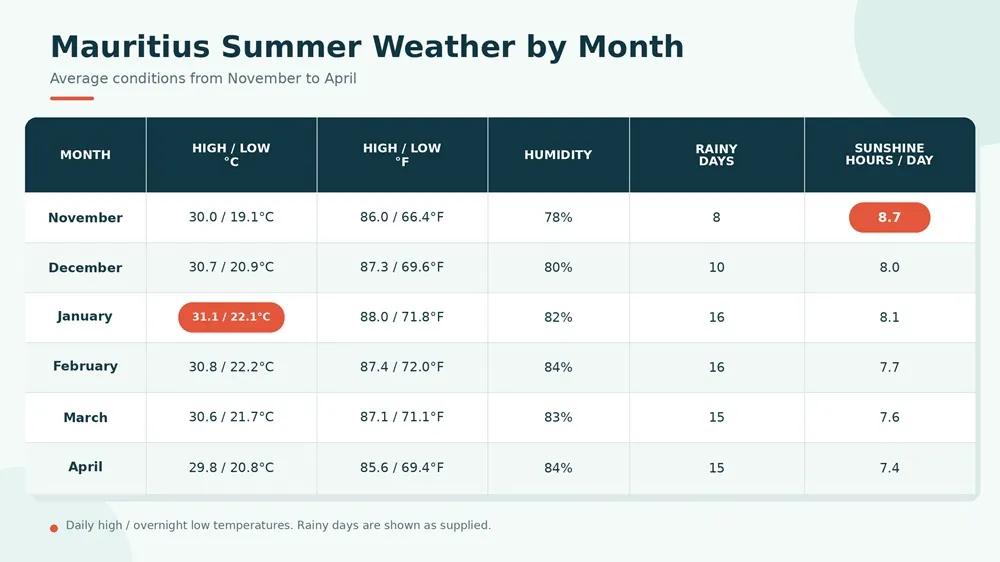
A rainy day here means more than 1 mm recorded during the day, not continuous rainfall. Humidity values are monthly reference figures, not afternoon readings.
Official Pamplemousses climate table
Which Summer Month Best Suits Your Holiday?
The ratings below are editorial assessments for a flexible beach-and-sightseeing trip, not weather probabilities or safety ratings.
· November — 5/5: A strong first choice if you want warmth with relatively fewer rainy days in the northern climate record.
· December — 4/5: Suitable for a festive beach holiday; compare early-month dates with Christmas and New Year before booking.
· January — 3/5: Good for travellers who enjoy heat and warm evenings and can move outdoor excursions between days.
· February — 3/5: Consider it if warm-water activities matter more than dry-weather consistency.
· March — 3/5: Allow a mix of beaches, indoor visits and weather-dependent excursions rather than a tightly fixed outdoor schedule.
· April — 4/5: Worth considering for slightly lower daytime temperatures while retaining warm sea conditions.
Rainfall in Mauritius from 2019 to 2024
This historical comparison covers the six calendar years from 2019 to 2024.
· Understand the wet-season pattern: Summer supplies much of the island’s annual rain, but rainfall varies substantially between years and locations.
· Read totals correctly: The table reports total rainfall volume over the island, in million cubic metres. It does not show rainfall depth at an individual beach.
· Keep comparisons consistent: All six entries use the rainfall-volume measure published by Statistics Mauritius.
Calendar year - Annual rainfall volume over Mauritius
2019 - 3,972 million m³
2020 - 3,717 million m³
2021 - 3,776 million m³
2022 - 4,105 million m³
2023 - 4,742 million m³
2024 - 4,077 million m³
Sources: Statistics Mauritius environment releases for 2020, 2022 and 2024.
· For a familiar depth measurement: Statistics Mauritius reports island-mean annual rainfall of 2,543 mm in 2023 and 2,180 mm in 2024.
· Annual totals hide concentrated events: January 2024 alone recorded an island-mean 573 mm. A wet month can strongly influence the year without describing every subsequent holiday week.
Statistics Mauritius 2024 report
Does the East or West Coast Get More Rain?
· The west is generally drier: Compare the official Medine western reference with the Fuel eastern reference when choosing your base.
· The east is generally wetter: However, regional averages cannot predict whether a particular east-coast beach will be wet on your chosen afternoon.
· The central uplands also receive substantial rainfall: Mountain and forest visits can have different conditions from the coast.
· Use local forecasts: Compare your departure point and destination before a cross-island excursion.
Official western climate table and official eastern climate table
How Should You Plan Around Summer Rain?
· Keep a museum, food experience or indoor visit available as an alternative.
· Carry a lightweight rain layer and a waterproof pouch for your phone.
· Leave room to reschedule boat trips and hikes.
· Avoid treating a weather-app rain icon as proof that the whole day is lost.
· During heavy-rain warnings, follow official advice rather than driving elsewhere in search of sunshine.
Cyclone Season in Mauritius
· The cyclone season usually runs from November to May, extending beyond the November–April summer definition.
· A nearby storm can disrupt travel without making landfall. Rain, swell and wind can affect different areas at different times.
· Cyclones affecting Mauritius needs a definition. A direct passage, a warning and indirect rainfall are different measures; a single annual average should not combine them.
· Regional Indian Ocean storm counts are not the number of cyclones that hit Mauritius. There is no fixed number of local impacts every year.
What Do Cyclone Warning Classes I to IV Mean?
· Class I: Issued 36–48 hours before the anticipated occurrence of gusts reaching 120 km/h.
· Class II: Intended, as far as practicable, to provide 12 hours of daylight before those gusts.
· Class III: Intended, as far as practicable, to provide six hours of daylight before those gusts.
· Class IV: Gusts of 120 km/h have been recorded in some locations and are expected to continue.
· Safety bulletin: May follow Class III or IV and explain remaining weather or environmental hazards.
· Termination: Follows the official process for determining that outdoor risks have considerably decreased.
These classes concern conditions affecting the islands; they are not equivalent to international storm-intensity categories.
Mauritius Meteorological Services warning system
Which Recent Cyclones Affected Mauritius?
· Calvinia, December 2019: Mauritius issued a Class III warning, and the airport closed. NOAA described the nearby system and associated heavy-rain concerns. NOAA Calvinia report
· Freddy, February 2023: Its passage affected Mauritius with flooding and gale-force winds before the system continued towards Madagascar. These were local effects, not a claim that its centre crossed Mauritius. Associated Press Freddy report
· Belal, January 2024: Severe flooding disrupted Mauritius, including Port Louis; flights were suspended and a curfew was imposed.
What Happens to Holiday Plans During a Warning?
· Hotels: Follow staff instructions; outdoor facilities, activities and service arrangements may change.
· Flights: Confirm changes directly with your airline before travelling to the airport.
· Excursions: Expect marine and outdoor operators to cancel or postpone unsafe departures.
· Preparation: Charge devices, retain essential medication and save airline, accommodation and insurer contacts.
· Movement: Follow official restrictions and do not visit beaches, rivers or flooded roads to watch the weather.
Mauritius Sea Temperature in Summer
For a location-specific reference, the following are published monthly averages for Bambous Virieux in southeast Mauritius, based on the provider’s preceding ten years of data. They are indicative coastal sea-surface temperatures, not official measurements for every lagoon.
· November: 25.6°C / 78.1°F
· December: 27.0°C / 80.6°F
· January: 27.8°C / 82.0°F
· February: 28.2°C / 82.8°F
· March: 28.1°C / 82.6°F
· April: 27.6°C / 81.7°F
Individual beaches, shallow lagoons and offshore sites can differ. The data supports planning for warm water, but temperature alone does not determine swimming safety.
Where Should You Consider Swimming and Snorkeling?
· Trou aux Biches and Mont Choisy: Consider these northern beaches when planning beach days, then assess the designated swimming area and conditions locally.
· Flic en Flac: Combine a west-coast beach visit with nearby food stops rather than assuming every part of the shoreline suits swimming.
· Blue Bay: Consider a guided marine excursion for reef snorkeling, with the operator selecting a suitable site.
· Lagoon versus open ocean: A reef can reduce incoming waves, but channels, currents, boat traffic and changing weather still matter.
· Visibility: Rainfall runoff, suspended sediment, wind and swell can change underwater visibility; summer does not guarantee clear conditions.
· Wildlife: Whale-shark sightings cannot be promised, and turtles are not exclusively summer encounters. Wildlife sightings remain unpredictable.
Which Outdoor and Water Activities Suit Summer?
· Blue Bay boat excursion: Choose a guided outing that combines marine interpretation with snorkeling when conditions allow.
· Île aux Cerfs day trip: Keep the boat crossing, beach time and any additional activities flexible.
· West-coast catamaran cruise: Compare departure points and what the trip includes before committing a full day.
· Northern island excursion: Ask about sea conditions and crossing times rather than choosing solely from photographs.
· Guided kayaking: Select a route appropriate to your experience and the forecast.
· Scuba diving: Let the dive centre match sites to conditions and your certification.
· Le Morne hike: Plan around heat, fitness and access conditions; use appropriate local guidance.
· Seven Waterfalls hike: Book with a guide who can assess rainfall and river conditions and change the route if necessary.
Browse the Mauritius Explored activities guide for individual experience details rather than assuming every outing runs daily.
Which Cultural Experiences Belong on a Summer Itinerary?
· Christmas and New Year: Look for confirmed events during your stay; reserve meals or celebrations that matter to you.
· Chinese New Year: Explore relevant cultural events when the festival falls within your dates.
· Thaipoosam Cavadee: Observe respectfully, leave space for worshippers and ask before photographing ceremonies.
· Maha Shivaratri: Understand the pilgrimage’s religious significance and allow for changes to road traffic.
· Summer food discoveries: Ask market vendors what is locally in season, then build a tasting stop around what is actually available.
Festival dates and public access vary by year. Use the official Mauritius tourism website alongside current local announcements.
Which Eco and Nature Experiences Are Worth Considering?
· Île aux Aigrettes: Explore a conservation-focused excursion and learn why protecting native species matters.
· Black River Gorges: Choose walks that suit the weather, with time for observing rather than rushing between viewpoints.
· Native birdwatching: Look for guided opportunities and keep a respectful distance from nests and feeding birds.
· Conservation education: Choose experiences that explain habitat restoration and responsible visitor behaviour. Mauritian Wildlife Foundation
· Responsible reef visits: Avoid standing on coral or touching wildlife; warm water does not establish that a reef is healthy.
Advantages of Visiting Mauritius in Summer
· Warm sea temperatures support a holiday centred on time in the water.
· Hot days appeal to travellers escaping a Northern Hemisphere winter.
· Beaches, cultural visits and food experiences can share one itinerary.
· November offers a relatively drier starting point in the northern climate record.
· Summer festivals can add cultural depth when dates align.
· Flexible travellers can move excursions around the weather.
· April retains warm-water appeal with slightly lower daytime temperatures.
Things to Consider Before a Summer Visit
· Humidity can make walking and sightseeing more tiring.
· Heavy rain can disrupt transport and outdoor activities.
· Cyclone warnings may require substantial changes to plans.
· Festive dates can limit accommodation choice and increase total costs.
· Weather-sensitive excursions need alternatives rather than guarantees.
Practical Tips for Visiting Mauritius in Summer
· Pack for your activities: Bring breathable clothing, a hat, swimwear, a light rain layer and suitable walking shoes.
· Keep a small day bag ready: Include water, sun protection, repellent and a waterproof pouch rather than repacking for every outing.
· Manage heat: Schedule demanding walks earlier, take breaks and avoid trying to cross off too many attractions in one afternoon.
· Prevent bites during daylight too: Use a proven repellent according to its label; coastal breezes do not replace bite prevention.
· Prepare medically: Discuss personal needs and current destination guidance with a travel health professional. CDC Mauritius guidance
· Choose your base by priorities: Consider the generally drier west for weather-sensitive beach plans; compare other coasts according to the experiences you want.
· Compare complete holiday costs: Check meals, transfers, festive supplements, excursion exclusions and cancellation terms.
· Use booking windows as planning targets: Start comparing Christmas/New Year options around 6–9 months ahead; for other summer dates, 3–6 months is a useful starting point, not a price guarantee.
· Keep excursions movable: Reserve important experiences, but favour clear weather-cancellation and rescheduling policies.
· For remote work: Confirm actual connection quality and keep critical work commitments separate from boat-trip or cross-island travel days.
Explore More of Mauritius
· Discover tours and experiences in the Mauritius activities guide.
· Browse more destination inspiration on Mauritius Explored.
Is Mauritius in Summer Right for Your Trip?
Mauritius in summer offers warm-water holidays, cultural experiences and plenty of reasons to spend time outdoors, provided your itinerary leaves room for changing conditions. Choose your month using climate patterns, then make daily decisions using forecasts and local advice.
For a first visit, combine a comfortable coastal base with a few well-chosen excursions and indoor alternatives. Returning visitors can explore a different region or build their trip around food and conservation. Start with the activity guide above, shortlist the experiences that matter most, and create a summer itinerary with space to adapt.
Frequently Asked Questions About Mauritius in Summer
Q: Is Mauritius good to visit in summer?
A: Yes, particularly if you enjoy warm seas and tropical weather and can keep outdoor plans flexible. Expect humidity, rain and the possibility of cyclone-related disruption.
Q: What is the hottest month in Mauritius?
A: January and February are generally the warmest months. Exact averages vary by station; the Pamplemousses reference table gives January a slightly higher average daytime maximum.
Q: How many cyclones hit Mauritius per year?
A: There is no fixed number for every year. Direct hits, nearby passages and storms triggering warnings are different counts, and regional storm totals do not represent local impacts.
Q: Is it safe to swim in Mauritius in summer?
A: Warm water can be comfortable for swimming, but safety depends on currents, waves, warnings and the particular location. Use designated areas and follow local advice.
Q: Does it rain every day in Mauritius in summer?
A: Not necessarily. Rainfall varies by month and region, and a day with measurable rain can also include sunshine. Monthly rainy-day counts do not mean continuous rain.
Q: Is November or April better for Mauritius?
A: November has fewer rainy days in the northern reference record, while April retains warmer sea temperatures. Choose according to whether drier conditions or warmer water matters more.
Q: Is Mauritius’s summer the same as Europe’s?
A: No. Mauritius’s summer runs from November to April. European summer holidays in July and August fall within Mauritius’s cooler season.
Conclusion
Summer in Mauritius is not a season to avoid — it is a season to plan around. The sea is at its warmest, the island at its greenest, the cultural calendar at its richest.
Explore this topic
Get new Mauritius guides by email
Join the Mauritius Explored list for trip ideas, practical updates and downloadable planning help.

Written by the Mauritius Explored editorial team, a Mauritian travel guide focused on beaches, activities, local places, and practical island planning.
Local Mauritius travel research, itinerary planning, and destination coverage since 2011.