Mauritius Beyond the Beach: 15 Cultural Places in Mauritius That Will...
Mauritius - The Island That Surprised Me
I had lived in Mauritius my whole life. Thirty-something years of sugarcane fields, the scent of frangipani at dusk, and the particular shade of turquoise that the Indian Ocean turns just before noon. I thought I knew this island. Then I started Mauritius Explored....
One Tuesday morning, a cousin visiting from London asked me to take her somewhere "real." Not the beach. Not the resort strip. Real.Authentic.Local
I paused. And then I drove her to a church in Cap Malheureux, a colourful Hindu temple, and a quiet museum in the capital where you can stand before the actual chains used during the slave trade. By the end of the day, she was quiet in the way people get when something has moved them. And I — a man who grew up here — had seen my own island differently.
That's what culture does. It adds depth to beauty.
Mauritius is famous for its beaches, and rightly so. But beneath the postcard surface lies one of the most complex, layered cultural stories in the Indian Ocean — an island with no indigenous people, shaped by waves of colonisers, enslaved Africans, indentured labourers from India and China, and free settlers from every corner of the world. That collision of histories has produced something extraordinary: a culture that is plural, warm, and utterly unlike anywhere else on earth.
Whether you're returning for the second time and want to go deeper, celebrating love on a honeymoon, exploring with family, or simply the kind of traveller who prefers meaning over marble pools — this guide is for you.
Here are 15 cultural places in Mauritius that deserve a spot on your itinerary.
Aapravasi Ghat (UNESCO World Heritage Site)
Natural History Museum (the dodo)
Eureka House (Creole colonial mansion)
Triolet Shivala (largest Hindu temple, southern hemisphere)
L'Aventure du Sucre (sugar mill museum)
Grand Bassin (sacred crater lake)
Chinese Pagoda & Heritage Museum
Chinatown District, Port Louis
Mauritius cultural food and daily life (woven throughout)
Notre Dame Auxiliatrice, Cap Malheureux
The Capital: Port Louis
Port Louis is noisy, colourful, chaotic, and completely alive. Most visitors pass through it on the way somewhere else. That's a mistake.
Aapravasi Ghat — Where History Is Written in Stone
There is a small stone building at the edge of Port Louis harbour. It doesn't look like much. A few crumbling arches, a courtyard, a staircase that leads down to the water.
But between 1849 and 1923, nearly half a million indentured labourers — mostly from India — arrived here. This was the first port of call. The first step onto Mauritian soil. Many of them had sold everything. Some had been deceived about what awaited them. All of them were beginning again.
Aapravasi Ghat is now a UNESCO World Heritage Site, and it is one of the most quietly powerful places I know. The museum on-site is small but thoughtful, with photographs, documents, and artefacts that give names and faces to people who could have easily become just a statistic.
What to know before you go:
It's located right in central Port Louis, easy walking distance from the waterfront
Allow at least 1.5 hours to do it justice
The guided tour is free on certain days — worth checking in advance
It can feel emotionally heavy; that's the point
This is essential for anyone who wants to understand why Mauritius is the way it is — diverse, resilient, and quietly proud.
The Blue Penny Museum — Two Stamps and a Nation's Story
A few minutes' walk from Aapravasi Ghat, tucked inside the Caudan Waterfront complex, is the Blue Penny museum, built around two postage stamps.
Yes, postage stamps.
The Blue Penny and the Red Penny — issued in 1847, among the first stamps ever printed outside Britain — are displayed here under controlled lighting, in a vault-like room. But the museum itself is much more than philately. It tells the complete story of Mauritius: the colonial era, the diversity of communities, the natural history, the sea voyages, the social upheavals. The exhibitions are beautifully designed and genuinely engaging, even for children.
The stamps themselves are only displayed for part of each month (they're rotated to preserve the colour), so check the schedule in advance. But even if they're not on display, the museum is worth every minute.
Perfect for: couples who enjoy history, families with older children, repeat visitors who haven't been before.
The Natural History Museum — The Dodo Was Real Here
The Natural History Museum in Port Louis is one of the oldest museums in the Indian Ocean region, and it holds something you simply cannot see anywhere else in the world: a near-complete skeleton of the dodo.
The dodo. The bird that became a symbol of extinction, of what humans can destroy. Mauritius is where it lived. Mauritius is where it died. And here — in a slightly faded colonial building on the edge of the city — you can stand a metre away from its bones.
The rest of the museum is rich too: specimens of endemic birds, marine life, geological samples, and colonial-era natural history illustrations. It has that particular smell of old wood and learning that good museums always have.
Entry is free. Don't skip it.
The Centre: The Highlands and the Plateau
Drive inland from Port Louis and the landscape shifts — cooler air, eucalyptus forests, the spine of the island rising around you. The central plateau is where Mauritius's older communities settled, and where some of its most significant sacred and historical sites can be found.
Eureka House — A Colonial Creole Mansion That Breathes
Eureka House in Moka is the finest example of Creole colonial architecture still standing in Mauritius. Built in the 1830s, it sits at the foot of a river gorge, flanked by waterfalls and tropical vegetation, with 109 doors and windows that flood every room with light.
Walking through Eureka is walking through the complexity of Mauritian history. The house was built by an English planter, later bought by a French Creole family, and it held within it the lives of the enslaved people who worked it. The museum does not shy away from this.
What makes it special:
The architecture itself is extraordinary — airy, elegant, built entirely without nails
Traditional Creole lunches are served in the gardens (the food is exceptional)
The surrounding estate has hiking trails and waterfall access
It's genuinely romantic — popular with honeymooners for a reason
Give yourself a full half-day here. Have lunch. Sit by the river for a moment.
The Martello Tower Museum — Napoleon, Wars, and an Unexpected View
Perched above the village of La Preneuse on the west coast (though technically accessible from the central region), the Martello Tower, squat circular tower was built by the British in the early 19th century — part of a network of defensive fortifications constructed after they took the island from the French.
It's now a small but charming museum about the military history of Mauritius, the rivalry between Britain and France for the Indian Ocean, and the strategic importance of the island during the Napoleonic era.
The view from the top is spectacular. And frankly, not many tourists know about this one. You may well have it to yourself.
The North: Sacred Sites and Living Communities
The north of Mauritius — from Terre Rouge up through Grand Baie and into the sugar country around Triolet — is one of the most culturally dense parts of the island. This is where some of the oldest Hindu temples in the southern hemisphere stand, and where the Creole fishing tradition is still very much alive.
Triolet Shivala — The Largest Hindu Temple in the Southern Hemisphere
The Maheswarnath Mandir in Triolet was founded in 1819, making it the oldest Hindu temple in Mauritius. But it's the scale of what has grown here that takes your breath away. The complex now includes multiple shrines dedicated to Shiva, Vishnu, Murugan, Brahma, and Ganesh, all surrounded by a vast courtyard and approached through towering gopurams (ornate tower gates) decorated in vivid colour.
This is a living temple. People come here every day to pray, to offer flowers, to mark the milestones of their lives. You are a guest in a sacred space.
How to visit respectfully:
Remove shoes before entering the temple
Dress modestly — shoulders and knees covered
Ask before photographing individuals at prayer
Visit in the early morning or late afternoon for the most atmosphere (and less heat)
Hindu festivals here — particularly Maha Shivaratri in February/March — draw tens of thousands of devotees. Witnessing a festival procession is one of the most extraordinary experiences Mauritius has to offer. Just be mindful and respectful if you attend.
The Pamplemousses Botanical Garden — History You Can Smell
The Sir Seewoosagur Ramgoolam National Botanical Garden in Pamplemousses is the oldest botanical garden in the Southern Hemisphere, established in 1736.
Yes, it's a garden. But it is also a living archive of Mauritius's colonial and natural history. The giant water lilies, the towering talipot palms, the groves of spice trees that were once more valuable than gold — every section tells a story.
There are also giant tortoises who have been here, quite plausibly, since the 18th century. Children tend to lose their minds with delight at this.
Named after the island's first post-independence Prime Minister, the garden is also a site of national pride. The historical significance and the sheer beauty make it a perfect destination for every kind of traveller.
Practical tips:
Hire a guide at the entrance — they are worth every rupee
Go early to beat the heat and the crowds
Combine with a visit to the nearby L'Aventure du Sucre sugar museum for a full day out
The East: Creole Heritage and the Coast
The east coast of Mauritius — quieter, wilder, with its famous lagoon at Belle Mare — is also home to significant Creole cultural heritage.
L'Aventure du Sucre — The Museum Inside a Sugar Mill
Housed in a beautifully restored 19th-century sugar mill near Pamplemousses (convenient to pair with the botanical garden), L'Aventure du Sucre is, without question, one of the finest museums in the Indian Ocean.
The story of sugar is the story of Mauritius. The island existed, for nearly two centuries, for no other purpose. Sugar drove the slave trade here. Sugar brought the indentured workers. Sugar made fortunes and broke bodies and shaped every community on the island. This museum tells that story with intelligence, honesty, and remarkable design.
The rum tasting at the end is not obligatory. But it is very good.
Highlights include:
Original industrial machinery from the mill, beautifully preserved
Deeply researched exhibitions on slavery, indenture, and colonial society
Rare photographs and maps
A dedicated section on the different varieties of Mauritian rum
An excellent restaurant on-site
Allow three hours minimum. It will genuinely surprise you.
Mahébourg Waterfront and Historical Museum — The Battle That Shaped Everything
The small town of Mahébourg in the southeast holds a place of outsized importance in Mauritian history. It was near here, in 1810, that the Battle of Grand Port was fought — the only naval victory inscribed on the Arc de Triomphe in Paris, because it was one of Napoleon's last victories over the British.
The National History Museum of Mahébourg, housed in a beautiful colonial manor, tells this story through artefacts recovered from the battle, including cannons, personal objects from officers, and navigational instruments. The waterfront itself has been recently developed, with a pleasant promenade and local market stalls.
On Sunday mornings, the waterfront market comes alive — a good opportunity to hear Creole spoken, try local street food (dholl puri, mine frite, gateau piment), and see ordinary Mauritian life in motion. That, in its own way, is cultural tourism too.
The South: Sacred Mountains and Ancient Ceremonies
The south of Mauritius is the least touristed and, for that reason, one of the most rewarding places to explore.
Grand Bassin — The Sacred Crater Lake
High in the mountains of the south, tucked inside an extinct volcanic crater, is Grand Bassin: a lake that Hindus believe is connected underground to the River Ganges.
Every year during the festival of Maha Shivaratri, pilgrims carry a kanwar — a decorated bamboo structure holding vessels of sacred water — on foot from their villages to Grand Bassin, sometimes walking 50 kilometres or more. It is one of the most remarkable acts of faith I have ever witnessed.
You can visit Grand Bassin at any time of year. The lake is serene and surrounded by statues of Hindu deities, with temples clustered on its banks. The air is several degrees cooler than the coast, and the silence — when you're there outside of festival season — is profound.
A large statue of Shiva, visible for miles, stands guard at the approach road. It's a striking introduction to a genuinely sacred place.
If you visit during Maha Shivaratri: Go early, stay respectful, and be prepared for the largest peaceable gathering you've ever seen in your life.
Bois Chéri Tea Estate — Where Tea and History Meet
In the southern highlands, the Bois Chéri Tea Estate has been producing tea since 1892. A visit here combines stunning scenery — rolling tea fields, mountain views, a glassy lake — with a genuine lesson in an industry that shaped the Mauritian south.
The small museum traces the history of tea cultivation on the island, and the tasting room offers a selection of flavoured Mauritian teas (vanilla, coconut, and rum-infused among them).
It's a calmer, more reflective experience than some of the busier sites — perfect for honeymooners who want something beautiful and unhurried, or families who need a peaceful afternoon after the intensity of the south.
The West: Chinese Heritage and Fort History
The Chinese Pagoda and Heritage Museum, Port Louis
While Mauritius is often described in terms of its African, Indian, and European heritage, the Chinese community — present since the early 19th century — has left a quietly significant mark on the island, particularly in commerce, cuisine, and architecture.
The Yuen Long area of Port Louis contains one of the oldest Chinese temples in Mauritius, and the Chinese Heritage Museum tells the story of the Hakka and Cantonese communities who settled here. It's a small museum, but a thoughtful one — and it draws attention to a part of Mauritian history that often gets overlooked.
Nearby, the streets of the Chinatown district are still lined with family-run shops selling dried goods, traditional medicines, and dim sum on weekend mornings. Walking through it is immersive in the best way.
Château de Labourdonnais — Wine, History, and a Working Estate
North of Port Louis, Le Chateau de Labourdonnais, a beautifully restored colonial estate dates to the 1850s and takes its name from the island's most celebrated French governor, Mahé de Labourdonnais.
Today it functions as a rum and fruit wine producer — yes, Mauritius makes fruit wine — while also opening its colonial mansion to visitors for guided tours.
The architecture alone is worth the visit: wide verandas, louvred shutters, tropical gardens. But the story of the estate, from its colonial origins through the abolition of slavery and beyond, gives the beauty some necessary weight.
There's a lovely restaurant and shop on-site, and the estate makes for a particularly pleasant afternoon for couples and families alike.
Notre Dame Auxiliatrice, Cap Malheureux — The Little Red Church at the Edge of the World
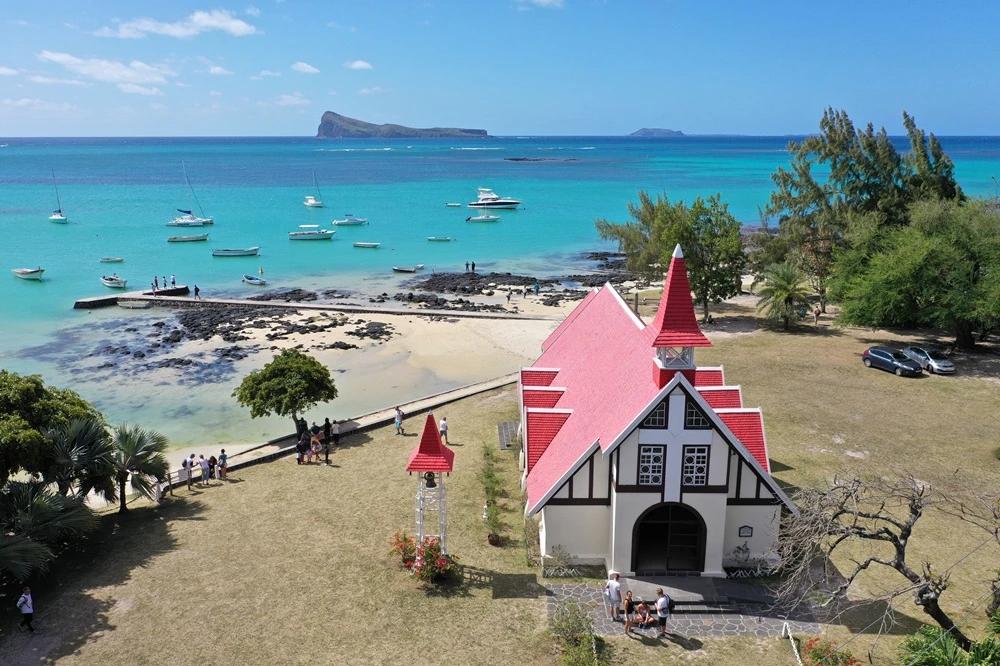
There is a photograph that has appeared on more Mauritian postcards, calendars, and travel magazines than perhaps any other. A small church with a deep red roof. A white coral-stone façade. And behind it, almost impossibly, the turquoise of the Indian Ocean and the silhouette of Coin de Mire island rising from the sea.
This is Notre Dame Auxiliatrice — the Red Church of Cap Malheureux — and it is one of the most photographed buildings in the entire country.
But here's the thing about places that are beautiful: the photograph never quite tells the whole story.
Cap Malheureux — whose name translates, rather dramatically, as "Cape of Misfortune" — was the site of the British landing in 1810, the moment that ended French rule over Mauritius for good. It was here that the troops came ashore, here that the island's fate was sealed. The village has been a fishing community ever since, quiet and unhurried, with pirogues still pulled up on the beach in the early mornings just as they have been for generations.
The church itself was built in 1938 — relatively recent by Mauritian standards — but it sits on ground with a much longer spiritual history. The red-roofed structure, with its simple interior and its view of the sea through the windows, has a quality that is hard to articulate. Peaceful is too soft a word. It feels suspended from time.
A Final Note: How to Experience Mauritian Culture Well
Culture is not a list to be checked off. It is something you enter, with curiosity and humility.
A few thoughts to carry with you:
Slow down. The best cultural experiences in Mauritius happen when you linger — when you have a second cup of tea at a small temple stall, or strike up a conversation with a guide.
Eat widely. Mauritian cuisine is one of the most underrated in the world. The food itself is a cultural document — Indian spices, Chinese techniques, French pastry traditions, African flavours, all living in a single plate of dholl puri.
Be respectful at sacred sites. Mauritius has places of worship that are still very much in use. A little courtesy goes a long way.
Hire local guides. Everywhere. They hold the stories that the signs don't tell.
Visit in the morning. Most cultural sites are quieter, cooler, and more atmospheric early in the day.
FAQ: Cultural Travel in Mauritius
1. Is Mauritius suitable for cultural tourism, or is it just a beach destination?
Absolutely suitable — and genuinely excellent. Mauritius has a UNESCO World Heritage Site (Aapravasi Ghat), a network of well-maintained historical museums, some of the oldest Hindu temples in the Southern Hemisphere, and a rich Creole heritage that is increasingly well-documented and celebrated. The beach reputation is deserved, but it can overshadow a cultural offer that rivals many far more famous destinations.
2. What is the best time of year to visit for cultural experiences?
Mauritius can be visited year-round, but the period from February to June avoids the cyclone season (December to March can bring storms) and coincides with several major festivals, including Maha Shivaratri and Holi. October and November are also excellent — cooler, quieter, with the island at its greenest after the dry season.
3. Are cultural sites in Mauritius suitable for children?
Many are excellent for families. The Pamplemousses Botanical Garden (giant tortoises!), the Natural History Museum (the dodo!), Eureka House (waterfalls and gardens), and L'Aventure du Sucre (rum for adults, fascinating machinery for curious kids) are all very child-friendly. Some of the heavier historical sites, like Aapravasi Ghat, are better suited to teenagers and adults who can engage with the weight of the history.
4. Do I need to book cultural sites in advance?
Most do not require advance booking. The exception is specialised tours — such as the guided experience at Eureka House or the tasting at Bois Chéri Tea Estate — which benefit from a call ahead, particularly during peak season (July to September, and December to January).
5. How do I get around to see these cultural places?
A hire car gives you the most freedom. Public buses connect most major towns and are a cultural experience in themselves (and very affordable), but they can be slow and schedules are limited. Many hotels offer guided excursion packages that combine several sites in a single day — these can be good value and take the logistics out of your hands. If you're based in the north, a day trip covering Pamplemousses, L'Aventure du Sucre, and the Chinese Museum in Port Louis is very manageable. The south requires a full day of its own.
Ready to Go Deeper?
If this guide has made you want to see Mauritius differently — to slow down, look closer, and discover what lies behind that postcard horizon — then you're already thinking like the right kind of traveller.
Start with one site. Just one. Stand in front of the chains at Aapravasi Ghat, or walk through the temple at Triolet at dawn, or sit in the garden at Eureka with a cup of vanilla tea, and let the island speak for itself.
It has a lot to say.
Written by Mauritian Explored travel blogger with over a decade of exploring the island's cultural soul. All sites visited personally. No sponsored content.
Explore this topic
Get new Mauritius guides by email
Join the Mauritius Explored list for trip ideas, practical updates and downloadable planning help.

Written by the Mauritius Explored editorial team, a Mauritian travel guide focused on beaches, activities, local places, and practical island planning.
Local Mauritius travel research, itinerary planning, and destination coverage since 2011.