Mauritius With Kids: Family Guide, Beaches & Best Resorts
Mauritius With Kids: The Complete Family Guide
Last updated 19 September 2026.
Is Mauritius good for families? Yes, and unusually so. Coral reefs enclose most of the coastline in shallow, calm lagoons, so young children can swim safely. The island is small — around 65 km by 45 km — so drives are short. English is widely spoken, there is no malaria, and family resorts with kids clubs are the norm rather than the exception. The main things to plan around are sun, mosquitoes and the wet season, not safety.
Mauritius is one of the easiest island destinations for a family holiday.
The island is small enough to explore without long travel days, but big enough to offer beaches, waterfalls, wildlife parks, forest walks, cultural attractions, boat trips, markets, museums and soft adventure. That is what makes Mauritius so good for families. You can do something different every day without making the trip feel stressful.
As a local, I always tell families not to plan only beach days. The beaches are beautiful, of course, but Mauritius has so much more for children and parents to enjoy together. You can see giant tortoises in the south, walk through an oceanarium in Port Louis, take a glass-bottom boat at Blue Bay, visit a sugar museum, explore Chamarel, ride through nature parks, taste street food in Mahébourg, or spend a slow afternoon under the trees at Mont Choisy.
The best family-friendly spots in Mauritius are not always the loudest attractions. Sometimes the best family memories come from simple places: a calm lagoon, a shaded garden, a safe beach, a small museum, a local market, or a viewpoint where the children can run around and parents can enjoy the scenery.
This guide includes 20 of the best places to visit in Mauritius with kids. Some are full-day attractions. Some are easy half-day stops. Some are best for toddlers. Others are better for older kids and teens. Together, they give families a balanced way to explore Mauritius beyond the resort.
Why Mauritius Works With Children
Plenty of tropical destinations are beautiful. Fewer are easy. Mauritius is both, and the reasons are practical rather than romantic.
— The lagoon. A near-continuous coral reef sits offshore around most of the island, so the water inside it is shallow, warm and generally flat. For a family, this is the single biggest difference between Mauritius and an open-ocean beach destination.
— The scale. Roughly 65 km by 45 km. Almost nothing is more than about ninety minutes from anywhere else, which means a day trip does not cost you the day.
— No malaria. Mauritius is officially malaria-free. Mosquitoes still matter — see the section below — but the biggest tropical worry for parents is off the table.
— Kids clubs are standard. Most four- and five-star resorts run one, many of them complimentary within a published age band.
— English is widely spoken, alongside French and Creole, so signage, menus and medical help are navigable.
— Children are genuinely welcome. Restaurants, markets and hotels treat a family arriving with small children as normal rather than as a complication.
— Short overnight flights from Europe — around eleven to twelve hours nonstop, landing in the morning, with the island on UTC+4 so jet lag from Europe is minimal.
When to Visit Mauritius With Kids
The Mauritius Meteorological Services defines the seasons precisely, and it is worth using the official version rather than the loose one: summer runs November to April, winter June to September, with May and October as transition months.
— Mean summer temperature 24.7°C, against 20.4°C in winter.
— January and February are warmest, with an average daily maximum of 29.2°C.
— Annual rainfall averages 2,010 mm, of which 1,344 mm — about 67% — falls in summer.
— February and March are the wettest months. October is the driest.
— The coast gets 7.5 to 8 hours of sunshine a day; the central plateau around 6, and it is cooler and wetter up there.
For families, that translates into a fairly simple set of trade-offs. April, May, September and October give you warm water, manageable heat and lower prices — the best combination if your school calendar allows it. December and January give you the warmest lagoon and full resort programmes, at the highest prices of the year. February and March are cheapest of the summer months for a reason.
Mauritius Summer Month by Month With Children
If you are travelling in the southern summer — which is when most European school holidays fall — this is what each month actually looks like with children.
— November. Transition into summer. Warming, humidity building, cyclone season opens. Warm sea without peak heat or peak pricing. Conditions vary and early-season rain is unpredictable. Good for families with pre-school children who can travel outside school holidays.
— December. Hot and increasingly humid, with a festive peak from mid-month. Warmest lagoon water, full resort programmes, festive activities for children. Highest prices and demand of the year — book very early, and expect festive supplements.
— January. Warmest month alongside February, average daily maximum 29.2°C, and wet. Excellent sea temperatures and quieter than December after the first week. Heat and humidity are hardest on toddlers, and cyclone risk is at its seasonal peak.
— February. Warmest and, with March, the wettest month. Peak cyclone period. Warm water, lower prices than December, half-term availability — but it needs genuine rainy-day plans, not optimism.
— March. Still hot, the other wettest month, with cyclone risk easing through it. Late-summer sea temperatures, good value, fewer crowds. Some boat excursions get cancelled for sea conditions.
— April. Late summer, warmth persisting while humidity and rain ease. Arguably the best summer month for families. Easter can push prices up, and the dates move each year.
Which Coast Is Best for a Family?
— North — Grand Baie, Trou aux Biches, Mont Choisy. Drier and sheltered, the busiest area, the widest choice of restaurants and boat trips. Strongest all-round for families: easy to eat out, short drives, calm swimming beaches, and the most alternatives if the weather turns.
— West — Flic en Flac, Tamarin, Black River. The driest coast, a long swimmable beach, a good base for driving. Very good, and slightly less crowded than the north with similar convenience.
— East — Belle Mare, Palmar, Trou d'Eau Douce. The wind drops in summer, which is exactly when this coast is at its best. Long, wide, quieter beaches. Fewer options outside the resorts, so your meal plan matters more here.
— South-west — Le Morne, Bel Ombre. Dramatic scenery, resort-led, quiet in the evenings. Good for a resort-focused trip, but it is a long drive from the airport with tired children.
— South-east — Blue Bay, Pointe d'Esny, Mahébourg. Sheltered lagoon, a marine park, and the closest area to the airport. Very good for first and last nights, and the best easy snorkelling on the island.
— Central plateau. Cooler and wetter, around six hours of sunshine a day against 7.5 to 8 on the coast. A day trip, not a base — but a useful escape from midday heat.
Best Areas to Stay in Mauritius With Kids
Trou aux Biches
The default recommendation for families with young children. A long, calm, shallow lagoon, shade along the public beach, and a good spread of hotels and restaurants within a short drive. If you want one base and minimal fuss, start here.
Grand Baie and Mont Choisy
Grand Baie is the most convenient place on the island: supermarkets, pharmacies, restaurants at every price point, boat operators, and the shortest supply run when you have forgotten something. It is busy, and that is the point. Mont Choisy, a few minutes away, is the quieter version with a huge sweep of beach and casuarina shade for picnics.
Flic en Flac
A long, flat, swimmable west-coast beach with sunsets, a dense restaurant strip and easy access to Casela and Chamarel. Popular with local families at weekends, which is a good sign and also means the public beach is busiest on Saturdays and Sundays.
Belle Mare and the east
Wide, long, quieter beaches and the island's classic resort coast. Best in the southern summer when the trade winds drop. Fewer independent restaurants nearby, so think carefully about half board versus all-inclusive before you book.
Blue Bay and Mahébourg
The best easy snorkelling on the island — a marine park reachable by glass-bottom boat from the beach — and around fifteen minutes from the airport, which makes it ideal for the first and last night of a trip. Mahébourg is a working town rather than a resort strip, which some families love and others find a bit too real.
Le Morne and Bel Ombre
The most dramatic scenery in Mauritius and largely resort-contained. Quiet after dark. Worth it if you want a self-sufficient resort holiday against a spectacular backdrop, but it is the longest transfer from the airport.
Types of Family Accommodation
— Family resorts. Kids club, pools, beach access, organised activities, babysitting on request. The lowest-friction option, and the reason most first-time families choose Mauritius.
— Private villas. Space, privacy, a kitchen and flexibility over meal times. Best for multi-generational groups, longer stays, or families with a baby who need to control the routine.
— Boutique and smaller hotels. Local character, quieter settings, often closer to nature. Better with older children who do not need a kids club.
— Self-catering apartments. The budget route, and genuinely practical in Grand Baie, Pereybère and Flic en Flac where shops and restaurants are within walking distance.
Mauritius Resorts With Verified Kids Clubs
Every age band and opening hour below was checked against the resort's own website. Where a property does not publish a range, this guide says so instead of estimating — and you should confirm before you book, because published ages change.
— Heritage Awali — Bel Ombre, south-west. Timomo Baby Club: 0–35 months, complimentary, open 08:30–15:30 daily, staffed by nurses trained in childcare and first aid. Timomo Kids Club also operates; its age range is not published. Premium All-Inclusive with dine-around across thirteen restaurants at Domaine de Bel Ombre. The infant provision here is unusual for Mauritius and is the standout find of this research.
— Club Med La Pointe aux Canonniers — Grand Baie, north. Baby Club Med from 4 months, with separate programmes for 2–3, 4–10 and 11–13, and a Chill Pass for 14–17. Clubs for ages 4+ are included in the all-inclusive. Best for families with a wide age spread including teenagers. Roughly 1h15 from the airport.
— Shandrani Beachcomber — Blue Bay, south-east. Kids Club complimentary for ages 3–11. Babysitting on request with a supplement and 24 hours' notice. Sold all-inclusive through tour operator packages — confirm exactly what you are buying. The marine park is on the doorstep and the airport transfer is short.
— Hotel Riu Turquoise — Le Morne, south-west. RIU Land children's programme; age bands not published, confirm directly. 24-hour all-inclusive. Value-focused families who intend to stay on the resort.
— Friday Attitude — Trou d'Eau Douce, east. Family-friendly 3*+ property with no kids club published — confirm directly. "All-in All-out" covers breakfast, lunch, afternoon tea, dinner and a selection of local drinks. Île aux Cerfs is on the doorstep.
— Also worth shortlisting, with age bands to confirm directly: Shangri-La Le Touessrok (east), Outrigger Mauritius Beach Resort (Bel Ombre), Sugar Beach and La Pirogue (Flic en Flac), Sofitel Mauritius L'Impérial (Flic en Flac), LUX* Grand Baie (north) and the wider Beachcomber group.
Before you book any of them, ask five questions in writing: the exact age band, the opening hours, whether it is included or charged, whether lunch is covered, and what babysitting costs and how much notice it needs.
All-Inclusive or Half Board With Children?
This is the decision that moves a family budget most, and the answer depends almost entirely on where you are staying rather than on the package itself.
— All-inclusive makes sense on an isolated stretch of coast, with younger children who snack constantly, and on longer stays. Soft drinks, ice creams and snacks add up faster with children than most parents expect.
— Half board plus eating out is usually better in Grand Baie, Pereybère, Flic en Flac or Tamarin, where there are real restaurants within walking distance. You eat better, you spend less, and the children see more of the island than the buffet.
— Check what "all-inclusive" actually includes. It is not a regulated term in Mauritius. Some packages cover local drinks only; some exclude certain restaurants or charge a supplement for them. Ask for the inclusion list in writing.
— Watch the meal-plan end time on departure day. It frequently stops at breakfast, which matters if you have a late flight and hungry children.
20 Family-Friendly Places to Visit in Mauritius
The island's best family outings, roughly north to south. Ages and durations are indicative — the right length of a visit with a four-year-old is not the right length with a twelve-year-old.
1. Casela Nature Parks (west). The biggest single family attraction on the island: safari by eco-rider, a petting zoo, zip-lining, the Tulawaka gold coaster, mini golf and a Zookeeper for a Day programme. Half day to full day. Something for nearly every age, which is rare.
2. Odysseo Oceanarium (Port Louis). Indoor, air-conditioned and genuinely interesting — the single best rainy-day option on the island. Two hours or so.
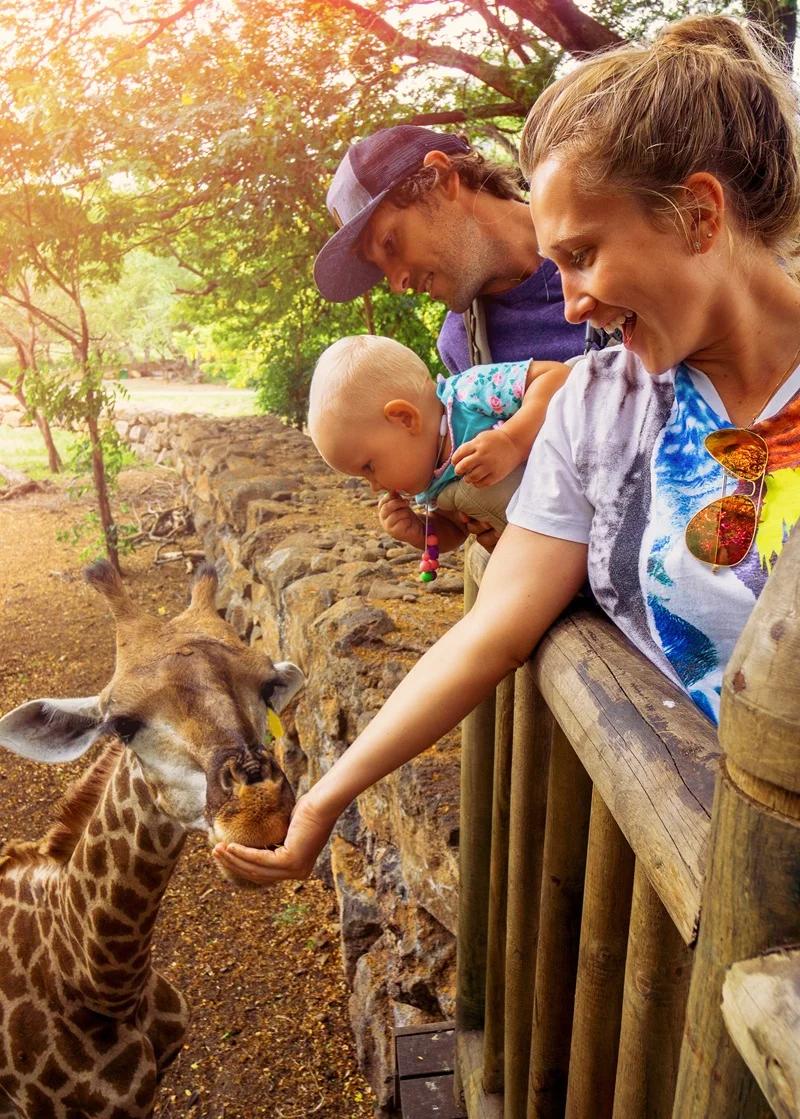
3. La Vanille Nature Park (south). Giant tortoises children can get close to, crocodiles, insects and a shaded forest walk. Two to three hours, and excellent with toddlers.
4. Blue Bay Marine Park (south-east). Glass-bottom boat over coral and tropical fish without anyone having to swim deep. One to two hours, and the gentlest introduction to snorkelling in Mauritius.
5. Trou aux Biches beach (north). Calm, shallow, shaded, safe. The benchmark family beach.
6. Mont Choisy beach (north). Long, wide and shaded by casuarinas. The best picnic beach on the island.
7. Flic en Flac beach (west). Long, flat and swimmable, with restaurants behind it and sunsets in front.
8. Pereybère (north). A small, sheltered, easy swimming beach with shops and cafés right there — good for a short stop rather than a full day.
9. Île aux Cerfs (east). The classic full-day catamaran excursion: a boat trip, a sandbank, lunch on board and a beach at the end. The biggest day out of most family trips.
10. Curious Mauritius (Chamarel). Optical illusions and photo tricks. Indoors, funny, and it works surprisingly well across a wide age range.
11. Chamarel Seven Coloured Earth and waterfall (south-west). Coloured dunes, a tortoise enclosure and a waterfall viewpoint reachable without a hike. About an hour.
12. Ebony Forest (Chamarel). Endemic-species conservation with a canopy walkway and real views. Better with children old enough to care about what they are looking at.
13. Vallée des Couleurs / Vallée d'Osterlog adventure parks (south). Buggies, zip lines and nature trails. Teenage territory, and check minimum ages and heights before you go.
14. Sir Seewoosagur Ramgoolam Botanical Garden, Pamplemousses (north). Giant water lilies, palm avenues and deep shade. Easy with a pushchair and a good heat escape.
15. L'Aventure du Sucre (Beau Plan). A former sugar factory turned museum, with a tasting room. Indoors, so another rainy-day option.
16. Domaine de Labourdonnais (Mapou). Orchards, gardens, a colonial house and a rum distillery. Space to run around, and a decent lunch stop.
17. Mahébourg waterfront and the National History Museum (south-east). A real town, a Monday market, waterfront walks and a small free museum.
18. World of Seashells (Bel Ombre). Small, indoor and genuinely engaging for children who collect things.
19. Mauritius Aquarium (Pointe aux Piments). Modest in scale but close to the northern hotels and easy with small children.
20. Grand Baie and La Cuvette (north). The practical hub — boat trips, shops, restaurants — with a small sheltered beach at La Cuvette for a quick swim.
Best Beaches in Mauritius for Families
— Trou aux Biches — calm shallow lagoon, shade, the safest all-round family swimming on the island.
— Mont Choisy — the most space and the best shade; ideal for a picnic day.
— Pereybère — small, sheltered and easy, with facilities right behind the sand.
— Belle Mare — long and wide with room to spread out; check the wind, which is stronger here outside summer.
— Blue Bay — the snorkelling beach, with the marine park just offshore.
— Flic en Flac — long, flat and swimmable, busiest at weekends.
— La Cuvette (Grand Baie) — a small protected cove, good for a short swim between other things.
— Le Morne — spectacular, and better for looking at and for watersports with teenagers than for toddler paddling.
Two rules that apply at every one of them. Lifeguard provision varies and is not universal, so supervise directly rather than assuming someone else is watching. And the lagoon is calm until it is not — the reef passes, where the lagoon meets the open sea, carry strong currents and are the reason drownings happen here.
What to Do in Mauritius by Age
Toddlers and pre-schoolers
Beach mornings, resort pools, Pamplemousses, La Vanille, the Blue Bay glass-bottom boat, the aquarium, short local outings and an early dinner. One main activity a day, and only one. Build the day around shade between about eleven and three, and expect the heat to do more damage to the schedule than anything else.
Ages six to twelve
This is the age Mauritius suits best. Île aux Cerfs or a west-coast catamaran, Casela, snorkelling at Blue Bay, Chamarel and Curious Mauritius, Ebony Forest, the easier walks at Pétrin or the Black River Gorges viewpoint, beach picnics and the markets. Children this age can manage a full-day boat trip and will remember it.
Teenagers
Kitesurfing and paddleboarding at Le Morne, hiking Le Morne or Le Pouce with a guide, quad biking and zip lines at the adventure parks, diving and snorkelling, dolphin and whale-watching excursions off the west coast, and Port Louis with the market and the Caudan waterfront. Several resorts run separate teen programmes — Club Med's Chill Pass covers 14 to 17 — which is worth checking if your teenager will not go near a kids club.
Rainy-Day Ideas in Mauritius With Kids
February and March are the wettest months, and rain in Mauritius usually arrives hard and passes quickly rather than settling in for the day. Still, have a list.
— Odysseo Oceanarium in Port Louis — the strongest indoor option.
— Curious Mauritius at Chamarel — entirely indoors and genuinely funny.
— L'Aventure du Sucre at Beau Plan — museum plus tasting room.
— World of Seashells at Bel Ombre.
— The Caudan Waterfront in Port Louis — shops, food and cover.
— Your own resort. Kids clubs run through rain, and most resorts have a wet-weather programme. It is worth asking what it is before you book if you are travelling in February or March.
— Head north or west. The east and the central plateau catch more rain; the north and west coasts are drier. On an island this size, driving out of the weather is a realistic plan.
Mosquitoes, Chikungunya and Dengue
Mauritius is officially malaria-free. Mosquito-borne illness still needs planning for, and in 2026 more than usual.
— There is an active chikungunya outbreak. The UK's National Travel Health Network and Centre recorded 6,675 confirmed cases as of July 2026, against 1,395 locally acquired cases in the whole of 2025. The US CDC has a Level 2 travel health notice in place, and Germany's foreign office notes cases have risen significantly since early 2026, particularly inland.
— Dengue is present year-round, with higher activity in the warm, wet months.
— These mosquitoes bite in daylight. This is the part most people get wrong. The evening-only repellent habit that works for malarial mosquitoes is the wrong habit here — use repellent through the day, and reapply as the label directs.
— Cover arms and legs where practical, especially at dawn and dusk and away from the coast.
— Choose air conditioning or screens, and use them.
— Clear standing water around self-catering accommodation.
— Vaccination exists for both chikungunya and dengue and is recommended for some travellers depending on age and medical history. That is a conversation with a travel health professional, not a decision to take from a travel guide.
— If anyone develops a fever with joint pain during or after the trip, see a doctor and tell them you have been in Mauritius.
Check your own national travel health service and the Mauritian Ministry of Health and Wellness before you travel. Links are in the sources section, and these figures need re-checking — they were current in July and September 2026 and they will move.
Cyclone Season and Family Holidays
Cyclone season runs roughly November to May. Most seasons pass without a direct hit, and Mauritius has a well-established four-class warning system with substantial notice periods.
— Class I — a cyclone may affect Mauritius; time to prepare. Issued not less than 36 and not more than 48 hours before gusts of 120 km/h are expected.
— Class II — the threat has firmed up. Issued to allow, as far as practicable, 12 hours of daylight before gusts of 120 km/h.
— Class III — dangerous conditions are close; stay indoors. Issued to allow, as far as practicable, 6 hours of daylight.
— Class IV — gusts of 120 km/h are being recorded and are expected to continue. Do not go outside.
For a family the practical impact is rarely danger and almost always disruption: a cancelled boat trip, a closed beach, or a delayed flight. Resorts have procedures and will tell you what to do. Travel insurance that covers weather-related cancellation and delay is the thing to get right, and buy it when you book rather than before you fly, so the whole period is covered.
Sun, Heat and Hydration
Sunburn and dehydration affect more visiting children in Mauritius than anything else on this page.
— UV is intense here, including on cloudy days and in winter. Reef-safe high-factor sunscreen, reapplied after swimming, plus hats and UV swim shirts.
— Keep children out of direct sun between roughly eleven and three in summer, and build the day around that rather than fighting it.
— Water constantly. Small children dehydrate quickly in this heat and will not ask.
— Watch the sand and pool surrounds — they get hot enough to burn small feet.
— Beach shoes also protect against sea urchins and rock.
Water Safety in the Lagoon
— Reef passes carry strong currents. They are where the lagoon drains to the open sea, and they are the main cause of drownings in Mauritius. Stay inside the marked swimming areas.
— Lifeguard cover is not universal. It varies between public and hotel beaches and between days of the week. Supervise directly.
— Obey swimming-prohibition signs. They are there for a reason that is not always visible from the beach.
— Life jackets on every boat trip, for every child, regardless of how calm the lagoon looks.
— After heavy rain or a storm, water clarity drops and run-off changes conditions. Wait a day.
— Stonefish are camouflaged on sandy and reef areas and have venomous spines. Water shoes largely remove the risk, and nobody should be handling marine life.
Food and Picky Eaters
Mauritian food is one of the easiest cuisines in the world to feed children on, because so much of it is mild by default and the rest can be ordered mild.
— Rice, noodles and grilled fish or chicken are everywhere and are as plain as you need them to be.
— Ask for it non-spicy — chilli usually arrives on the side rather than in the dish, which is exactly what you want with children.
— Street food is excellent and cheap. Dholl puri is the national snack and most children take to it immediately. Choose busy stalls with high turnover and food served hot.
— Tropical fruit is superb and does a lot of the work of getting fluid into a small child who will not drink water.
— Resort buffets always have a plain option, and most kitchens will do something off-menu for a toddler if you ask.
Getting Around With Children
— Private transfers are priced per vehicle, not per person. Published 2026 tariffs from the airport are around €35 for a sedan to Grand Baie, Flic en Flac, Belle Mare, Trou aux Biches or Port Louis, and about €45 to Le Morne or Bel Ombre. A family of four with a week's luggage will usually need the minivan at around €55 — still cheaper per head than a couple pays.
— A hire car is the best way to see the island with children, and frequently cheaper than two organised excursions. Driving is on the left. Roads are good on the main routes and narrow and winding through villages.
— Confirm child seats in advance. Availability varies by operator and they are not always fitted as standard — ask before you book, and confirm what the law requires for your children's ages.
— Avoid driving unlit rural roads after dark with a tired car full of children.
— Buses are cheap — fares start at around Rs 12 — but they are slow and not practical with small children, luggage and a pushchair.
— Taxis are rarely metered. Agree the fare before you get in.
How Long Should a Family Trip Be?
— Five days. One region, real beach time, one or two outings. Do not try to see the island. One base — north or west for the shortest drives.
— Seven days. The standard family trip: beach days, one boat trip, one inland day and one flexible day. One base. Two moves in a week is one too many with children.
— Ten days. Two coasts without rushing, plus the interior and the south-east. Two bases, with the move mid-trip on a low-key day.
— Fourteen days. Everything above at a slower pace, with genuine downtime. Two bases, or one base and a short island hop.
A Seven-Day Family Itinerary
21. Day 1 — arrive, settle, pool only. Everyone is tired after an overnight flight. Nothing else is realistic.
22. Day 2 — full beach and lagoon day. Reset body clocks. Swimming, snorkelling, an early night.
23. Day 3 — boat trip. Blue Bay or Île aux Cerfs. Book the biggest outing early in the week so there is room to move it if the weather forces a change.
24. Day 4 — slow day. Resort, kids club, one short local outing. Do not skip this day.
25. Day 5 — inland. Chamarel, a waterfall, or the Black River Gorges viewpoint. Cooler air and a complete change of scene.
26. Day 6 — flexible. Market morning, or the beach again. This is your weather buffer; use it for whatever got rained off.
27. Day 7 — beach morning, then depart. Check late check-out and, importantly, when the meal plan ends.
What to Pack
— Reef-safe high-factor sunscreen — it is expensive on the island and the reef-safe range is limited.
— UV swim shirts and wide-brimmed hats.
— Beach shoes for everyone — stonefish, sea urchins, hot sand.
— Daytime insect repellent, and enough of it.
— Light, breathable clothing, plus something long-sleeved for evenings and for bite protection.
— A light sweater or fleece for the central plateau and for winter evenings.
— Sturdy shoes if you plan any walking — the volcanic trails are rough.
— Your own snorkel masks if your children are fussy about fit.
— Modest clothing for temple visits, including Grand Bassin.
— Any regular medication, in its original packaging, with a copy of the prescription.
What a Mauritius Family Holiday Actually Costs
Flights and accommodation dominate any family budget and both move with the season, so no honest guide quotes a single figure. What can be pinned down are the on-island costs, and these were checked on 18 September 2026.
— The tourist fee is the one most guides miss. Mauritius has charged €3 per person aged twelve or over, per night, since 1 October 2025. It is collected at check-in and is not included in the room rate. Children under twelve are exempt. A family of four with one child under twelve pays for three people — €63 over seven nights, €126 over fourteen.
— Airport transfers are per vehicle, so a family pays roughly what a couple pays: about €35 to most resort areas, €45 to Le Morne or Bel Ombre, around €55 for a minivan.
— Excursion child rates are real and substantial — but check the age band, because it is not the same as the tourist-fee threshold. The full-day Île aux Cerfs catamaran is €67 per adult and €37 for a child aged 3 to 12, with infants free. A family of four with two children in that band pays €208 rather than €268.
— Eating locally is genuinely cheap. A meal in an inexpensive restaurant is around Rs 300, roughly €5.45. Street food is a fraction of that.
— Petrol is a fixed national price — Rs 70.65 a litre as of 15 August 2026 — so fuel for a week of family sightseeing is a small line.
— Public beaches, coastal walks, viewpoints and markets are free, and they are not a consolation prize.
The three decisions that move a family total most, in order: the month you travel, the board basis, and hire car versus transfers and organised excursions. Everything else is noise by comparison.
Booking a Family Trip
— Family rooms, interconnecting rooms and two-bedroom suites are limited at most resorts and go first. If you need a specific configuration, book early and get it confirmed in writing.
— Peak periods need the longest lead time — late December and early January above all, then July and August for European school holidays.
— Shifting outside a school-holiday boundary saves more than downgrading the resort, and costs you nothing in experience.
— Confirm the kids club — age band, hours, included or charged, whether lunch is covered — before you pay.
— Buy travel insurance when you book, not before you fly, so cancellation is covered for the whole period.
— Complete the Mauritius All-in-One Travel Digital Form before you travel, at the official government portal, and check the current requirements for your nationality.
Final Thoughts: Mauritius Is More Than a Honeymoon Island
Mauritius is often seen as a honeymoon destination, but it is also one of the best islands for families.
The island offers a rare mix of safe beaches, warm hospitality, nature, culture, wildlife, marine life and soft adventure. Parents can relax, children can explore, and every day can feel different.
You can spend one day swimming at Trou aux Biches, the next seeing giant tortoises at La Vanille, then take a glass-bottom boat at Blue Bay, visit Chamarel, explore Port Louis, walk through a botanical garden or enjoy a sunset at Flic en Flac.
That is what makes Mauritius so special for families.
It is not only beautiful.
It is easy to love, easy to explore and full of places where children and parents can create memories together.
Mauritius With Kids: FAQs
Is Mauritius good for families?
Yes, and it is one of the easier long-haul family destinations. Coral reefs create shallow, calm lagoons for safe swimming, the island is small enough that drives are short, English is widely spoken, there is no malaria, and family resorts with kids clubs are standard. The things to plan around are sun, mosquitoes and the wet season.
Is Mauritius good for toddlers?
Very. Shallow lagoon beaches, short drives, mild food and resorts that expect small children. The limiting factors are heat and rhythm rather than facilities: plan one activity a day, keep children in shade from late morning to mid-afternoon, and choose a calm-lagoon base like Trou aux Biches or Belle Mare.
Which area is best for families with young children?
Trou aux Biches in the north for the calmest shallow water and the easiest logistics, or Belle Mare on the east coast for space and resort facilities. Blue Bay suits families who want snorkelling and a short airport transfer. Grand Baie works if you want restaurants and shops within walking distance.
Which area is best for teenagers?
Grand Baie in the north for restaurants, shops, watersports and a bit of life in the evening, or Le Morne in the south-west for kitesurfing and hiking. Several resorts run separate teen programmes — Club Med's Chill Pass covers ages 14 to 17 — which is worth checking if a kids club is a non-starter.
What are the best family beaches in Mauritius?
Trou aux Biches for the calmest shallow swimming, Mont Choisy for space and shade, Pereybère for an easy sheltered dip, Belle Mare for room to spread out, Blue Bay for snorkelling and Flic en Flac for a long flat swimmable stretch with restaurants behind it. Supervise directly at all of them — lifeguard cover is not universal.
Which month is best for Mauritius with kids?
April is arguably the best summer month: warm sea, easing humidity and calmer weather. October is the driest month of the year and a strong shoulder choice. December and January give the warmest lagoon at the highest prices. February and March are cheapest of the summer months because they are the wettest.
Is Mauritius too hot for children in summer?
January and February are warmest, with an average daily maximum of 29.2°C, and humidity makes it feel warmer. It is manageable with a routine built around it: beach or pool early, shade from about eleven to three, activities again late afternoon. Toddlers feel it most, so choose a base with reliable air conditioning.
Is February safe during cyclone season?
February is the peak cyclone period, but most seasons pass without a direct hit and the island's four-class warning system gives substantial notice — Class I is issued 36 to 48 hours before gusts of 120 km/h. The realistic impact on a family trip is disruption rather than danger: cancelled boat trips and flight delays. Insure for it.
Which Mauritius resorts have kids clubs?
Most four- and five-star resorts do. Verified examples: Heritage Awali runs the Timomo Baby Club for 0–35 months, complimentary, 08:30 to 15:30, staffed by nurses; Club Med La Pointe aux Canonniers takes babies from 4 months with programmes through to a teen Chill Pass; Shandrani Beachcomber's club is complimentary for ages 3–11. Confirm age bands directly, as published ranges change.
What can children do in Mauritius when it rains?
Odysseo Oceanarium in Port Louis is the strongest indoor option, followed by Curious Mauritius at Chamarel, L'Aventure du Sucre at Beau Plan and the World of Seashells at Bel Ombre. Resort kids clubs run through rain. Rain here usually passes quickly, and the north and west coasts are drier than the east and the plateau.
Are mosquitoes a problem for children in Mauritius?
Mauritius is malaria-free, but there is an active chikungunya outbreak — 6,675 confirmed cases as of July 2026 against 1,395 in all of 2025 — and dengue is present year-round. These mosquitoes bite in daylight, so use repellent through the day rather than only in the evening. Discuss vaccination with a travel health professional before you travel.
Is the tap water safe in Mauritius?
There is no specific official warning against it, but the mineral content differs from what most visitors are used to and many people prefer bottled or filtered water — including for brushing teeth if anyone has a sensitive stomach. Hotels generally provide bottled water. With children, the bigger risk is dehydration rather than the water itself.
Do you need a car in Mauritius with kids?
Not if you intend to stay on one beach. If you want to see the island, a hire car is usually cheaper than two organised excursions for a family and far more flexible. Driving is on the left, main roads are good, village roads are narrow. Confirm child seats in advance — they are not always fitted as standard.
How many days should a family spend in Mauritius?
Seven nights is the standard trip and works well: beach days, one boat trip, one inland day and a flexible day, all from a single base. Five nights is enough for one region without rushing. Ten to fourteen lets you use two bases and see both coasts properly. With children, two moves in a week is one too many.
Is Mauritius expensive for families?
Flights and accommodation dominate and move with the season. On-island costs are modest: a local restaurant meal is around Rs 300 (about €5.45), transfers are priced per vehicle so a family pays roughly what a couple does, and excursions have real child rates. Budget separately for the €3 per night tourist fee, which applies to everyone aged twelve or over.
What should I pack for Mauritius with children?
Reef-safe high-factor sunscreen, UV swim shirts and hats, beach shoes for everyone, daytime insect repellent, light breathable clothing plus something long-sleeved for evenings and bite protection, sturdy shoes for trails, a light sweater for the plateau, and modest clothing for temple visits.
Explore this topic
Get new Mauritius guides by email
Join the Mauritius Explored list for trip ideas, practical updates and downloadable planning help.

Written by the Mauritius Explored editorial team, a Mauritian travel guide focused on beaches, activities, local places, and practical island planning.
Local Mauritius travel research, itinerary planning, and destination coverage since 2011.