Frequently Asked Questions About Drones in Mauritius
Frequently Asked Questions About Drones in Mauritius
Mauritius rewrote its drone rules from the ground up with effect from 1 January 2025, and updated the fees again in July 2026 — so most of what you will find online about flying a drone here, including the widely-repeated “no permit needed under 7 kg” and the Rs 10,000 aerial work permit, describes a regime that no longer exists.
Under the Civil Aviation (Unmanned Aircraft System) Regulations 2024, any drone carrying a camera must be registered with the Department of Civil Aviation, and so must the person operating it, before it leaves the ground. Recreational flying is confined to private property with the owner’s permission — which means the beaches, viewpoints and national parks that fill Mauritius drone reels are not open to casual flying.
This FAQ sets out what the regulations actually say, what each step costs, how long it takes, and what the penalties are, with every figure sourced to the instrument it comes from. It was last verified in August 2026; because this area of law is moving quickly, confirm anything decision-critical directly with the Department of Civil Aviation before you travel.
Section 1: Legal Framework & Registration
Q: Is it legal to fly a drone in Mauritius?
A: Yes, but only within a permission-based system that is stricter than most visitors expect. Drone operations are governed by the Civil Aviation (Unmanned Aircraft System) Regulations 2024, made under section 11(1) of the Civil Aviation Act 1974 and in force since 1 January 2025. These regulations replaced regulations 91, 91A, 91B and 91C of the Civil Aviation Regulations 2007, which is why older guidance — including most drone-law websites — is now wrong. The regulator is the Department of Civil Aviation (DCA), based at Sir Seewoosagur Ramgoolam International Airport, Plaine Magnien. Flying without the required registration and authorisation is a criminal offence, not an administrative oversight.
Key Fact: Regulation 25 of the Civil Aviation (Unmanned Aircraft System) Regulations 2024: “These regulations shall come into operation on 1 January 2025.”
Source: Government Notice No. 232 of 2024, Republic of Mauritius [1]
Q: Who regulates drones in Mauritius, and what should I read first?
A: The Department of Civil Aviation (DCA) is the sole aviation regulator; there is no separate drone agency, and the body sometimes referred to online as the “Civil Aviation Authority of Mauritius” does not exist under that name. Beyond the 2024 Regulations themselves, the DCA has issued a detailed technical rulebook, MCAR-UAS Issue 01 Revision 00, dated 9 December 2024, which sets out the operating categories, pilot competency requirements and drone class marks. Two further documents are worth reading before you do anything else: the DCA’s communiqué on drone operations of 2 December 2024, and its current FAQ on drone operations. All are published on the DCA drone portal, and all application forms are submitted to civil-aviation@govmu.org.
Key Fact: MCAR-UAS Issue 01 Rev 00, dated 09 December 2024, is issued under regulation 135 of the Civil Aviation Regulations 2007 and sets the Open, Specific and Certified operating categories, subcategories A1–A3 and drone class marks C0–C4.
Source: Department of Civil Aviation, Mauritius Civil Aviation Requirements — UAS [3]
Q: Do I have to register my drone, and is that one registration or two?
A: Two. Regulation 5 requires registration of the aircraft itself, and regulation 7 separately requires registration of the UAS operator — the person or entity responsible for the flight. Both must be in place before you fly. The exemptions are narrow: a privately-built drone under 250 g with no camera, purely recreational use of a drone with no camera, indoor operations, state aircraft, and drones of 25 kg or more, which fall outside these regulations and under the Civil Aviation Regulations 2007 instead. In practice, if your drone has a camera, you register — regardless of its weight and regardless of whether you are flying for fun. Operator registration is valid for three years and is renewable.
Key Fact: DCA communiqué of 2 December 2024: all drones equipped with a camera or data-capturing device must be registered regardless of intended use, and the DCA issues a unique registration number.
Source: Department of Civil Aviation communiqué, “Operation of Drones,” 2 December 2024 [4]
Q: My drone is under 250 g. Am I exempt?
A: Almost certainly not. The exemption in the 2024 Regulations is not a weight exemption — it is a weight and camera exemption, and it applies to privately-built drones under 250 g with no camera or data-capture device. A sub-250 g consumer drone with a camera, which describes essentially every popular model in that class, requires both drone and operator registration. This is one of the most commonly misunderstood points about the Mauritian regime, because several other jurisdictions do operate a straightforward 250 g cut-off. Mauritius does not.
Key Fact: The registration exemption under regulation 5 applies to privately-built UAS below 250 g flown in subcategory A1 without a camera or data-capturing device; toy drones without cameras used indoors or on private premises are also exempt.
Source: Civil Aviation (Unmanned Aircraft System) Regulations 2024 [1]; DCA communiqué, 2 December 2024 [4]
Q: What does registration cost?
A: The fee schedule was replaced by the Civil Aviation (Unmanned Aircraft System) (Amendment) Regulations 2026, and the DCA has stated that the new fees apply to applications received from 22 July 2026. Registering the drone costs Rs 2,000 and registering the operator costs Rs 1,500, with operator renewal at Rs 1,000 and amendments at Rs 500 to Rs 1,000. Those are the baseline costs for lawful recreational flying. Operating authorisations are a different order of magnitude — see Section 3. Note that these amounts supersede every figure published before mid-2026, including the Rs 10,000 “aerial work permit” still quoted on numerous drone-travel sites.
Key Fact: Second Schedule as substituted by GN 12 of 2026: registration of a UAS Rs 2,000 (reg 5(3)); registration of a UAS operator Rs 1,500 (reg 7(3)); renewal of operator registration Rs 1,000 (reg 7(8)).
Source: Civil Aviation (Unmanned Aircraft System) (Amendment) Regulations 2026, GN No. 12 of 2026 [2]; DCA communiqué on fees, 1 June 2026 [5]
Q: Does my drone need Remote ID?
A: Yes. The 2024 Regulations require Direct Remote Identification (DRI), either built into the aircraft or added as a compliant module. The broadcast must include the operator registration number, the drone’s geographical position and height, its route or course, and the position of the remote pilot, and the user must not be able to alter that data. Serial numbers must follow the ANSI/CTA-2063 standard. Separately, regulation 18(3) places an obligation on anyone distributing, importing or selling a drone in Mauritius to ensure it can be programmed to prevent entry into prohibited or restricted areas — in other words, geofencing is a legal requirement at the point of sale, not an optional manufacturer feature.
Key Fact: DCA communiqué, 2 December 2024: “All drones shall be programmed such that their entry in restricted or prohibited areas is controlled.”
Source: Civil Aviation (Unmanned Aircraft System) Regulations 2024, First Schedule and reg 18(3) [1]; DCA communiqué [4]
Section 2: Where Can You Fly?
Q: What is the maximum legal altitude?
A: 400 feet above the surface — roughly 120 metres — and the limit is the same for recreational and commercial operations. Regulation 8(5)(h) prohibits flight above 400 feet without a specific permission, and MCAR-UAS states the equivalent requirement in metric terms, requiring the aircraft to remain within 120 metres of the closest point of the surface. Drone class marks C0 to C3 carry a built-in 120 m height limitation. There is one narrow allowance: where an obstacle taller than 105 m is being surveyed, the operation may on request be raised to 15 metres above that obstacle. Anything higher requires a permission under regulation 8(6).
Key Fact: Regulation 8(5)(h) prohibits operating a UAS “at a height of more than 400 feet above the surface” without permission; MCAR-UAS requires unmanned aircraft to be “maintained within 120 metres from the closest point of the surface of the earth.”
Source: Civil Aviation (Unmanned Aircraft System) Regulations 2024 [1]; MCAR-UAS Issue 01 Rev 00 [3]
Q: Can I fly a drone on Mauritian beaches?
A: For recreational flying, no — and this is the point on which most online guidance, including the page this document audits, is misleading. The DCA’s official guidance for recreational users is explicit on both sides of the rule: fly only within private property and with the owner’s permission, and do not fly over public areas, beaches or nature parks. Since almost every beach in Mauritius is public, and the ones that are not belong to a hotel whose permission you would need anyway, recreational beach flying is effectively closed. This is the single biggest gap between what people believe about drone flying in Mauritius and what the regulator actually says, and it is why so much of the drone footage circulating online was not lawfully obtained.
Key Fact: DCA guidance for recreational operators: “Fly only within private property and with the owner’s permission” and “Do not fly over public areas, beaches, or nature parks.”
Source: Department of Civil Aviation, “Drone Operations in Mauritius” FAQ, effective 1 January 2025 [6]
Q: How far must I stay from the airport?
A: Far enough that you should treat the whole Plaine Magnien and Blue Bay area as off-limits without written permission — but be aware that the specific figures circulating online are not official. Regulation 8(5)(i) prohibits flying in an aerodrome traffic zone during the hours an air traffic control watch is maintained, without permission. It does not express that zone as a radius in kilometres. The dimensions of the control zone, restricted areas and danger areas are published in the Mauritius Aeronautical Information Publication, which the DCA’s own guidance material cites at ENR 3.4-9 and ENR 5.1-1 to 5.1-7. The frequently-quoted “8 km” figure does not appear in any Mauritian instrument, and a “27 km no-fly zone covering a third of the island” claimed on a travel forum is unsupported.
Key Fact: Regulation 8(5)(i) prohibits UAS operation “in an aerodrome traffic zone at that aerodrome” during ATC watch hours without permission; the zone’s dimensions are defined in the Mauritius AIP, not as a published kilometre radius.
Source: Civil Aviation (Unmanned Aircraft System) Regulations 2024 [1]; DCA Drone Guidance Material [7]
[Verification recommended — the AIP is not openly published on the DCA website. Confirm the exact control zone and aerodrome traffic zone boundaries for Sir Seewoosagur Ramgoolam International Airport (FIMP/MRU) and Sir Gaëtan Duval Airport, Rodrigues (FIMR/RRG), with the DCA before operating anywhere in the south-east.]
Q: What are the minimum distances from people, buildings and vehicles?
A: Three numbers matter. You must keep at least 30 metres horizontally from any person not directly involved in the operation. You must stay at least 150 metres from a congested area. And DCA guidance material sets 50 metres from any vessel, vehicle or structure not under the control of the person in charge of the aircraft. In subcategory A3 — the category for larger drones and for pilots without the A2 certificate — MCAR-UAS requires a 150 metre horizontal safe distance from residential, commercial, industrial and recreational areas. Flight must be maintained in direct, unaided visual line of sight throughout; beyond-visual-line-of-sight operation is not available in the open category at all.
Key Fact: Regulation 8(3) requires a minimum of 30 metres horizontally from any person not directly associated with the operation; regulation 8(5)(b) requires 150 metres from a congested area.
Source: Civil Aviation (Unmanned Aircraft System) Regulations 2024 [1]; MCAR-UAS Issue 01 Rev 00 [3]
Q: Is there a published no-fly-zone map for Mauritius?
A: Not in a form the public can readily use, and this is a genuine and long-standing frustration — the question has been asked on drone forums since at least 2019 without a satisfactory answer. Regulation 18 prohibits flying in a prohibited area without the Minister’s authorisation, and the DCA’s guidance material points to the Aeronautical Information Publication for the boundaries of restricted, prohibited and danger areas. But there is no interactive map, no public geographical-zone layer and no downloadable list of named no-fly sites. Until one exists, the practical approach is to treat the airport environs, the port, State House and any military or police installation as prohibited, and to seek written confirmation from the DCA for any specific location.
Key Fact: Regulation 18(1): “No person shall fly a UAS in a prohibited area unless authorised by the Minister.”
Source: Civil Aviation (Unmanned Aircraft System) Regulations 2024 [1]
[Verification recommended — no published no-fly-zone map or gazetted list of UAS geographical zones could be located. Ask the DCA whether a geographical-zone dataset has been published since this document was compiled.]
Q: Can I fly over national parks, nature reserves or marine parks?
A: Treat all of them as closed. The DCA’s recreational guidance names nature parks explicitly among the places you must not fly over. The conservation legislation itself is less direct than you might expect: the National Parks and Reserves Regulations 1996, which regulated aircraft over reserved land, were revoked by the Native Terrestrial Biodiversity and National Parks Act 2015, and no replacement visitor-conduct regulations appear to have been made. The Forests and Reserves Act 1983 governs nature reserves and prohibits interference with a reserve, but says nothing about aircraft. For marine parks, the Blue Bay Marine Park management plan quotes a prohibition on landing or taking off from a marine park and on dropping articles from aircraft — but that is a landing and dropping rule, not an overflight ban. The operative published restriction for a drone pilot is therefore the aviation one, and it is sufficient.
Key Fact: Black River Gorges National Park (proclaimed 1994, 6,574 ha) and Bras d’Eau National Park (proclaimed 25 October 2011, 497.2 ha) are managed by the National Parks and Conservation Service. Neither publishes a site-level drone rule; the DCA’s “do not fly over… nature parks” guidance is the operative restriction.
Source: Department of Civil Aviation FAQ [6]; National Parks and Conservation Service [15][16]; Native Terrestrial Biodiversity and National Parks Act 2015 [17]
Q: What about specific attractions — Chamarel, Le Morne, Aapravasi Ghat, Île aux Cerfs?
A: They differ, and the differences are worth knowing. Chamarel Seven Coloured Earths publishes the clearest site-level drone rule in the country: drones are not permitted unless authorised in advance, and commercial photography or video requires prior approval from park management. La Vanille Nature Park publishes an equivalent rule. Le Morne Cultural Landscape and Aapravasi Ghat are both UNESCO World Heritage Sites, and it is a common misconception that this status itself restricts drones — it does not, and neither site manager publishes a drone policy. What restricts them in practice is that Le Morne is surrounded by resort-held private land and public beach, and Aapravasi Ghat is a 0.164-hectare site in central Port Louis where the rules on congested areas and assemblies of people bite hard. Île aux Cerfs and Île aux Bénitiers are privately operated and are not protected areas, so the controlling rule there is private property plus the owner’s permission.
Key Fact: Chamarel Seven Coloured Earths, published rules and regulations: “Drones are not permitted, unless authorized in advance.” La Vanille Nature Park: “The use of drones is prohibited without prior authorization.”
Source: Chamarel 7 Coloured Earth [18]; La Vanille Nature Park [19]; UNESCO World Heritage Centre [20][21]
Q: Can I fly from my hotel or resort?
A: Only with the property’s permission, and that permission is not a courtesy — it is the legal basis for the flight. Because the DCA restricts recreational flying to private property with the owner’s consent, a hotel’s authorisation is what makes the flight lawful in the first place. Many Mauritian resorts decline, for guest-privacy and safety reasons, and at least one international group operating on the island publishes a formal drone policy. Ask before you travel rather than at check-in, get the answer in writing, and be aware that permission to launch from hotel grounds does not extend to flying out over the public beach or lagoon beyond them.
Key Fact: The DCA requires recreational operators to “fly only within private property and with the owner’s permission” — making the property owner’s consent a precondition of lawful recreational flight, not merely house rules.
Source: Department of Civil Aviation FAQ [6]
[Verification recommended — individual resort policies vary and are rarely published. Confirm directly with your property.]
Section 3: Permits & Licensing
Q: What are the Open, Specific and Certified categories, and which do I need?
A: Mauritius has adopted a three-tier, risk-based structure modelled on the European approach. The Open category covers lower-risk operations and is subdivided into A1, A2 and A3 according to how close you fly to people and what class of drone you use. The Specific category covers operations that exceed open-category limits and requires a risk assessment. The Certified category covers the highest-risk operations. Each tier requires its own authorisation from the DCA, applied for under regulations 10, 11 and 12 respectively, and each carries a substantial fee. There is also a Light UAS Operator Certificate under regulation 13 for organisations conducting a programme of operations, and a separate approval for anyone wishing to train UAS pilots.
Key Fact: Authorisation fees from 22 July 2026: Open category Rs 25,000 (reg 10(3)); Specific category Rs 50,000 (reg 11(3)); Certified category Rs 75,000 (reg 12(3)); Light UAS Operator Certificate Rs 75,000 (reg 13(3)); approval as a trainer of UAS pilots Rs 200,000 (reg 14(4)). Renewals are charged at the same rate.
Source: Civil Aviation (Unmanned Aircraft System) (Amendment) Regulations 2026, GN No. 12 of 2026 [2]
Q: Do I need a remote pilot licence?
A: You need documented competency, and for subcategory A2 you need a certificate. For A1 and A3, the requirement is an online training course followed by a theoretical examination of 40 multiple-choice questions across nine subjects, with a 75% pass mark; the Authority issues proof of completion. For A2, you must additionally complete self-practical training in A3 conditions and pass a further theory examination of at least 40 questions at the same pass mark, covering meteorology, UAS flight performance and technical and operational risk mitigations. That produces a Certificate of Remote Pilot Competency valid for five years. Data protection is an examinable subject in its own right.
Key Fact: The A2 Certificate of Remote Pilot Competency is valid for five years and is issued in the format NNN-RP-XXXXXXXXX, where NNN is the ISO 3166 three-letter country code.
Source: MCAR-UAS Issue 01 Rev 00, 9 December 2024 [3]
Q: How do I get permission for something the standard rules do not allow?
A: Regulation 8(6) provides for a specific permission covering operations that would otherwise be prohibited — flying above 400 feet, over a congested area, or within an aerodrome traffic zone, for example. It costs Rs 5,000 per permission and the DCA’s guidance material gives a typical processing time of five working days from receipt of complete documentation. Certain locations require you to obtain another authority’s clearance before applying to the DCA: State House requires approval from the Secretary of Home Affairs and the Presidential office, port and harbour areas require the Mauritius Ports Authority, and restricted areas generally go through the Defence and Home Affairs Division. Build that sequencing into your timeline.
Key Fact: DCA Drone Guidance Material: “Typical processing time for a drone special permission is 5 working days,” subject to complete documentation. Fee for a permission under reg 8(6): Rs 5,000 per permission.
Source: DCA Drone Guidance Material [7]; GN No. 12 of 2026 [2]
Q: How long does the whole process actually take?
A: Longer than a holiday. The five working days quoted for a special permission applies only once you are already registered — and the DCA’s own FAQ warns that registration “is time consuming and involve police clearance which can take at least 3 months to complete.” That three-month figure comes from the regulator itself, not from a forum, and it is the single most decision-relevant fact for anyone planning a trip. Public commentary through 2025 suggests applicants have found the process slow and hard to progress. Plan on months, not weeks, and start before you book.
Key Fact: Department of Civil Aviation FAQ, on drone and operator registration: the process “is time consuming and involve police clearance which can take at least 3 months to complete.”
Source: Department of Civil Aviation, “Drone Operations in Mauritius” FAQ [6]
Section 4: Tourists & Visitors
Q: Can a tourist realistically fly a drone in Mauritius?
A: Legally, yes; practically, only with months of advance preparation. There is no tourist exemption and no short-stay visitor scheme. A visitor must satisfy the same registration requirements as a resident — the drone under regulation 5 and themselves as operator under regulation 7 — before flying. The DCA’s FAQ addresses foreign users directly: if you are already registered in your home country, you supply proof of registration for both the drone and the operator, a copy of your passport, and photographs of the drone; otherwise you register before travelling or apply in Mauritius. Given the stated police-clearance lead time, the honest advice for a two-week holiday booked next month is that lawful flying is unlikely to be achievable, and the realistic options are to leave the drone at home or to commission a DCA-approved local operator.
Key Fact: There is no visitor or short-stay exemption in the Civil Aviation (Unmanned Aircraft System) Regulations 2024; foreign users must complete both UAS registration (reg 5) and UAS operator registration (reg 7).
Source: Civil Aviation (Unmanned Aircraft System) Regulations 2024 [1]; DCA FAQ [6]
Q: Can I bring a drone into Mauritius, and what happens at customs?
A: You can bring one in, but there is an import-clearance requirement that most travellers do not know about. Under the Information and Communication Technologies (Clearance to Import ICT Equipment) Regulations 2019, ICT equipment must be cleared by the Information and Communication Technologies Authority (ICTA) before importation and customs clearance. ICTA states that it takes two working days to grant a clearance once a complete application is received, that clearance is valid for a single consignment, and that there is no prescribed fee at present. A Type Approval Certificate may also be required — and the DCA’s own open-category application form lists ICTA type approval of the drone among its required supporting documents. Apply online through the ICTA portal before you fly.
Key Fact: ICTA guidelines: “Clearance must be obtained prior to importation and customs clearance”; ICTA takes “2 working days to grant a clearance to import after a complete application is received”; clearance is valid for a single consignment; “There is no prescribed fee as at date.”
Source: Information and Communication Technologies Authority, Guidelines on Clearance to Import ICT Equipment [8]
Q: Does my home-country registration or licence transfer to Mauritius?
A: Not automatically, but it shortens the paperwork. The DCA accepts proof of existing registration from another authority as supporting documentation, and the UAS registration form specifically asks for proof of cancellation of registration from a previous authority where the aircraft was registered abroad. That is a document-recognition arrangement, not mutual recognition: an existing EASA, FAA or CAA registration does not by itself entitle you to fly in Mauritius, and you still need Mauritian drone and operator registration. Whether a foreign remote-pilot certificate is accepted in place of the Mauritian competency requirement is not clearly stated in the published material.
Key Fact: The DCA’s UAS registration application form (Issue 1 Rev 0, 9 December 2024) requires “proof of cancellation of registration from the previous authority” where the UAS was registered abroad.
Source: DCA, Application Form for the Registration of Unmanned Aircraft System [9]
[Verification recommended — the treatment of foreign remote-pilot competency certificates is not addressed in the published guidance. Confirm with the DCA.]
Q: Do I need insurance?
A: Yes for anything beyond the narrowest recreational case, and you should treat it as mandatory in all cases. The DCA’s open-category application form requires “insurance cover for third-party liabilities, including coverage in Mauritius” as a supporting document, and regulation 7(3)(c) requires particulars of any insurance policy covering UAS liability as part of operator registration. MCAR-UAS requires specific-category operators to confirm that appropriate insurance will be in place for every flight. Critically, check that your policy explicitly extends to Mauritius — many consumer drone policies are territorially limited, and a domestic-only policy will not satisfy the requirement.
Key Fact: The DCA open-category application form requires “Insurance cover for third-party liabilities, including coverage in Mauritius.”
Source: DCA, Application for Operations in Open Category [10]
[Verification recommended — no minimum sum insured is published in any official Mauritian source. Ask the DCA what level of cover it will accept before purchasing a policy.]
Section 5: Commercial Use & Filming
Q: What counts as commercial drone use?
A: Mauritius no longer draws the old bright line between “recreational” and “aerial work.” The 2024 Regulations classify operations by risk — Open, Specific or Certified — and require an operating authorisation in every category, with the exemptions for unregistered flying limited to camera-less drones. In practice, if you are producing footage for a client, a brand, a hotel, a stock library or a monetised channel, you are operating outside the narrow recreational envelope and you need an authorisation, registered operator status, demonstrated pilot competency and insurance. Applications go to the DCA under regulation 10, 11 or 12 as appropriate.
Key Fact: The pre-2025 “Permission for Aerial Work (PFAW)” at Rs 10,000 — still quoted by numerous drone-law websites — was part of the repealed regulations 91–91C regime and no longer exists.
Source: Civil Aviation (Unmanned Aircraft System) Regulations 2024 [1], which replaced regs 91, 91A, 91B and 91C of the Civil Aviation Regulations 2007
Q: Can I use drone footage I shot in Mauritius commercially?
A: Only if the flight that produced it was authorised for that purpose, and only if the underlying footage does not breach other rules. Two separate constraints apply beyond aviation law. First, site-level rules: Chamarel Seven Coloured Earths requires prior approval from park management for commercial photo or video shoots, and La Vanille Nature Park requires permission for professional photography, filming or media production, irrespective of how the images were captured. Second, data protection: identifiable faces, vehicle registration plates and private residences captured by a drone are personal data under the Data Protection Act 2017, and commercial publication engages the Act. Selling or licensing footage from an unauthorised flight does not retrospectively legitimise the flight.
Key Fact: Chamarel Seven Coloured Earths: “Recreational photography is allowed, but commercial photo or video shoots require prior approval from the park’s management.”
Source: Chamarel 7 Coloured Earth, Rules and Regulations [18]; Data Protection Act 2017 [22]
Q: Can I hire a local operator instead?
A: For most visiting production needs this is the sensible route, and the DCA maintains a published list of commercial UAS operators. A local approved operator already holds the registrations, the authorisation, the competency certification and the insurance, knows which sites need which clearances and how far ahead to seek them, and can obtain a regulation 8(6) permission where the shot requires one. Given a three-month registration lead time and authorisation fees starting at Rs 25,000, commissioning an approved operator will usually be both faster and cheaper than qualifying a visiting crew.
Key Fact: The Department of Civil Aviation publishes a list of commercial UAS operators, updated periodically, on its drone portal.
Source: Department of Civil Aviation, List of Commercial UAS Operators [11]
[Verification recommended — the published list is dated; request the current version from the DCA.]
Section 6: Penalties & Enforcement
Q: What are the penalties for flying illegally?
A: Severe on paper. Regulation 22 of the 2024 Regulations provides that any person who contravenes the regulations commits an offence and is liable on conviction to a fine not exceeding one million rupees and to imprisonment for a term not exceeding twelve months. That mirrors the general penalty in section 9 of the Civil Aviation Act 1974. Where a body corporate commits the offence, responsible managers face the same penalty unless they can show the offence occurred without their consent or connivance and that they exercised due diligence. One correction worth making explicitly: a superseded DCA FAQ dated 22 August 2024 renders an older penalty as Rs 100,000,000 — that figure is inconsistent with the parent Act’s ceiling and should be treated as a typographical error.
Key Fact: Regulation 22: “Any person who contravenes these regulations shall commit an offence and shall, on conviction, be liable to a fine not exceeding one million rupees and to imprisonment for a term not exceeding 12 months.”
Source: Civil Aviation (Unmanned Aircraft System) Regulations 2024, GN No. 232 of 2024 [1]; confirmed in the DCA communiqué of 2 December 2024 [4]
Q: Is the law actually enforced?
A: No prosecution, fine or seizure in Mauritius could be confirmed from any official source, court record or credible news report — and that absence should be reported honestly rather than dressed up either way. What is documented is concern from the aviation side: a TripAdvisor destination expert has reported that pilots landing at Plaisance have complained of drones endangering aircraft, and referred to a drone incident over Pereybere that prompted a police investigation. Those accounts are anecdotal. The prudent reading is that enforcement has been light historically, that the 2025 regime is new, and that a Rs 1,000,000 maximum fine and a criminal record are not risks worth running for a holiday video.
Key Fact: No publicly documented enforcement case, prosecution or drone seizure in Mauritius could be located from official Mauritian sources.
Source: Searches of Mauritius Police Force, Government Information Service and national media returned no confirmed cases
[Verification recommended — absence of published cases is not evidence that enforcement does not occur.]
Section 7: Safety & Environmental Responsibility
Q: How close can I fly to wildlife, and where is that most sensitive?
A: Further than you think, and Mauritius has some of the most sensitive seabird colonies in the Indian Ocean. Peer-reviewed best-practice guidance published in PLOS ONE in 2025 recommends a minimum slant-range distance of 170 metres from breeding terns — the most sensitive group tested — a minimum flight altitude of 50 metres on approach, taking off more than 200 metres from a colony edge, approaching gradually and horizontally rather than vertically, and terminating the flight if more than 10% of birds take to the air, allowing at least ten minutes of recovery. Terns and noddies are exactly what breeds on the northern islets: Serpent Island alone has been estimated to hold up to 850,000 pairs of terns. Round Island, Serpent Island and Gunner’s Quoin are nature reserves where landing is not permitted at all.
Key Fact: Velilla et al. (2025) recommend a minimum distance of 170 m from breeding common and Sandwich terns, a minimum altitude of 50 m, take-off more than 200 m from the colony edge, and terminating the flight if more than 10% of birds become airborne.
Source: Velilla, E. et al., “Best practice guidance for recreational and professional drones near colonial breeding birds,” PLOS ONE 20(11): e0332619 (2025) [23]; Mauritian Wildlife Foundation [24]
Q: Which Mauritian species are most at risk from drone disturbance?
A: The National Parks and Conservation Service lists ten protected native species, several of them found nowhere else on earth and concentrated in exactly the areas people want to film. The Mauritius kestrel (Falco punctatus) and pink pigeon (Nesoenas mayeri) occur in Black River Gorges National Park; the Mauritius olive white-eye (Zosterops chloronothos), listed by NPCS as critically endangered, occurs there and on Île aux Aigrettes; the echo parakeet (Psittacula eques), Mauritius fody (Foudia rubra) and Mauritius cuckooshrike (Coracina typica) are all Black River Gorges species. The Mauritius fruit bat (Pteropus niger) is protected. Offshore, Round Island holds the entire Indian Ocean breeding population of the Round Island petrel and the largest Mascarene colonies of red-tailed and white-tailed tropicbirds.
Key Fact: The NPCS Fauna Unit lists the Mauritius olive white-eye (Zosterops chloronothos) as critically endangered, occurring in Black River Gorges National Park and on Île aux Aigrettes.
Source: National Parks and Conservation Service, Fauna Unit [16]
[Verification recommended — IUCN Red List categories are periodically revised and the NPCS list may lag. BirdLife International downlisted the echo parakeet from Endangered to Vulnerable in 2019. Check current categories at iucnredlist.org before republishing.]
Q: What are the privacy rules on filming people?
A: The Data Protection Act 2017 applies to drone footage, and the DCA expressly instructs operators to comply with it when capturing or storing personal data. Personal data means any information relating to an identified or identifiable individual — which covers recognisable faces, vehicle registration plates and identifiable private property. You need a lawful basis to process it, and systematic monitoring of a publicly accessible area on a large scale triggers a data protection impact assessment. Penalties under the Act run to Rs 100,000 and up to five years’ imprisonment for general offences, rising to Rs 200,000 for security and transfer breaches. Data protection is a compulsory subject in the Mauritian remote-pilot syllabus, which is a fair indication of how seriously the regulator treats it.
Key Fact: Data Protection Act 2017 (Act 20 of 2017), in force 15 January 2018; general offences carry a fine of up to Rs 100,000 and imprisonment of up to 5 years. The regulator is the Data Protection Office, headed by the Data Protection Commissioner.
Source: Data Protection Act 2017 [22]; Data Protection Office, Mauritius [25]
[Verification recommended — no household or domestic-purposes exemption was found in the Data Protection Office’s published guidance, and Mauritius has issued no drone-specific privacy guidance. Do not assume hobby use is exempt.]
Q: What practical safety issues catch people out in Mauritius?
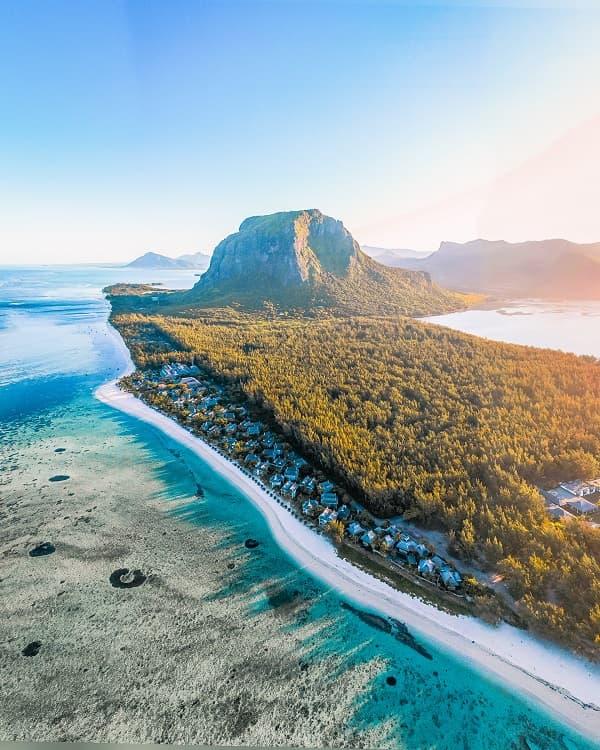
A: Wind, water and salt, in that order. Mauritius is a trade-wind island and the south-east coast in particular — Le Morne, Blue Bay, Pointe d’Esny — is windy enough to sustain a year-round kitesurfing industry, which is precisely why drones get carried away there. Flights over the lagoon put your aircraft over water with no landing option, and the “underwater waterfall” illusion off Le Morne that draws so many pilots sits several kilometres offshore, well beyond visual line of sight and beyond safe battery range; the famous images of it are helicopter and satellite shots, not drone shots from the beach. Salt air degrades motors and airframes quickly. Fly in the calmer early morning, keep well within battery reserve, and remember that visual line of sight is a legal requirement, not a guideline.
Key Fact: Visual line of sight is mandatory under regulation 8(2), which requires “direct and unaided visual contact with the aircraft”; beyond-visual-line-of-sight operation is not permitted in the open category.
Source: Civil Aviation (Unmanned Aircraft System) Regulations 2024 [1]; MCAR-UAS Issue 01 Rev 00 [3]
Q: What is the honest bottom line for a visitor?
A: If you are coming to Mauritius on holiday in the next few months and have not already begun registration, the realistic answer is that you will not be flying lawfully. Registration requires police clearance that the regulator itself says takes at least three months; ICTA import clearance is a separate step; recreational flying is confined to private property with the owner’s permission, which rules out the beaches and viewpoints that most people want to film; and the maximum penalty is a million-rupee fine and twelve months’ imprisonment. If drone footage genuinely matters to your trip, commission a DCA-approved local operator. If you want to fly yourself on a future visit, start the paperwork six months out.
Key Fact: Registration involves police clearance taking “at least 3 months to complete” per the DCA’s own FAQ, while ICTA import clearance is a separate prior requirement under the ICT (Clearance to Import ICT Equipment) Regulations 2019.
Source: Department of Civil Aviation FAQ [6]; ICTA Guidelines [8]
Part 4: References
Primary legislation and regulations — Mauritius
[1] Civil Aviation (Unmanned Aircraft System) Regulations 2024, Government Notice No. 232 of 2024
[2] Civil Aviation (Unmanned Aircraft System) (Amendment) Regulations 2026, Government Notice No. 12 of 2026 (Second Schedule — Fees)
[3] Mauritius Civil Aviation Requirements — UAS (MCAR-UAS), Issue 01 Revision 00, 9 December 2024, Department of Civil Aviation
[4] Department of Civil Aviation, Communiqué “Operation of Drones,” 2 December 2024 —
[6] Department of Civil Aviation, “Drone Operations in Mauritius” FAQ (current UAS version)
[7] Department of Civil Aviation, Drone Guidance Material (ref. 231121)
[10] Department of Civil Aviation, Application for Operations in Open Category
[11] Department of Civil Aviation, List of Commercial UAS Operators
[12] Civil Aviation Act 1974 (Act 15 of 1974), as amended
[13] Department of Civil Aviation, drone requirements and forms portal
[14] Department of Civil Aviation, Information Notice to RPA Operators No. 01/2016, 27 July 2016 — superseded, cite only as regulatory history —
Conservation, protected areas and heritage
[15] National Parks and Conservation Service, Park Management Unit
[16] National Parks and Conservation Service, Fauna Unit (protected species list)
[17] Native Terrestrial Biodiversity and National Parks Act 2015 (Act 14 of 2015)
[18] Chamarel Seven Coloured Earth, Rules and Regulations
[19] La Vanille Nature Park, Entry Conditions
[20] UNESCO World Heritage Centre, Le Morne Cultural Landscape (inscribed 2008)
[21] UNESCO World Heritage Centre, Aapravasi Ghat (inscribed 2006)
Privacy
[22] Data Protection Act 2017 (Act 20 of 2017), Republic of Mauritius
[25] Data Protection Office, Mauritius
Environmental and scientific
[24] Mauritian Wildlife Foundation, Northern Islets and Île aux Aigrettes
International framework
[26] International Civil Aviation Organization, Member States — · Mauritius is an ICAO Member State and falls within the ICAO Eastern and Southern African (ESAF) Regional Office area, Nairobi
[27] ICAO Annex 2 Appendix 4 (Remotely Piloted Aircraft), Annex 6 Part IV (International Operations — RPAS) and Doc 10019, Manual on Remotely Piloted Aircraft Systems
Explore this topic
Get new Mauritius guides by email
Join the Mauritius Explored list for trip ideas, practical updates and downloadable planning help.
Written by the Mauritius Explored editorial team, a Mauritian travel guide focused on beaches, activities, local places, and practical island planning.
Local Mauritius travel research, itinerary planning, and destination coverage since 2011.