Round Island Keel-Scaled Boa in Mauritius: The Recovery Story
Updated 7 October 2026
On a volcanic cone twenty kilometres off the north-east coast of Mauritius lives a snake that can do something no other living snake can. It bends the front half of its own upper jaw downwards, independently of the back half, hinging on a joint beneath its eye. That anatomy has been known since the 1980s. The harder question is newer: how many of these snakes there now are, and how much of the answer depends on people continuing to show up.
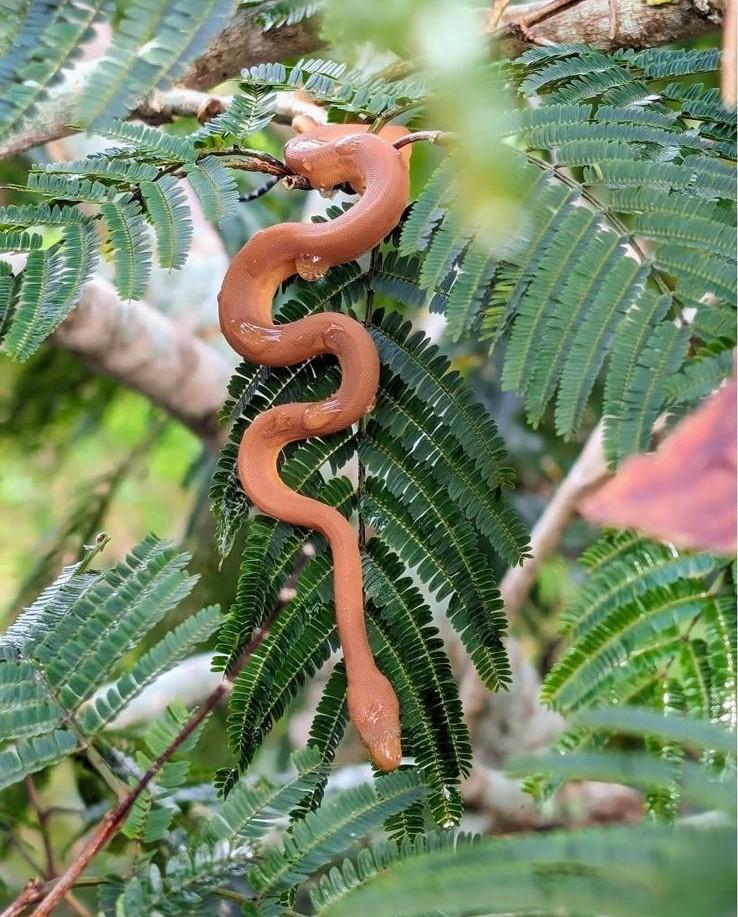
The Round Island keel-scaled boa (Casarea dussumieri) is a threatened snake endemic to Mauritius and the last surviving member of its family. It lives on two small offshore islands, hunts lizards by night, and has climbed back from a few dozen animals in the 1970s after five decades of island restoration.
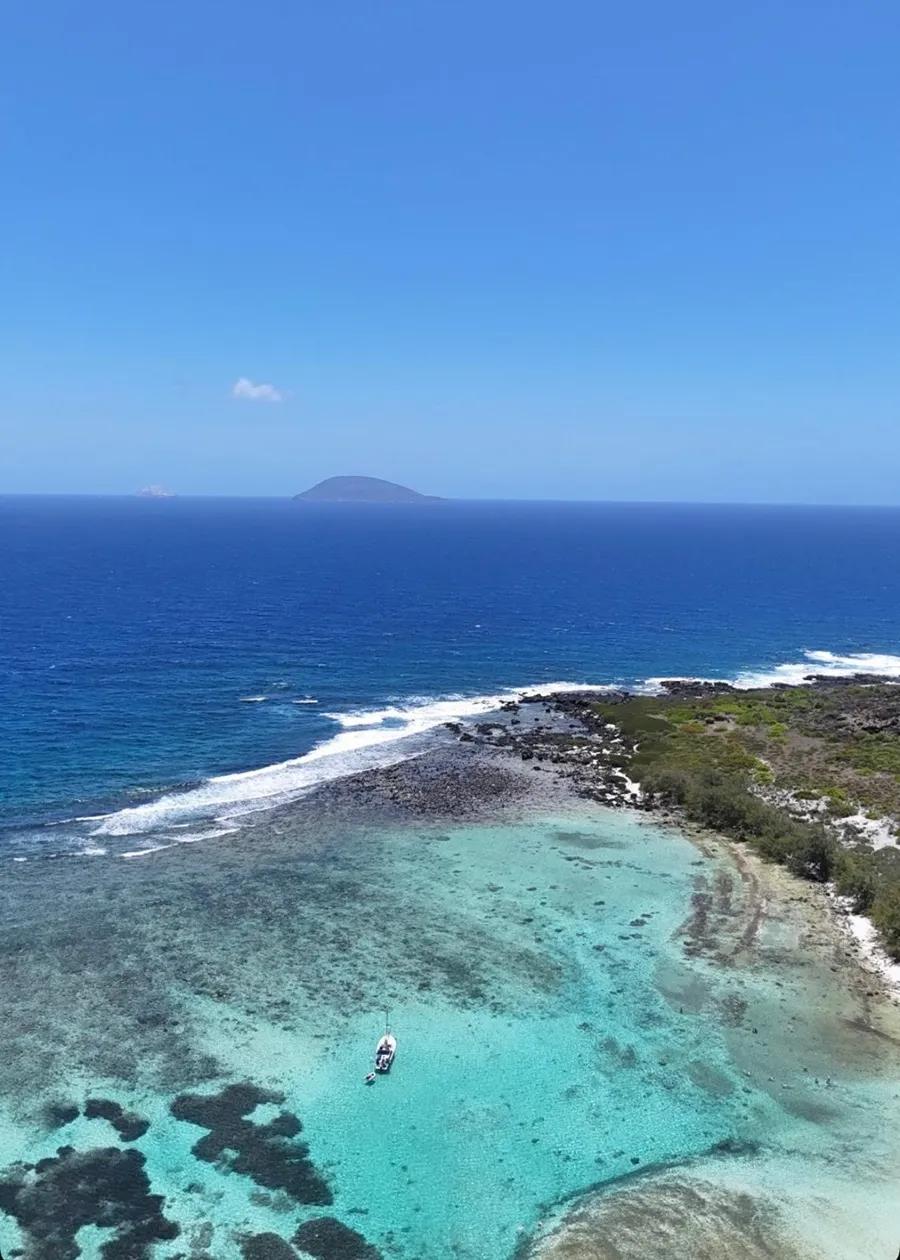
Round Island in the background from Ilot Gabriel
What is the Round Island keel-scaled boa?
It is a slender, nocturnal, lizard-eating snake found nowhere on earth but Mauritius. The scientific name is Casarea dussumieri, described by Schlegel in 1837 and named after Jean-Jacques Dussumier, a French merchant shipowner.
Despite the common name it is not a true boa. Schlegel placed it in the genus Boa, and for over a century it sat in the boa family, Boidae. It now has a family of its own, Bolyeriidae — the splitjaw snakes — which reference works describe as a lineage not closely allied with the true boas (Grzimek's Animal Life Encyclopedia).
Bolyeriidae held two species. The other, the Round Island burrowing boa, has not been recorded since the mid-1970s, leaving this animal as what ZSL's EDGE of Existence programme calls the sole surviving representative of its family — a statement about extinction rather than antiquity.
A Juveline Keel-Scaled Boa/Round Island Boa by Pouvalen Seeneevassin
Where does it live?
Its range today is a fragment of what it was. The species was recorded historically on Gunner's Quoin, Flat Island and Île de la Passe, and subfossil remains place it on mainland Mauritius — a relict distribution produced by losses, not a species always confined to one rock.
The current picture is better than most older accounts suggest. A 2025 study of the Mauritius restoration programme reports that the keel-scaled boa and Telfair's skink both "exist in functional populations on two offshore islands (Round Island and Gunner's Quoin)" (Young and colleagues, 2025). Statements that it survives only on Round Island are out of date. "Functional" is a technical term here: the population meets defined criteria for playing its ecological role, not merely for being present.
Why is its upper jaw unusual?
The maxilla is the main tooth-bearing bone of the upper jaw, and in most snakes it is a single bone on each side. In this species it is divided into a front and a back section joined by a movable joint — the intramaxillary joint — sitting beneath the eye, so the front of the upper jaw can bend independently of the rear (Grzimek's).
The observation is solid: the joint exists and it moves. Working with living animals, Cundall and Irish measured the snout and front maxillary teeth being actively depressed "15°-20° below rest position through bilateral retraction of the palatomaxillary arches" (Cundall and Irish, 1989). The skull was later imaged by CT scanning (Maisano and Rieppel, 2007; specimen scans), and field observations published in 2022 recorded the joint in use as a boa fed on Round Island (Roesch and colleagues).
The explanation remains a proposal. Cundall and Irish suggested the arrangement helps the snake close its jaws around hard, barrel-shaped prey, which is essentially what the available lizards are. ZSL puts it more directly, saying the adaptation "helps the snakes to better hold on to their preferred prey of geckos and skinks" (EDGE) — a fair reading of a 1989 hypothesis, but a hypothesis still.
It is not a forked jaw, and not a split in the lower jaw: one bone of the upper jaw is divided front and back. No source credits it with better strike accuracy either; the proposed benefit is grip, not aim.
How does it live?
It is nocturnal and semi-arboreal, climbing in the surviving palms and low vegetation (EDGE). Females are much the larger sex, about 144.5 cm against roughly 83 cm for males, and boas occur across the island up to 280 metres, most often in palm-rich habitat (Survival Blueprint).
Its colour shifts over a 24-hour cycle. ZSL describes specialised skin cells that let individuals "darken during the day, when they are inactive", and lighten "at night when they are more active" (EDGE). The pattern is documented; its function is not.
It hunts lizards by sight, raising its head and approaching with tongue flicking in the slow straight-line crawl called rectilinear motion (Grzimek's). The main prey are geckos and skinks — on Round Island, adult Telfair's skinks and Günther's geckos — with small birds and seabird chicks taken occasionally (Survival Blueprint). It is not venomous.
Females lay up to 12 soft-shelled eggs in leaf litter or hollow palm trunks (EDGE); recorded clutches run from three to 12, averaging 7.3. They are long-lived, which matters for how slowly a population rebuilds: the oldest known captive individual, at Jersey Zoo, is recorded as at least 42 years old (MWF Annual Report 2024).
How did conservation change its future?
The story starts with something that did not happen: Round Island was never colonised by rats. MWF describes the island as spared the predators "such as cats and rats that have caused irreversible damage elsewhere" (MWF Annual Report 2024). That absence is why a snake wiped out across mainland Mauritius persisted here at all, and why accounts describing a rat eradication on Round Island are mistaken. There were no rats to remove.
What did arrive were goats and rabbits, introduced in the early nineteenth century. Their browsing stripped the island: the palm savannah severely depleted, the hardwood forest lost altogether, much of the soil eroded away. Goats were eradicated in 1979 and rabbits in 1986, after which "the vegetation on Round Island began to recover", with natural regeneration of three tree species and population increases among threatened reptiles (Young and colleagues, 2025; dates also in Moorhouse-Gann and colleagues, 2022).
Prey recovered alongside the vegetation: Telfair's skink, one of the boa's main prey species, roughly doubled in the three years after the rabbits went (Durrell). The boa itself has been tracked through all of it by monthly night searches of fixed one-hectare plots, with individuals microchipped. In stages between 2012 and 2014 a further step was taken: 70 young adult boas of equal sex ratio were moved to Gunner's Quoin (Survival Blueprint; MWF Annual Report 2024). The work is a long-standing collaboration between the Mauritian government, the Mauritian Wildlife Foundation and Durrell.
How many remain?
The most recent usable estimate comes from MWF's annual report for 2024, published in 2025: 10,853 adult boas on Round Island, with a 95% confidence interval of 8,820 to 12,887 (MWF Annual Report 2024).
That figure needs its method attached, because it is not a count but an extrapolation. In 2011 the adult population was estimated by mark-recapture at 1,636 animals (95% CI 807–2,466), when surveyors encountered 0.123 adult boas per person-hour. The 10,853 figure is that estimate scaled up to the average encounter rate of the three most recent years; in 2024 that rate was 0.745 per person-hour.
The report is candid about the limits, cautioning in the same section that "due to the heterogeneity of habitat on the island it is not possible to accurately extrapolate this result to obtain the total number of adult boas on Round Island."
The effort behind the figure was also thin. A normal year involves 72 quadrat surveys across six one-hectare plots; in 2024 only 31 were completed, the report citing reduced capacity, poor weather, cyclone evacuations and problems gaining access.
The 2018 Red List assessment worked with roughly 1,818 adults across both islands. That is not evidence of a sixfold rise in six years: it appears to rest on the same 2011 estimate plus an allowance for Gunner's Quoin.
For the historical low, MWF describes a species "once considered the world's rarest snake numbering between 60 and 70 individuals in the 1970s", giving no source or year, while ZSL's blog has put the figure nearer 50. A few dozen animals is the honest version.
Why does protection still matter?
Two official measures apply here, and they say different things on purpose. The IUCN Red List measures how close a species is to extinction: the keel-scaled boa was assessed as Vulnerable in 2018 by Cole, Hector, Roopa, Mootoocurpen and Goder (assessment record; category also carried by The Reptile Database). Older accounts calling it Endangered are out of date.
The IUCN Green Status, launched in 2021, measures something else: how far a species has recovered towards being ecologically functional across its original range. On that scale the boa's 2024 assessment gives a Species Recovery Score of 15.4%, placing it in the category Critically Depleted, with Conservation Dependence rated High (Young and colleagues, 2025). The two verdicts do not conflict. Saved is not the same as recovered.
"Conservation Dependence: High" is a judgement about what would happen if the work stopped. In the 2025 study's counterfactual analysis, the keel-scaled boa is one of only two species assessed that the authors consider would most likely be extinct within ten years without conservation action. Island reptiles here are highly vulnerable to introduced mammalian predators, with populations lost within a few years of invasion, particularly by rats and shrews. Biosecurity on a rat-free island is not a formality; it is the thing holding the recovery up.
The extinct burrowing boa
The keel-scaled boa's lost relative is often confused with it. The Round Island burrowing boa, Bolyeria multocarinata, was about a metre long, smooth-scaled rather than keeled, and it was a burrower — an animal of soil and leaf litter, where the keel-scaled boa climbs. Grzimek's names catch it: the smooth-scaled splitjaw and the keel-scaled splitjaw.
It has not been recorded since the mid-1970s; MWF gives 1975, Grzimek's says 1974. Two British conservationists, David Bullock and Steve North, encountered one in 1975 on the day before they left after six weeks on the island, and may be the last people to have seen the animal alive (MWF, 2023). It was formally assessed as Extinct in 2021 — an assessment date, not a date of death.
Can visitors see it?
No, and it is better to say so plainly. Round Island was declared a nature reserve in 1957 and is closed to the public (Moorhouse-Gann and colleagues, 2022; MWF). Access is by permission only, in practice limited to conservation staff and authorised researchers. Dive boats from the north visit sites in the surrounding waters, so you may pass the island; landing on it is another matter.
How restricted it is shows in MWF's own working year: the team that manages the island completed only 31 of a normal 72 boa surveys in 2024, partly through difficulty obtaining access. Captive animals are held at Durrell's Jersey Zoo, but nothing published promises public display.
What you can visit is the programme the boa belongs to. Île aux Aigrettes, 26 hectares and 850 metres off the south-east coast near Mahébourg, has been a nature reserve since 1965 and open to guided visitors since 1998. The Mauritian Wildlife Foundation runs the walk itself, roughly 1.5 to 2 hours including the boat crossing, with rates quoted on request (MWF). There you can see Telfair's skink and Günther's gecko, both Round Island reptiles and both prey species for the boa. The snake itself is not there. Our guide to the Île aux Aigrettes conservation visit covers the trip.
If you are planning more widely, our guide to Mauritius nature reserves covers the reserves and parks that are open, and there is more on exploring Mauritius national parks. Neither offers this boa, which is rather the point: it survives because one island was kept closed, kept rat-free and kept watched for fifty years.
Frequently asked questions
What is the Round Island keel-scaled boa?
A nocturnal, lizard-eating snake endemic to Mauritius, scientific name Casarea dussumieri, and the only surviving member of the family Bolyeriidae. Despite the name it is not a true boa. Its distinguishing feature is an upper jaw divided into two movable sections, found in no other living snake.
Is the Round Island boa venomous?
No. It is not venomous, and Grzimek's Animal Life Encyclopedia records its known significance to humans as none (Grzimek's). It takes small lizards by seizing and holding them, which is where its unusual jaw is thought to help. The islands it lives on are closed to the public in any case, so encounters do not arise.
Is it extinct, and how does it differ from the burrowing boa?
The keel-scaled boa is not extinct; it was assessed as Vulnerable on the IUCN Red List in 2018. The animal that is gone is a different species, the Round Island burrowing boa (Bolyeria multocarinata) — a smooth-scaled burrower last recorded in the mid-1970s and formally assessed as Extinct in 2021. The two were the only members of their family.
Where does the Round Island keel-scaled boa live today?
On two small islands off northern Mauritius: Round Island and Gunner's Quoin, where a 2025 study reports functional populations on both (Young and colleagues, 2025). It was historically recorded on Flat Island and Île de la Passe as well, and subfossil remains show it once lived on mainland Mauritius.
How many Round Island boas are estimated to remain?
MWF's annual report for 2024, published in 2025, gives 10,853 adults on Round Island (95% confidence interval 8,820–12,887). This is an extrapolation from night-survey encounter rates against a 2011 population estimate, not a census, and the report itself cautions that habitat variation across the island makes accurate island-wide extrapolation impossible (MWF Annual Report 2024). In the 1970s the species was thought to number only a few dozen animals.
Can tourists visit Round Island?
No. Round Island has been a nature reserve since 1957 and is closed to the public, with access granted only by permission and in practice only to conservation staff and authorised researchers (Moorhouse-Gann and colleagues, 2022). Dive boats visit the surrounding waters, but landing is not permitted. Île aux Aigrettes, run by the Mauritian Wildlife Foundation, is the conservation island visitors can walk on.
References
● Mauritian Wildlife Foundation, Annual Report 2024 — published 2025, describing 2024 fieldwork. Population estimate and method, encounter rates, survey effort, Gunner's Quoin reintroduction dates, Jersey Zoo longevity record.
● Young, R. E. and colleagues (2025), Assessing the past and future impact of a long-term island restoration program, Conservation Science and Practice 7(11): e70109, published 6 August 2025. Distribution, Green Status findings, eradication dates, counterfactual analysis.
● Moorhouse-Gann, R. J. and colleagues (2022), Impacts of herbivory by ecological replacements on an island ecosystem, Journal of Applied Ecology. Island size, nature reserve status and public closure, eradication dates, tortoise introduction and its mixed outcomes.
● ZSL EDGE of Existence, Round Island Keel-scaled Boa species profile — undated. Family status, intramaxillary joint, colour change, semi-arboreal behaviour, prey, clutch size.
● Hector, A., EDGE Survival Blueprint for the Round Island keel-scaled boa. Sex-specific size, habitat use and elevation range, named prey species, clutch range and average, monitoring design, Gunner's Quoin translocation numbers.
● Cundall, D. and Irish, F. J. (1989), The function of the intramaxillary joint in the Round Island boa, Casarea dussumieri, Journal of Zoology 217: 569–598. Measured jaw movement and the proposed feeding function.
● Maisano, J. A. and Rieppel, O. (2007), The skull of the Round Island boa, Casarea dussumieri, based on high-resolution X-ray computed tomography, Journal of Morphology 268: 371–384. See also the specimen scan archive.
● Roesch, C. and colleagues (2022), Feeding observations of the Keel-scaled Boa, Casarea dussumieri, on Round Island, Mauritius, showing the use of its intramaxillary joint, Herpetology Notes.
● Cole, N., Hector, A., Roopa, P., Mootoocurpen, R. and Goder, M. (2018), Casarea dussumieri, The IUCN Red List of Threatened Species 2018. Red List category and assessment date.
● The Reptile Database, Casarea dussumieri — taxonomy, synonymy, diagnosis, etymology and Red List category.
● Grzimek's Animal Life Encyclopedia, Splitjaw Snakes (Bolyeriidae) — family characteristics, the divided maxilla, hunting behaviour, the two species, significance to humans.
● Mauritian Wildlife Foundation (2023), David Bullock and Steve North on Round Island — firsthand account of the last observed burrowing boa.
● Mauritian Wildlife Foundation (2025), Round Island: 50 years of conservation success — reserve designation and closure to the public.
● Mauritian Wildlife Foundation, Île aux Aigrettes — island size and location, reserve date, tour duration and booking.
● Durrell Wildlife Conservation Trust, Mauritius programme — partnership and restoration overview.
Explore this topic
Get new Mauritius guides by email
Join the Mauritius Explored list for trip ideas, practical updates and downloadable planning help.

Written by the Mauritius Explored editorial team, a Mauritian travel guide focused on beaches, activities, local places, and practical island planning.
Local Mauritius travel research, itinerary planning, and destination coverage since 2011.