Red & Yellow Flamboyant Trees in Mauritius: A Guide to the Bloom
Flamboyant Trees in Mauritius: Chasing the Island's Season of Colour
You come around the bend somewhere past the cane fields, windows down, the radio low. The road has been green for twenty minutes — that dense, humid, unrelenting green the island does so well. Then the canopy opens and the whole windscreen turns red.
Not pink. Not orange. Red, the way a struck match is red, held up against a sky doing its best November blue. There are two of them, maybe three, arching over the tarmac from either side, and for about four seconds you are driving through a tunnel of fire with the sunlight coming through the petals like light through a stained-glass window. Fallen blossoms are scattered on the road ahead in a loose scarlet carpet. A gust comes off the sea and more of them let go, spiralling down over the bonnet.
You will probably pull over. Almost everyone does.
This is the season. From roughly October to February, the flamboyant trees in Mauritius — along with a whole supporting cast of yellow, purple, coral and white bloomers — turn an island already famous for its lagoons into something closer to a paint box. These are the flowering trees Mauritius spring and summer are built around, and they happen along village roads and highway medians, in botanical gardens and school yards, over church walls and beach car parks. It is free, it is everywhere, and it is over almost as quickly as it begins.
This guide is about how to catch it.
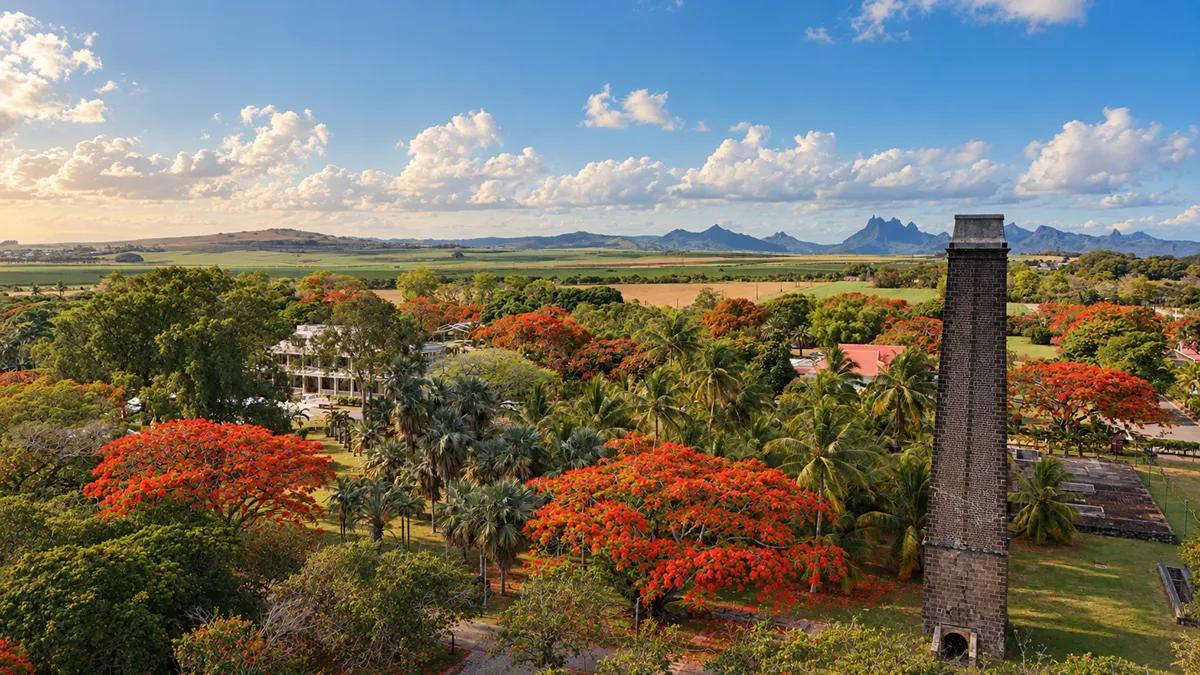
Chateau de Labourdonnais, Mapou
Why the Flamboyant Season Belongs to Mauritius
Here is the thing that surprises visitors: the tree everyone associates with Mauritius is not Mauritian at all.
Delonix regia — the flamboyant, the royal poinciana, the gulmohar — comes from the dry deciduous forests of Madagascar, where it is genuinely rare in the wild even as it has become one of the most widely planted ornamental trees on earth. It reached Mauritius in the nineteenth century and found conditions that suited it almost perfectly: a warm, frost-free climate, a long dry-ish winter to trigger leaf drop, and a wet, hot summer to fuel the flowering
What the tree does with those conditions is the point. Through the cool months it stands there looking like nothing much — an umbrella of fine, fern-like leaflets, sometimes half bare. Then, as the days lengthen and the heat builds, it drops most of its foliage and flowers on naked wood. The result is not a tree with flowers on it. It is a tree made entirely of flower, a horizontal crown of colour with nothing green to dilute it, spreading wider than the tree is tall.
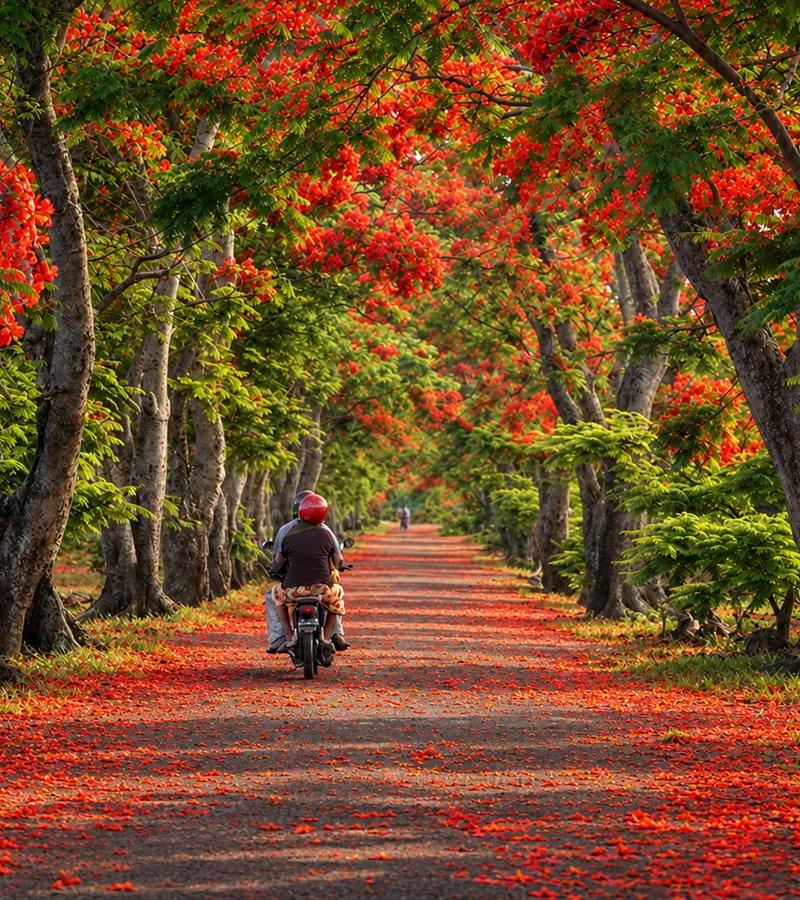
Flamboyant Tree alley located in Mon Choisy
Mauritians have never treated this as a botanical curiosity. The flamboyant is the island's unofficial Christmas tree, flowering exactly when the schools break up, the bonuses land, and the country turns its attention to the end-of-year holidays. It has nicknames that tell you everything about how it is felt rather than studied: the bonus tree, the yearly bouquet. It shows up on postcards, on café signage, in the background of a hundred thousand family photographs taken on the last Sunday before Christmas. Ask anyone who grew up here what December looks like and there is a decent chance they will describe a red canopy before they describe a beach.
And the flamboyant is only the loudest voice in the choir. The same months bring the golden haze of the yellow flame trees, the lilac drift of jacarandas on the cool central plateau, bougainvillea spilling over every second garden wall, the sculpted white-and-yellow of frangipani, and the deep orange goblets of the tulip tree. Taken together, the colourful trees in Mauritius make October to February the island's most photogenic and least-marketed season.
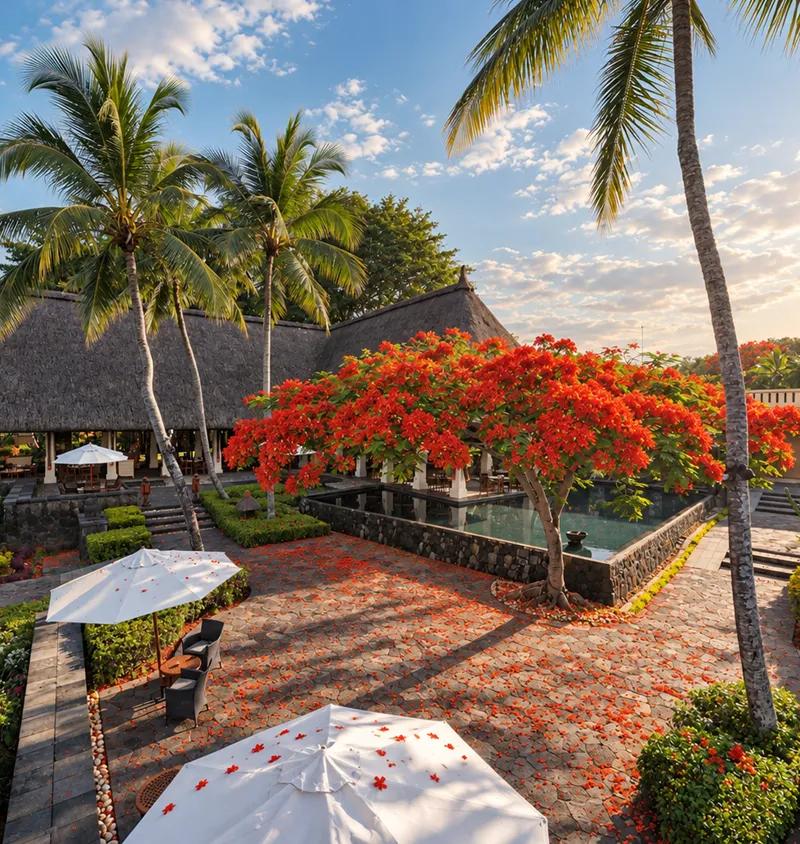
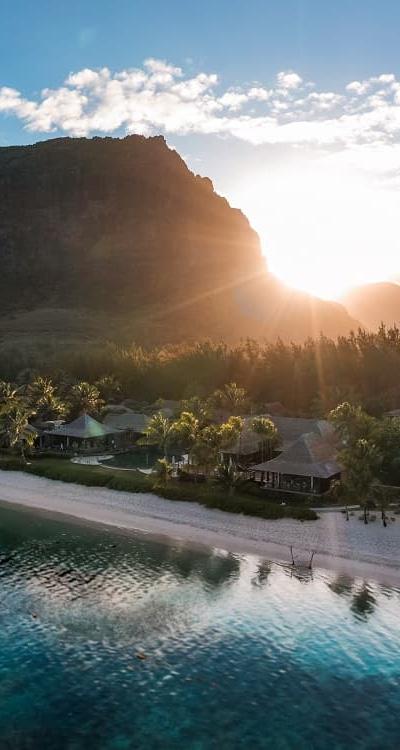
Oberoi Resort, Balaclava
This guide walks through each of the main players — what they look like, when they peak, how to tell them apart, and how to build a few days of travel around them. Locations are kept out of the main text on purpose; you will find a full, separately formatted reference list at the very end, ready to drop into a map.
The Red Flamboyant — Mauritius's Crown of Fire
If you only see one tree in bloom on this island it will be the red flamboyant Mauritius is famous for, and it will ruin you slightly for the others.
The red flamboyant is a wide, low, spreading thing — usually somewhere between eight and fifteen metres tall, but often half again as broad as it is high, which is why a mature specimen can shade an entire courtyard on its own. The flowers arrive in loose clusters at the ends of the branches, each bloom about the width of your palm, with four flared petals in scarlet or vermilion and a fifth, larger petal — the standard — streaked and speckled with cream and yellow. Get close and you will see that the "solid" red of the canopy is nothing of the sort. It is thousands of individual flowers, each one slightly different, each one flecked with white like a brushstroke.
The scale is what photographs never quite carry. Standing under a big one at noon, the light coming through the petals turns the shade beneath a warm rose-pink, and the ground is stippled with fallen blossom that crunches faintly underfoot. The scent is faint — this is not a perfumed tree, and anyone promising you a heady fragrance is selling something — but on a hot, still afternoon there is a dry, sweetish, slightly green smell around the trunk that mixes with warm tarmac and cut grass into something completely specific to a Mauritian summer.
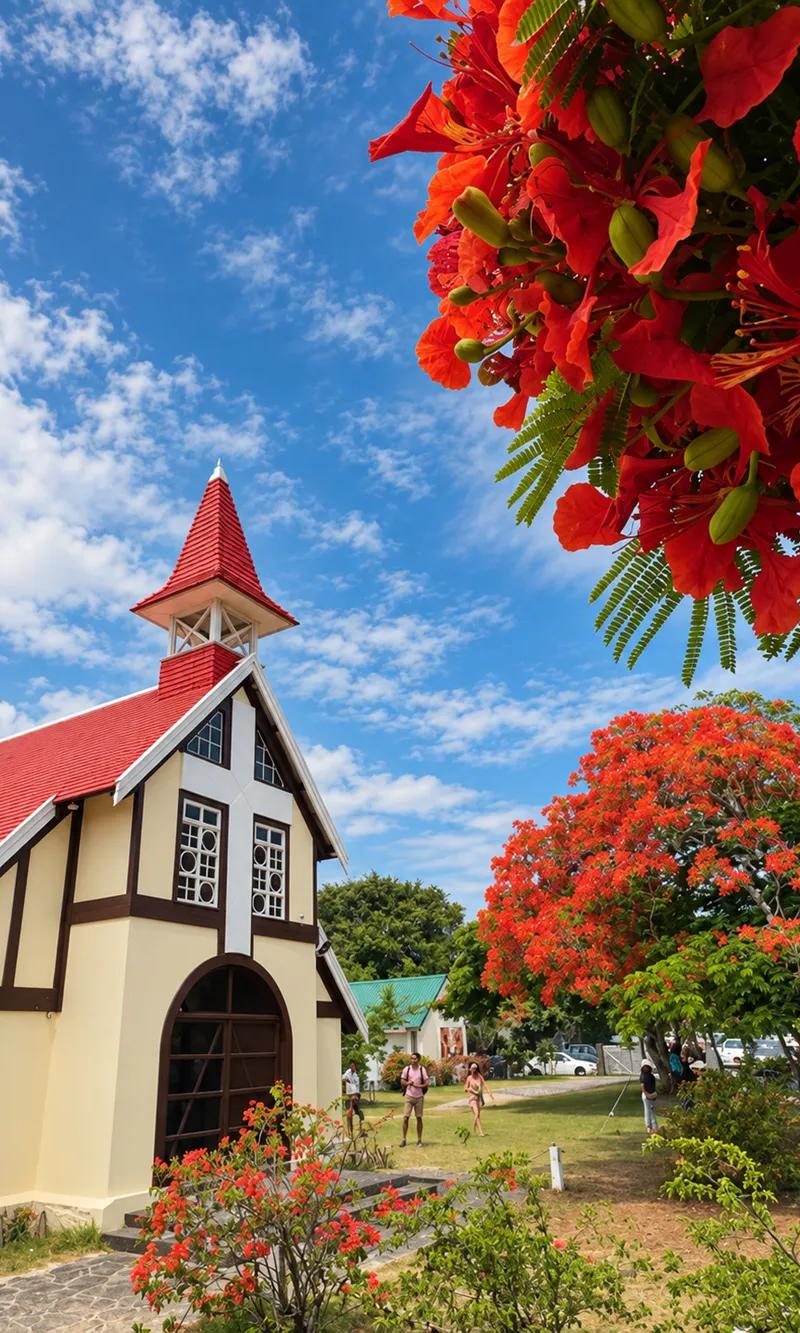
Cap Malheureux, Grand Gaube
When the Red Flamboyants Peak
Broadly, expect flowering from late October or November through to January, with the most reliable peak across late November, December and early January. Coastal and lowland trees typically colour up first, because they are warmer; trees on the higher, cooler central plateau often lag by two or three weeks and can still be going strong in late January. In a year with a warm, wet start to summer the whole show arrives early and burns bright; after a dry, cool October it can be patchy and late. This is a natural event, not a scheduled one, and locals will tell you no two seasons look the same.
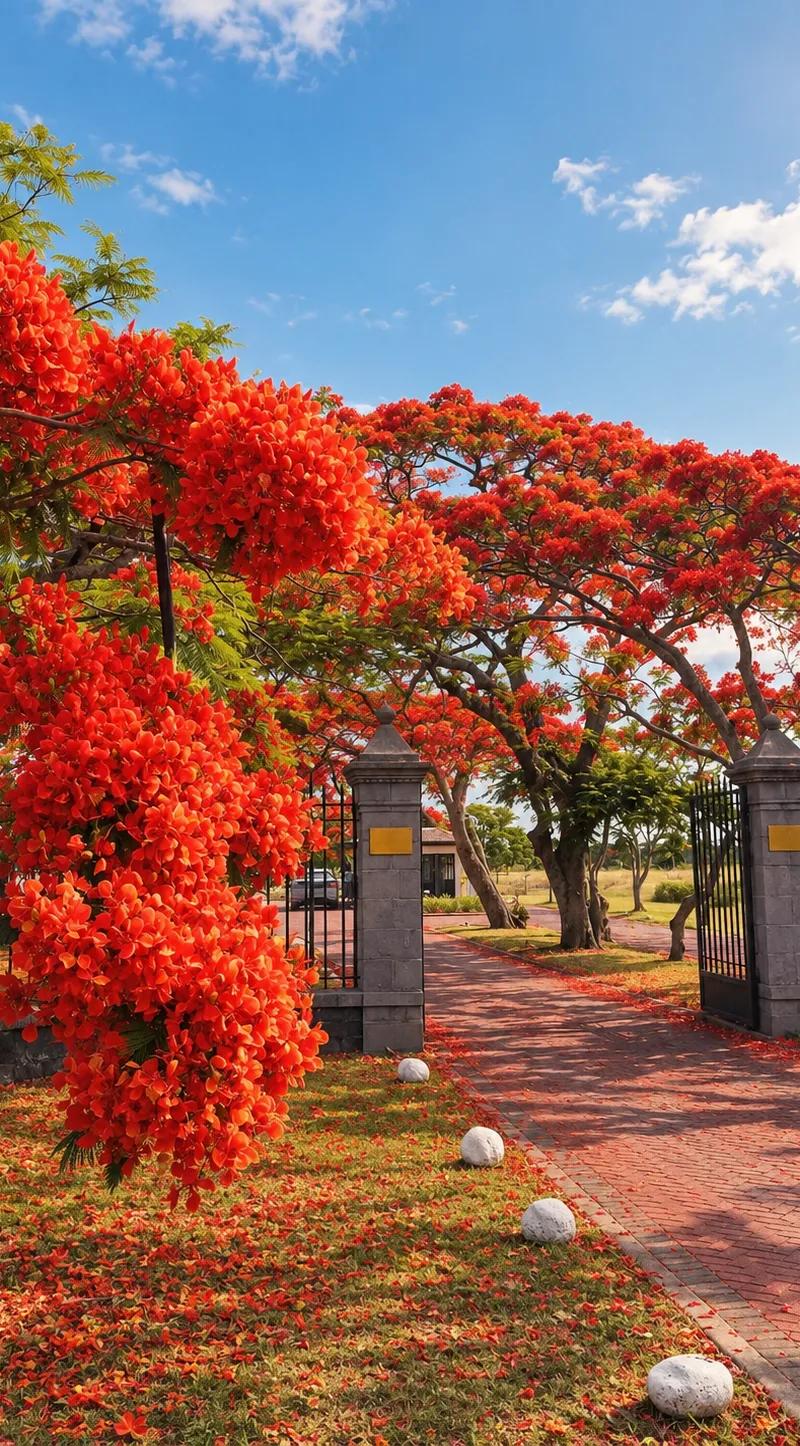
Mont Choisy Golf Club Entrance
Where They Turn Up — and When to Photograph Them
You do not need to hunt for the red flamboyant. It has been planted for a century and a half along village roads, around churches and temples, in school grounds, on hotel driveways, in public gardens, and across the median strips of the busier roads, and it self-sows enthusiastically along the coast. The most dramatic groupings tend to be on the northern and eastern coastal roads and around the old sugar estates, where long avenues were planted deliberately and have now grown into arches.
For photography, the first ninety minutes after sunrise and the last ninety before sunset are worth setting an alarm for. Low, warm light makes the red glow rather than glare, and side-lighting picks out the texture in the canopy that harsh overhead sun flattens into a red blob. Midday is the one time to avoid — the contrast between blazing canopy and black shade is more than most sensors can hold. An overcast bright day is a surprisingly good fallback: colours saturate, and you lose the blown-out sky.
One small piece of local knowledge: the ground matters as much as the canopy. A week or two into peak bloom, the fallen petals form a red carpet under the tree, and a shot that includes both crown and carpet reads far better than the canopy alone.
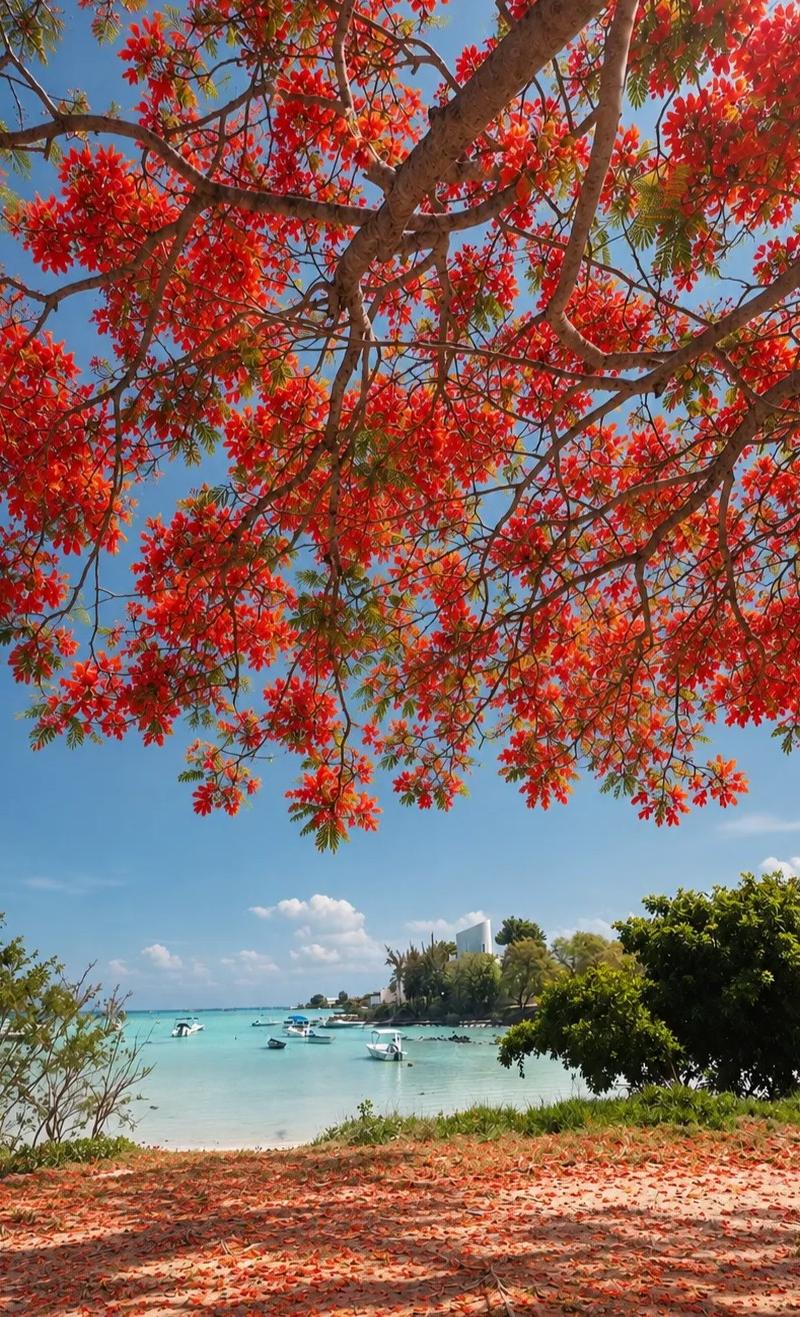
Bay of Calodyne in Grand Gaube
The Yellow Flamboyant — The Underrated Golden Giant
Then there is the one people photograph without ever learning its name.
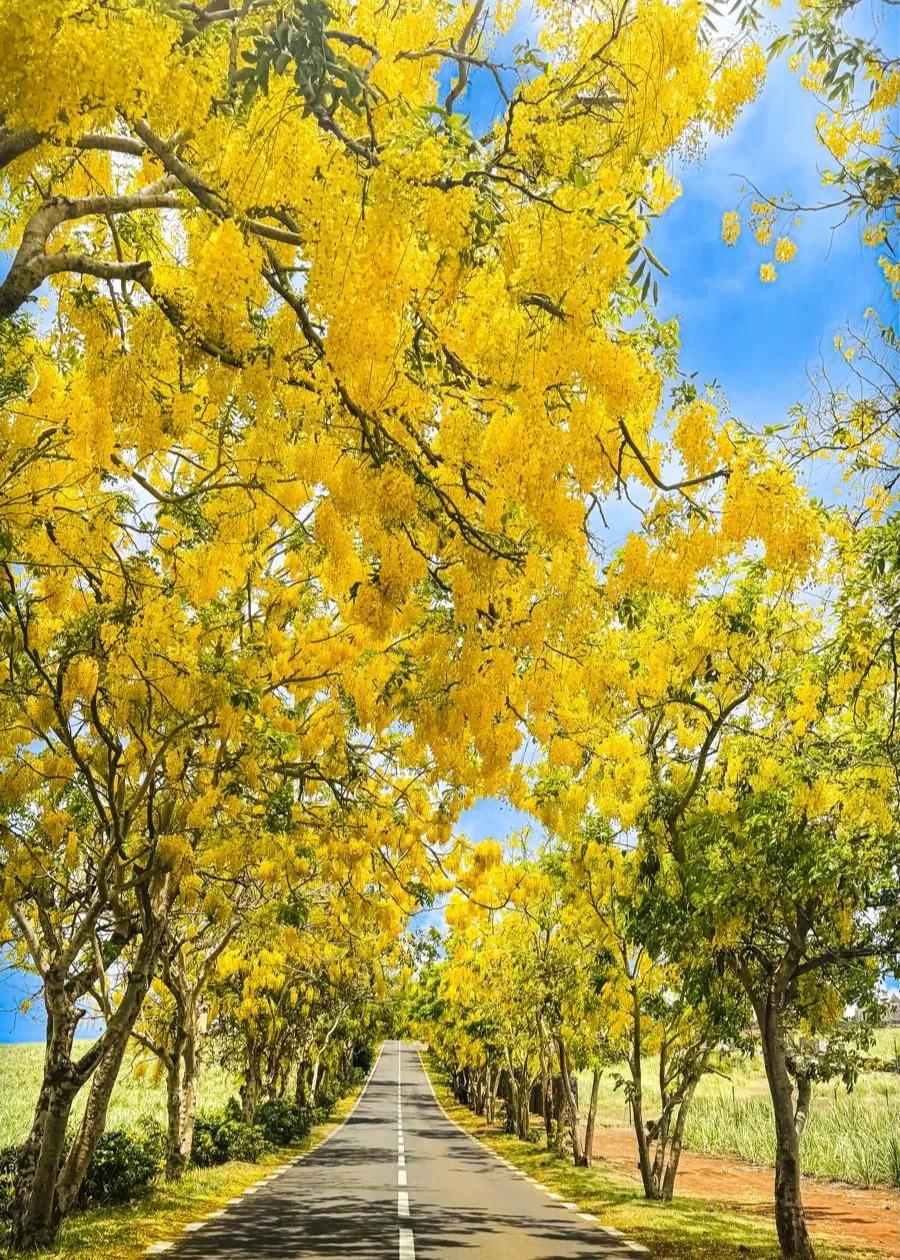
The tree Mauritians call the yellow flamboyant is usually Peltophorum pterocarpum — known elsewhere as the copperpod, the yellow flame tree or the yellow poinciana — and it is a different species from the red flamboyant, not a colour variant of it. The confusion is completely understandable: same broad umbrella shape, same habit of flowering in the hot months, same trick of turning an ordinary street into an event. But the details differ once you know where to look.
Where the red flamboyant carries its flowers in loose clusters at the branch tips, the yellow flame holds them in upright, branching spires that stand up from the crown like candles, each one packed with small, crinkled, buttery-yellow flowers and covered in fine rust-brown fuzz on the buds and stems. The overall effect from a distance is not a solid block of colour but a golden haze — softer than the red, more like the tree is glowing than burning. And it keeps its leaves while it flowers, so you get gold layered over dark green rather than gold on bare wood.
It also drops. Heavily. Beneath a yellow flame in full flow the pavement turns lemon-coloured, and the flat, copper-brown winged seed pods that follow give the tree its other common name and stay on the branches long after the colour has gone.
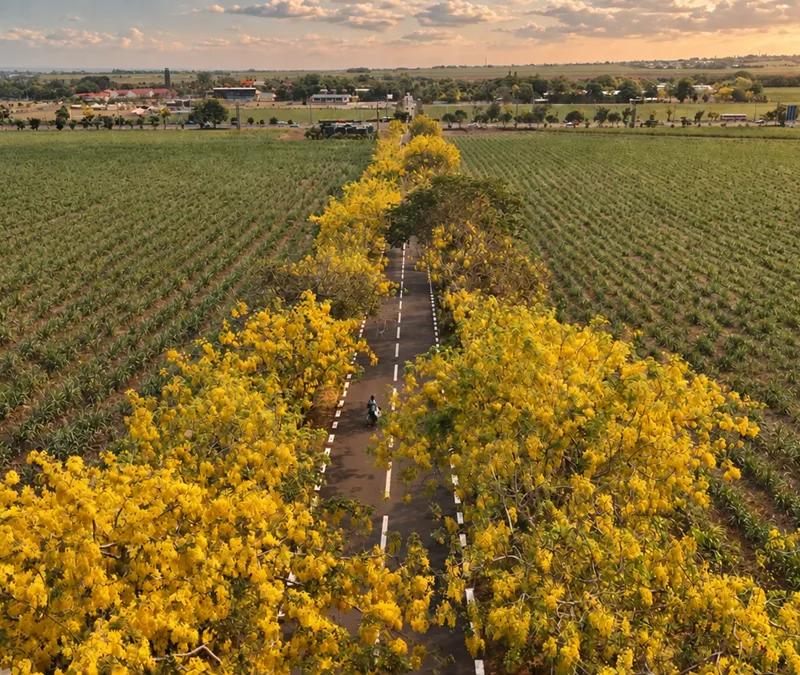
Beau Plan Road in Pamplemousses
Looking for the Yellow Place in Mauritius
Search for yellow flamboyant Mauritius online and you will mostly find photographs of avenues rather than named places. Somewhere in every conversation about the bloom, someone asks about the yellow place in Mauritius — the spot where the gold is so concentrated that the whole street reads as one colour. It is a fair question with an unromantic answer: there is no single Yellow Place in Mauritius, because the yellow flame was planted as an avenue and amenity tree rather than a landmark, which means the effect depends entirely on where a long enough run of mature trees happens to line up.
What you are looking for, practically, is an avenue — a botanical garden allée, a colonial estate driveway, an urban boulevard with a planted median, the approach road to an institution. These are scattered across the central towns and the older estate landscapes, with individual specimens along coastal roads and in village squares almost everywhere. The reference list at the end of this post gives you the specific candidates to check on a map.
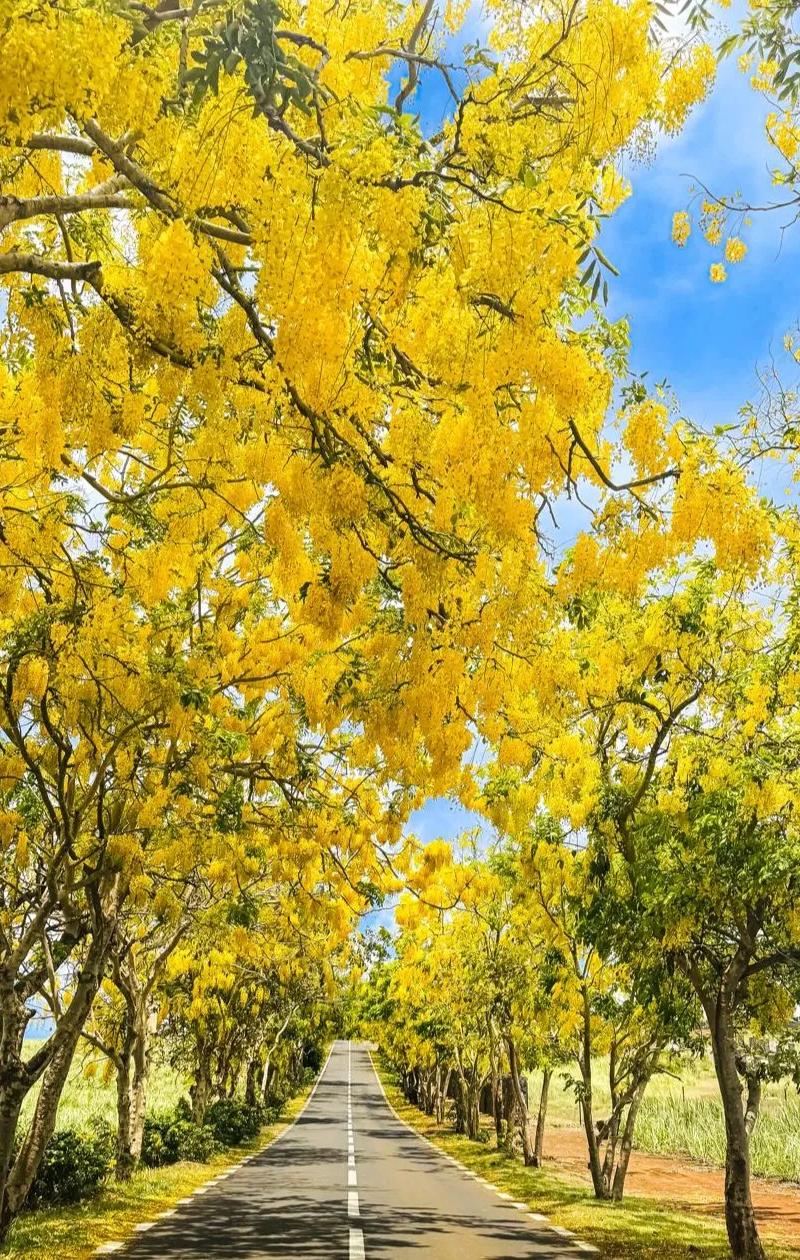
Beau Plan Road in Pamplemousses
Bloom Timing and How It Differs
The yellow flame tends to run slightly ahead of and longer than the red, with flowering commonly from around September or October into December, and often a lighter second flush later in the summer. That makes it the tree to chase if you arrive in early spring and find the flamboyants still only in bud. In practice the two overlap through November and December, which is the sweet spot: if you time a trip for the last weeks of the year, you can have red and gold within a few hundred metres of each other.
Light behaves differently on yellow, too. Where red wants low golden sun, the yellow flame photographs beautifully in soft, bright overcast, and it is one of the few flowering trees that holds up well at midday because the flowers sit above green foliage that anchors the contrast.
The Jacaranda and the Purple Bloomers — A Lilac Dream
Take the road up to the central plateau in October and the temperature drops a few degrees, the cloud comes in lower, and the colour palette changes completely.
Up here, in the cooler towns where the colonial-era houses have hedges and the gardens have lawns, the purple trees come out. Locals will sometimes call them purple flamboyants, and while that is not botanically accurate it is such a well-established habit that arguing about it is pointless. What you are almost always looking at is the jacaranda (Jacaranda mimosifolia), a South American import with feathery, almost fern-like foliage and trusses of soft trumpet-shaped flowers in a colour that sits somewhere between lavender, periwinkle and blue depending on the light and the day.
The Purple Effect, and How to See It Well
A jacaranda in full flower does something no other tree on this list manages: it makes the air look coloured. Because the flowers are small, densely packed and slightly translucent, and because they cover bare branches, a mature tree reads less as a solid object than as a purple cloud that has settled in a garden. Then the flowers fall — jacaranda petals drop constantly, and the pavement beneath turns violet, so that the tree appears to be reflected in the ground beneath it. Standing on that carpet while more of it comes down is one of the quietly great experiences of a Mauritian spring.
Timing is roughly October and November, earlier than the red flamboyant, which is exactly why the two are so rarely photographed together. Conditions matter more here than for any other tree on this list: bright direct sun washes purple toward grey and confuses most cameras, while soft overcast light or the cool hour after sunrise makes the colour deepen and separate. A drizzly plateau morning that feels like a wasted day for the beach is a perfect day for jacarandas.
The purple trees concentrate on the cooler, wetter high ground of the island's interior, in the older residential districts and public gardens, with scattered specimens on estate roads lower down.
LOCATION REFERENCE LIST — FOR GOOGLE MAPS RESEARCH
RED FLAMBOYANT
• Cap Malheureux, around the Notre-Dame Auxiliatrice chapel — Rivière du Rempart
• Mont Choisy to Pointe aux Canonniers coastal road — Pamplemousses / Rivière du Rempart
• Domaine de Labourdonnais, Mapou — Rivière du Rempart
• Marie Reine de la Paix, Port Louis — Port Louis
• Belle Mare coastal road, near the old sugar mill ruins — Flacq
• Château de Bel Ombre and estate approach roads — Savanne
• Old Medine Sugar Mill area, Bambous — Black River
• Sir Seewoosagur Ramgoolam Botanical Garden, Pamplemousses — Pamplemousses
• Bay of Calodyne — Grand Gaube
• Mont Choisy Golf Club Entrance — Grand Baie
YELLOW FLAMBOYANT
• Sir Seewoosagur Ramgoolam Botanical Garden, Pamplemousses — Pamplemousses
• Jardin de la Compagnie (Company Garden), Port Louis — Port Louis
• Beau Plan — Pamplemousses
• Mahébourg waterfront and Rue Shivananda — Grand Port
• Grand Baie main coastal road — Rivière du Rempart
PURPLE / JACARANDA BLOOMERS
• Curepipe Botanic Gardens — Plaines Wilhems
• Floréal residential roads (around Hillcrest / John Kennedy Ave) — Plaines Wilhems
• Trou aux Cerfs crater road, Curepipe — Plaines Wilhems
• Le Réduit and University of Mauritius grounds, Moka — Moka
• Eureka House and gardens, Moka — Moka
Timing: The Best Time to Visit Mauritius for Flowers
If you want everything at once, come in late November or December. That fortnight or so is when the red flamboyants hit full stride, the yellow flames are still going, the bougainvillea is at full volume and the frangipani is scenting the evenings. If your priority is the purple trees, come earlier — October into November. If you want the reds at their most theatrical and can accept that the jacarandas will be over, December and early January are your window.
The honest caveat: the answer to the best time to visit Mauritius for flowers moves by two or three weeks each year. Flowering is driven by rainfall and heat, and a cool, dry start to summer pushes everything back. Before committing to specific dates for a specific tree, ask someone on the ground — a hotel, a guesthouse owner, a local photography group — what the trees are doing right now.
Come and See It for Yourself
Here is what nobody tells you about the flamboyant season: it is short, and it is not announced.
There is no festival, no ticketed viewing, no board at the airport telling you the flamboyant trees in Mauritius have started. One week the branches are bare and grey, and the next the whole island has quietly set itself on fire, and the people who live here take photographs out of car windows on the way to work like they haven't seen it thirty times before. Then, sometime in January or February, the petals go down, the leaves come back, and the whole thing folds itself away for another year.
If you are planning a trip between October and February, build in a day for this. Not a tour — a day. Take the small roads, go up to the plateau in the morning while the light is soft, come down to the coast for the afternoon, and stop every single time something makes you say look at that. Bring a picnic. Take the long way back.
And when you get your shots: save this post for your trip planning, and drop a comment with where and when you saw the best trees this season — the timings shift every year, and readers heading out next month will thank you for it. If you want more guides to Mauritius nature and scenery as each season turns, sign up for the newsletter and I'll send the next one your way.
The trees are already budding. Go and look up.
Explore this topic
Get new Mauritius guides by email
Join the Mauritius Explored list for trip ideas, practical updates and downloadable planning help.

Written by the Mauritius Explored editorial team, a Mauritian travel guide focused on beaches, activities, local places, and practical island planning.
Local Mauritius travel research, itinerary planning, and destination coverage since 2011.