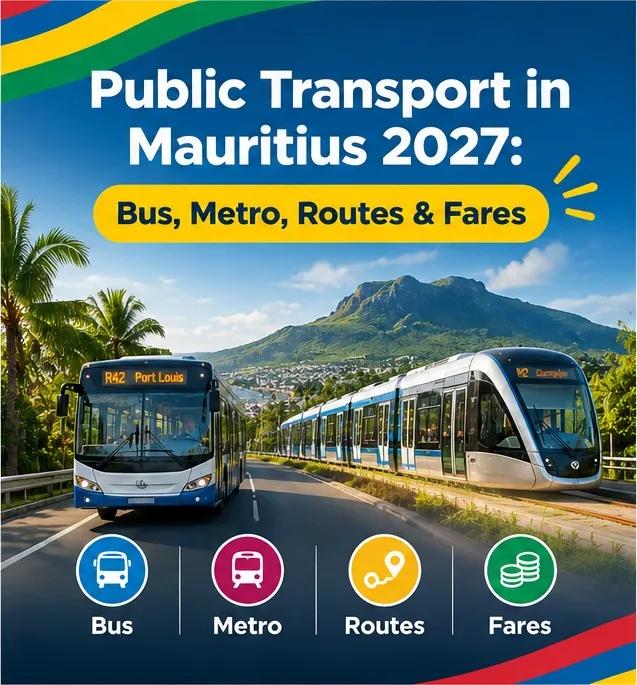
Public Transport in Mauritius 2027: Bus, Metro, Routes & Fares
Public Transport in Mauritius: Buses, Metro & How to Get Around
Last checked: 4 November 2026
Routes, fares and operating hours can change. Verify important connections before travel.
Yes, you can travel around much of Mauritius without renting a car. Buses connect most towns, villages and many popular beaches at low cost, while the Metro Express is useful along the central urban corridor between Port Louis and Curepipe, with a branch through Ébène to Réduit. The system works best when your day is simple: one destination, one direct route or one easy change, and a return before services thin out in the evening.
Public transport is less useful for waterfall-hopping, remote hiking trailheads, hidden beach access, multi-stop south-coast road trips and late dinners. For those days, a taxi, transfer, tour or rental car often saves several hours.
This guide explains how buses and the Metro work, current fare ranges, airport bus routes, the main transport hubs, the best places to stay without a car, and which Mauritius activities are genuinely practical by public transport. For the wider pre-trip checklist, see our Mauritius Travel Advice 2027.
Quick answer: is public transport good for tourists in Mauritius?
• Best for: Port Louis, Grand Baie and the north coast, Flic en Flac, Mahébourg and Blue Bay, markets, popular beaches and central towns.
• Less suitable for: Chamarel, Black River Gorges trailheads, waterfalls, scattered south-coast stops, hidden beaches and late-night returns.
• Bus payment: Carry Mauritian rupees in small notes and coins. Each bus ride is paid separately.
• Metro: Useful for Port Louis–Curepipe and the Rose Hill–Ébène–Réduit branch; it does not serve the airport or beach resorts.
• Airport: Public bus routes 09, 10 and 198 stop at SSR International Airport; the Metro does not.
• Most important rule: Plan your return before you leave. A journey that is easy at 09:00 can become awkward if the last useful bus leaves before dinner.
Public Transport in Mauritius at a Glance
Local bus
Where it works best: Most towns, villages and many public beaches across Mauritius.
Best for: Budget travel, simple point-to-point journeys and local day trips.
Main limitation: Long journeys can be slow, transfers may be required, and services often finish earlier outside the main urban areas.
Express bus
Where it works best: Selected intercity routes, including some services to and from Port Louis.
Best for: Faster travel between major transport hubs and key towns.
Main limitation: Express services operate on fewer routes and may have different timetables or fare structures.
Airport bus
Where it works best: Connections from SSR International Airport to Mahébourg, Curepipe, Rivière des Galets and Port Louis.
Best for: Travellers arriving during the day with light luggage, flexible plans and time to spare.
Main limitation: Journeys are slower than private transfers, and handling large luggage can be inconvenient. The airport bus stop is located in the car park rather than directly outside the arrivals hall.
Metro Express
Where it works best: The central urban corridor between Port Louis and Curepipe, including the Réduit branch.
Best for: Urban travel, moving between central towns and connecting with major bus interchanges.
Main limitation: The Metro does not serve SSR Airport, Grand Baie, Flic en Flac, Le Morne or the main resort areas along the coast.
If You Remember Only Six Interchanges
For most coastal travel, these are the six interchange points that matter most:
Port Louis — Immigration Square / Transportation Centre: main gateway for Grand Baie, Trou aux Biches, Mont Choisy, Pereybere, Cap Malheureux and other north-coast routes.
Port Louis — Victoria Urban Terminal / Victoria Square: important for the airport route 198 and many central, south and south-east services.
Quatre Bornes: the most useful inland interchange for Flic en Flac and several west-coast journeys.
Central Flacq: the key east-coast interchange for Belle Mare, Palmar and Trou d'Eau Douce.
Mahébourg: the main south-east hub for Blue Bay, the airport and onward regional connections.
Souillac: the main south-coast hub for Bel Ombre, Baie du Cap, Chemin Grenier and nearby southern towns.
Practical note: Do not search only for “bus terminal” when planning a coastal trip. In places such as Grand Baie, Belle Mare, Tamarin, Mont Choisy and Trou d’Eau Douce, the useful boarding point may simply be a roadside stop near the beach or village centre. Search by destination and stop name, then confirm the direction and return service.
How Mauritius Buses Work
Mauritius does not have one single bus operator or one integrated ticket. In the official NLTA timetable network, services are divided between the state-owned National Transport Corporation (NTC), four named private companies (UBS, TBS, RHT and MBT), and a large number of individual licensed operators. This guide covers Mauritius island only and excludes Rodrigues services. For a visitor, the practical rule is still simple: identify the correct route and destination, board the bus, pay the conductor, and buy a new ticket if you change buses.
Your First Bus: 7 Simple Steps
Find the route using your starting point and destination, not just a route number. Route numbers can be useful, but place names are easier to verify.
Check the direction on the front of the bus before boarding. The same route can pass through a stop in both directions.
Signal clearly at the stop so the driver knows you want the bus.
Board first. A conductor normally comes through the bus after departure.
Tell the conductor where you are getting off. Pay in Mauritian rupees and keep the ticket until you leave the bus.
If you are unsure of the stop, show the conductor the destination and ask where to get off.
Press the bell or tell the conductor before your stop. Do not wait until the bus has already reached it.
Cash: Carry small notes and coins. Large notes can be awkward, especially early in the day.
Transfers: There is no integrated bus transfer. If you change buses, you buy another ticket.
MECard: The Metro Express MECard is for the Metro only; it does not pay for regular buses.
Express services: Some routes use air-conditioned or express buses with separate tariffs and operating patterns. Route 215 between Port Louis and Grand Baie is one current example, but verify its operating day before relying on it.
Which Operator Matters Most for a Tourist?
North coast: TBS is particularly important, alongside individual operators for some northern and northeast links.
East coast: Individual operators are essential for Belle Mare, Palmar, GRSE, Central Flacq and many east-coast connections; NTC also provides cross-island links to Central Flacq.
South and southeast: Individual operators are important for Mahebourg, Blue Bay and south-coast services, while UBS operates the airport/Port Louis route 198 and NTC covers several south and southwest corridors.
West coast: NTC, UBS and individual operators all matter, depending on whether you are heading to Albion, Flic en Flac/Wolmar, Bambous or the Black River coast.
Central towns: NTC, UBS and RHT are the main named bus companies you are likely to encounter, with Metro Express providing a separate rail option.
Practical rule: Do not choose a bus by company name. Choose it by route number, destination and stop, then use the operator name only when you need the correct terminal, timetable source or contact.
Bus Fares and Payment
Current published general fare schedule: the Road Traffic (Bus Fares) Amendment Regulations 2022, effective 8 May 2022, set adult fares from Rs 17 for the shortest stage to Rs 47 for the longest general-route stages. Certain special routes have separate tariffs. No later general bus-fare regulation was found in the Land Transport legislation list at the time of checking, but fares should still be verified before publication and before travel.
What a tourist should assume about payment
• Regular buses: Cash is the safest assumption; carry rupees in small notes and coins.
• Each ride: Paid separately. A journey with one change means two tickets.
• Tourist/day pass: We found no island-wide tourist day pass or combined bus/Metro ticket.
• Metro: Uses separate single-use tickets or MECards.
• Budget planning: Public transport is inexpensive, but the time cost of a long route can matter more than the fare.
For the wider cost comparison — transport, food, activities and accommodation — see our Mauritius Holiday Cost 2027 guide.
Bus Routes, Timetables and Maps
Do not try to memorise hundreds of route numbers. The useful skill is knowing how to check a route and where you need to change.
Search from your accommodation or nearest recognised stop to your destination using Mauritius Buses or Bus Mauritius.
Look for the hub in the middle. Cross-island trips often involve Port Louis, Rose Hill, Quatre Bornes, Curepipe or Mahébourg.
Check the first and last departures, and whether the timetable differs on Saturday, Sunday or a public holiday.
Treat timetable websites as route-planning tools, not live tracking. Mauritius Buses states that its data starts with the latest official NLTA timetable guide and adds later network changes; times are estimates and services can change.
For a flight, booked excursion or last bus home, leave a margin and confirm the route on the day.
Useful route tools: Mauritius Buses · Bus Mauritius · National Transport Corporation
Main Bus Hubs Tourists Should Know
Port Louis — Victoria Urban Terminal / Victoria Square
Why it matters for visitors: One of the main transport interchanges in the capital, serving airport route 198 and numerous central and southern bus services.
Useful for: Airport connections, central Mauritius, southern routes and onward travel through Port Louis.
Port Louis — Immigration Square / Transportation Centre
Why it matters for visitors: A key departure area for northbound and other intercity services.
Useful for: Grand Baie, Trou aux Biches, Mont Choisy and other northern destinations.
Good to know: Different route planners may use slightly different names for this terminal area, so check the exact departure point before travelling.
Rose Hill
Why it matters for visitors: One of the most useful combined bus and Metro Express interchanges in central Mauritius.
Useful for: Connections toward the east, west, north-west and other central towns.
Good to know: Rose Hill is particularly useful when combining a Metro journey with an onward bus connection.
Quatre Bornes
Why it matters for visitors: An important central transport hub with strong connections toward the west coast.
Useful for: Flic en Flac, central Mauritius and onward connections toward other towns.
Good to know: Quatre Bornes is also useful for travellers combining public transport with shopping or market visits.
Curepipe — Jan/Ian Palach North & South
Why it matters for visitors: One of the major bus hubs in the central highlands.
Useful for: Central Mauritius, southern connections and airport travel.
Airport connection: Route 09 from SSR International Airport terminates at Jan Palach South.
Good to know: The spelling may appear as either Jan Palach or Ian Palach depending on the map or route planner.
Mahébourg
Why it matters for visitors: The main public-transport hub for southeast Mauritius.
Useful for: SSR Airport, Blue Bay, Pointe d'Esny area, nearby southeast villages and cross-island connections.
Good to know: Mahébourg is one of the most practical bases in Mauritius for travellers relying heavily on buses.
Central Flacq
Why it matters for visitors: The main east-coast interchange for local and cross-island journeys.
Useful for: Belle Mare, Palmar, Trou d'Eau Douce and other eastern coastal areas.
Good to know: Travellers staying on the east coast will often change buses here rather than travelling directly between coastal villages.
Vacoas Bus Station
Why it matters for visitors: A major central interchange located close to the Metro Express and Vacoas town centre.
Useful for: Port Louis, Curepipe, Quatre Bornes, Henrietta and Grand Bassin connections.
Good to know: Vacoas is particularly useful for travellers moving between the central plateau and other parts of the island.
Rivière du Rempart Bus Station / Traffic Centre
Why it matters for visitors: An important interchange for the northeast of Mauritius.
Useful for: Port Louis, Goodlands, Grand Gaube, Roches Noires, Poudre d'Or and Central Flacq.
Good to know: This hub becomes particularly useful for travellers staying in smaller northeast coastal villages where direct cross-island services are limited.
Saint Pierre Bus Station / Traffic Centre
Why it matters for visitors: A useful inland interchange on the Moka corridor between Port Louis and eastern Mauritius.
Useful for: Flacq, Curepipe, Rose Hill, Quartier Militaire and surrounding central areas.
Good to know: Most tourists will use Saint Pierre as a transfer point rather than as a final destination.
Rose Belle Bus Terminus
Why it matters for visitors: A secondary but useful interchange for southern and southeast Mauritius.
Useful for: Travellers moving between the Curepipe/central corridor, Grand Port and nearby southern villages.
Good to know: Rose Belle can be useful when travelling toward the south or southeast without returning through Mahébourg.
Port Louis has more than one major terminal area, which is why route planners can appear confusing. For a city-day itinerary, see A Day in Port Louis. Vacoas, Rivière du Rempart, Saint Pierre and Rose Belle are also useful interchanges when a journey crosses the central, north-east or southern parts of the island.
Coastal Bus Terminals and Stops Tourists Should Know
Not every famous coastal town in Mauritius has a formal bus terminal. Some places have a true bus station or terminus; others are served by a cluster of roadside stops along the coastal road. The names below are the most useful tourist reference points. Terminal and stop names can vary between route planners, road signs and local usage, so verify the exact stop for your journey before you travel.
North and North-West Coast
Grand Baie — La Pointe / Super U stop area. Grand Baie does not have one single formal bus station. These central stops are useful for Port Louis, Pereybere, Cap Malheureux, Goodlands and other northern villages.
Pereybere — Public Beach stop area. The main coastal stops serve Pereybere beach and connect along the north-coast corridor between Grand Baie, Cap Malheureux and Goodlands.
Cap Malheureux — Church / village stop. The stop near the red-roof church is the most useful reference point for visitors arriving by bus from Grand Baie or Pereybere.
Mont Choisy — Public Beach / coastal-road stops. There is no major terminal; buses run along the coast between Trou aux Biches, Mont Choisy and Grand Baie.
Trou aux Biches — Oasis Hotel / coastal-road stop area. Use the main coastal stops for beach access and services toward Port Louis, Triolet, Mont Choisy and Grand Baie.
Grand Gaube — Grand Gaube Terminus. A useful local terminus for the north-east coast, with onward connections through Goodlands and the northern network.
Goodlands — Goodlands Bus Station. One of the most useful northern interchanges for Grand Gaube, Cap Malheureux and surrounding villages.
Triolet — Triolet Bus Terminus. Useful for connections toward Trou aux Biches, Mont Choisy and the north-west coast.
West and South-West Coast
Flic en Flac — Beach-area / Government School stops with the route continuing toward Wolmar. Flic en Flac is served by several roadside stops rather than one central tourist terminal; Quatre Bornes is the key inland interchange for many west-coast journeys.
Tamarin — Village / Salt Pans roadside stops. There is no major terminal; use the main coastal-road stops for services toward Black River, Baie du Cap, Quatre Bornes and Port Louis.
Albion — Police Station / Mon Plaisir stop area. These are practical reference points for services toward Port Louis and Rose Hill.
Le Morne — Le Morne village / hotel-junction stops. There is no central bus terminal, and the exact stop depends on whether you are heading to the village, public beach or hotel strip.
Baie du Cap — Baie du Cap terminus / main village stop. An important south-west turning point for services linking Le Morne, Bel Ombre, Souillac, Quatre Bornes and Curepipe.
Bel Ombre — Village / Government School stop area. Buses continue along the south-west corridor toward Souillac and Baie du Cap; resort entrances may still require a walk or taxi.
South and South-East Coast
Souillac — Souillac Bus Station. The main south-coast hub for Gris Gris and Souillac, with connections toward Bel Ombre, Baie du Cap, Chemin Grenier, Rivière des Anguilles, Mahébourg and Curepipe.
Rivière des Galets — Rivière des Galets Bus Station. A secondary south/south-west hub useful for connections between Souillac, Chemin Grenier, Mahébourg and Curepipe.
Mahébourg — Mahébourg Traffic Centre / Bus Station. The main south-east transport hub and the most useful interchange for airport buses, Blue Bay, Port Louis, Curepipe and east/south-coast connections.
Blue Bay — Public Beach / terminus area. Blue Bay is a destination stop rather than a large interchange; Mahébourg is the main hub for onward travel.
Pointe d'Esny — Use Mahébourg as the main transport hub. Pointe d'Esny does not have a major tourist interchange, and some beach-access points are away from the main bus route, so the final section may require walking or a short taxi ride.
East Coast
Belle Mare — Main roadside stops through Belle Mare village / beach area. Belle Mare does not have a major tourist terminal; Central Flacq is the important regional interchange for wider east-coast and cross-island travel.
Central Flacq — Central Flacq Bus Station. The main east-coast transport hub for Belle Mare, Palmar, Trou d'Eau Douce and cross-island connections.
Trou d'Eau Douce — Village stop area. There is no large tourist terminal; use the main village stops for services toward Central Flacq, Palmar and surrounding east-coast areas.
Palmar — Temple / local coastal stops. Useful for hotels and beaches between Belle Mare and Trou d'Eau Douce, with Central Flacq remaining the main interchange for longer journeys.
If You Remember Only Six Interchanges
For most coastal travel, these are the six interchange points that matter most:
Port Louis — Immigration Square / Transportation Centre: main gateway for Grand Baie, Trou aux Biches, Mont Choisy, Pereybere, Cap Malheureux and other north-coast routes.
Port Louis — Victoria Urban Terminal / Victoria Square: important for the airport route 198 and many central, south and south-east services.
Quatre Bornes: the most useful inland interchange for Flic en Flac and several west-coast journeys.
Central Flacq: the key east-coast interchange for Belle Mare, Palmar and Trou d'Eau Douce.
Mahébourg: the main south-east hub for Blue Bay, the airport and onward regional connections.
Souillac: the main south-coast hub for Bel Ombre, Baie du Cap, Chemin Grenier and nearby southern towns.
Practical note: Do not search only for “bus terminal” when planning a coastal trip. In places such as Grand Baie, Belle Mare, Tamarin, Mont Choisy and Trou d’Eau Douce, the useful boarding point may simply be a roadside stop near the beach or village centre. Search by destination and stop name, then confirm the direction and return service.
Airport Buses
Mauritius Buses lists three public routes serving SSR International Airport: 09, 10 and 198. The airport stop is in the middle of the car park; after leaving the terminal building, head right toward the parking area. The route-planning page also advises allowing roughly 90 minutes after landing for immigration and baggage before relying on a bus connection. If you are still planning your arrival, see Flights to Mauritius 2027 before choosing your airport transport.
Airport Bus Routes from SSR International Airport
Route 09
Main connection: Curepipe (Ian Palach South) ↔ Mahébourg Traffic Centre, via SSR International Airport
First bus from the airport: 05:00
Last bus from the airport: 19:25
Average frequency: About every 9 minutes
Best for: Travellers heading toward Curepipe, Mahébourg or the central corridor.
Route 10
Main connection: Mahébourg Traffic Centre ↔ Rivière des Galets, via SSR International Airport
First bus from the airport: 05:45
Last bus from the airport: 18:15
Average frequency: About every 21 minutes
Best for: Travellers continuing toward the south and southwest coast.
Good to know: This is the least frequent of the three main airport routes.
Route 198
Main connection: Port Louis (Victoria Urban Terminal / Victoria Square) ↔ Mahébourg Traffic Centre, via SSR International Airport
First bus from the airport: 05:25
Last bus from the airport: 18:25
Average frequency: About every 16 minutes
Best for: Travellers heading directly toward Port Louis or connecting there for northern destinations such as Grand Baie.
Good to know: For Grand Baie, travellers can continue from Port Louis using a northbound service such as route 215, subject to the current timetable.
Before relying on an airport bus
Allow enough time after landing for immigration and baggage collection.
Check the last departure from the airport, not only the route frequency.
Public buses are most practical for daylight arrivals with light luggage.
For late arrivals, heavy luggage or accommodation requiring several changes, a private transfer or taxi may be more convenient.
Which Airport Bus Should You Take?
Route 198 — Port Louis: The most useful airport bus for travellers heading to Port Louis. Mauritius Buses estimates about 70 minutes from the airport to Port Louis and about Rs 44 for the full airport-to-Port Louis ride.
Route 09 — Curepipe or Mahébourg: Useful if you are heading toward the central corridor or staying around Mahébourg. The route runs between Curepipe and Mahébourg via the airport.
Route 10 — South-coast direction: Runs between Mahébourg and Rivière des Galets via the airport. It is the least frequent of the three airport routes, so check the departure window carefully.
Mahébourg: All three airport routes connect toward Mahébourg, making it the easiest coastal hub to reach by public bus directly from the airport.
Airport Connections to Popular Tourist Areas
Grand Baie: Take route 198 from the airport to Port Louis, then change to route 215 for Grand Baie. This is the example given by Mauritius Buses and shows why many airport-to-resort journeys require at least one transfer.
North-coast resorts: For Trou aux Biches, Mont Choisy, Pereybere or Cap Malheureux, travel first to Port Louis on route 198 and then connect to the appropriate northbound coastal service.
Blue Bay: Use an airport bus toward Mahébourg, then change at Mahébourg for the local Blue Bay service. This is normally more practical in daylight with light luggage.
Flic en Flac and west-coast resorts: Expect at least one major interchange and a long overall journey. For an arrival day, a transfer or taxi is usually much simpler.
Le Morne / Bel Ombre / south-west: Public transport is possible only with onward changes and can take a large part of the day. These are poor airport-bus choices after a long flight.
Before You Choose the Airport Bus
Check your landing time: The airport routes stop running well before the last flights arrive. Compare your expected baggage-clearance time with the last airport departure, not just your scheduled landing time.
Travel light: The airport stop is in the car park and regular buses are not designed around large holiday luggage.
Plan the transfer before boarding: Most resort areas need at least one change, so know the interchange and the last onward bus before leaving the airport.
Keep cash ready: Bus fares are inexpensive, but regular buses should still be treated as cash-based; carry small Mauritian notes and coins.
Use a transfer when the maths stops making sense: A late arrival, heavy luggage, children, or two long connections can turn the cheapest option into the least practical one. Compare a private airport and hotel transfer if you want a direct arrival.
How to Use the Metro Express
The Metro Express is a light-rail system for the central urban corridor, not an island-wide tourist train. The operator describes 20 stations between Port Louis and Curepipe, while the completed network also includes the Rose Hill–Ébène–Réduit branch, bringing the full system to 22 stations.
Where it helps: Port Louis, Beau Bassin/Rose Hill, Quatre Bornes, Phoenix, Vacoas, Curepipe, Ébène and Réduit.
Where it does not go: SSR Airport, Grand Baie, Trou aux Biches, Flic en Flac, Le Morne or the resort coasts.
Interchanges: Port Louis, Rose Hill, Quatre Bornes, Vacoas and Curepipe are the most useful places to combine Metro and bus travel.
Published hours: Metro Express currently publishes operating hours of 06:00–19:00. Verify the timetable before travel, especially on public holidays or when a branch service matters.
Single-use fares: The published stage-based single-use fare is Rs 35–55. Adult MECard journeys are slightly cheaper at approximately Rs 32–52.
How to travel: Buy a single-use ticket at the station or use an MECard. Tap on before travel and tap off when you leave.
MECard purchase price: Check the machine/operator immediately before buying. Metro Express pages currently show inconsistent promotional/purchase-price information, so this guide does not lock in a card purchase price.
Best Places to Stay Without a Car
No base makes every part of Mauritius easy by public transport. Choose the base that matches the days you actually want to do.
Grand Baie
Why it works: Strong north-coast bus coverage, regular connections toward Port Louis, and a high concentration of shops, restaurants and boat departure points within a relatively compact area.
What still needs planning: Late dinners can be difficult if buses have already finished, and cross-island nature days are usually slow by public transport.
Best for: First-time visitors who want flexibility, easy short-distance journeys and plenty of services close to their accommodation.
Trou aux Biches
Why it works: Good bus links along the north-west coast, with services continuing toward Grand Baie, Mont Choisy and Port Louis.
What still needs planning: There are fewer services, shops and evening options than in Grand Baie, so it is important to check the last practical return bus.
Best for: Travellers who want a quieter, beach-focused base while still having useful public-transport connections.
Flic en Flac
Why it works: The long public beach is easy to use without a car, and bus connections link the area with Port Louis, Quatre Bornes and other west-coast locations.
What still needs planning: Cross-island journeys can take a long time, while inland attractions, waterfalls and hiking areas are much easier by taxi or rental car.
Best for: Beach-focused holidays with occasional trips to Port Louis or the central towns.
Mahébourg / Blue Bay
Why it works: Mahébourg is one of the main transport hubs in southeast Mauritius, with airport buses and local connections continuing toward Blue Bay.
What still needs planning: Smaller beaches, hidden coastal access points, heritage sites and nature attractions around the southeast are more scattered and may require a taxi or additional planning.
Best for: Travellers looking for a quieter local atmosphere, easy airport access and simple beach or town days without a car.
Rose Hill / Quatre Bornes / Curepipe
Why it works: These central towns have some of the strongest public-transport connections in Mauritius, combining the Metro Express with dense bus networks and major interchanges.
What still needs planning: There is no beach on the doorstep, so any coastal day will require additional travel.
Best for: Markets, shopping, city travel, central-island exploration and travellers who prioritise transport convenience over staying directly on the coast.
For more detail on two useful car-free bases, see A Day in Grand Baie and our Mahébourg village guide.
What You Can Reach Easily by Public Transport
North-coast beaches: Trou aux Biches, Mont Choisy, Grand Baie and Pereybere are among the easiest beach areas to link by bus. Several north-coast routes overlap through this corridor.
Cap Malheureux and northern villages: Possible on the same north-coast network; allow more time and check the return service.
Port Louis: Well connected from the north and central towns, and reached by route 198 from the airport.
Flic en Flac: Reachable from Port Louis and Quatre Bornes, but journey times vary and a cross-island day can become long.
Mahébourg and Blue Bay: Mahébourg works as the southeast hub, with onward local bus travel to Blue Bay.
Central towns: Rose Hill, Quatre Bornes, Vacoas and Curepipe are the easiest places to mix bus and Metro travel.
Pamplemousses: Practical from the north and useful to combine with a north-coast day, but check the frequency before building a tight schedule.
What Is Difficult by Bus
A route can exist and still be a poor holiday-day plan. The question is not only “Can I get there?” but “How much of the day will I lose getting there and back?”
Chamarel: The waterfall, Seven Coloured Earth, viewpoints and nearby stops are dispersed. Public transport does not connect them efficiently as a single day.
Black River Gorges and trailheads: Buses can get you closer to the region, but the final access to many hikes and viewpoints is the difficult part.
Hidden beaches and small access roads: Places such as Beau Vallon, some Pointe d’Esny access points and La Cambuse are much easier with a car, taxi or local lift.
South-coast road trips: The individual towns may be served, but linking several scenic stops in one day becomes slow and transfer-heavy.
Late-night dining: Many rural/coastal services finish in the late afternoon or early evening. Always check the last practical return before you sit down for dinner.
Early boat departures: If your boat leaves before the first useful bus from your base, use a taxi rather than risking the booking.
For multi-stop inland days, compare renting a car in Mauritius. Our 7-day Mauritius itinerary also shows why a vehicle is more efficient for some inland days.
Public Transport for Beaches, Markets, Culture and Activities
Public transport is not only a budget option. For the right activity, it can be the simplest way to avoid parking and experience a more local side of the island.
Popular beach day
How public transport fits: North-coast beaches, Flic en Flac and Blue Bay are among the easiest beach areas to reach by bus when you are staying in the right base.
Practical verdict: Easy
Best approach: Choose one beach area or a simple coastal corridor rather than trying to cross the island several times in one day.
Mauritius Explored Advise: Yes Possible
Port Louis, markets and city culture
How public transport fits: Port Louis is well connected by direct buses and the Metro Express from the central corridor.
Practical verdict: Easy
Best approach: Public transport works particularly well for markets, museums, shopping and city sightseeing where parking would otherwise be inconvenient.
Mauritius Explored Advise: Yes Possible
Mahébourg and southeast town day
How public transport fits: Mahébourg is a major southeast transport hub, with airport routes and local buses connecting the town with nearby areas.
Practical verdict: Easy
Best approach: Use Mahébourg as the main hub, then continue locally toward Blue Bay or nearby southeast destinations.
Shopping in the central towns
How public transport fits: Rose Hill, Quatre Bornes and Curepipe are well connected by both buses and the Metro Express.
Practical verdict: Easy
Best approach: Combine the Metro with short bus connections for markets, shopping centres and town visits.
Mauritius Explored Advise: Yes Possible
Boat trips
How public transport fits: Bus travel can work if the first departure from your base gets you to the harbour before check-in and the return service runs late enough after the excursion.
Practical verdict: Possible with planning
Best approach: Check the boat departure and return bus times before booking. For very early departures, a taxi is usually safer.
Mauritius Explored Advise: Do not Plan by Bus
Le Morne / Black River coast
How public transport fits: Public buses serve the broader southwest coast, but journeys are often longer and may require changes.
Practical verdict: Possible, but slow
Best approach: Public transport is more realistic for a single destination than for a multi-stop southwest sightseeing day.
Mauritius Explored Advise: Yes Possible, can have long wait, especially after Tamarin
Waterfalls and hiking
How public transport fits: Many waterfall access points, trailheads and nature sites are some distance from the nearest practical bus stop.
Practical verdict: Taxi, tour or car usually better
Best approach: Use public transport only where the final access is straightforward. For remote trailheads or multiple nature stops, private transport is usually much more efficient.
Mauritius Explored Advise: Not Recommended
Chamarel and a multi-stop south itinerary
How public transport fits: Attractions such as Chamarel Waterfall, Seven Coloured Earth, viewpoints and other southern stops are spread out and not linked efficiently by bus.
Practical verdict: Car, taxi or tour better
Best approach: If you want to visit several attractions in the same day, private transport will usually save significant time and reduce the risk of missed connections.
Mauritius Explored Advise: Yes Possible, but not recommeneded, can have very long wait
Useful planning pages: Best Beaches in Mauritius · Best Markets in Mauritius · Hiking in Mauritius · Shopping in Mauritius
Seasonal Culture, Public Holidays and Service Changes
Mauritius transport planning changes with the calendar. A route that is straightforward on a normal weekday can take longer during a pilgrimage, festival procession, public holiday or severe-weather day.
Maha Shivaratree: The pilgrimage toward Grand Bassin can create heavy pedestrian movement, diversions and congestion on affected roads. Do not plan a tight bus connection through the area.
Festival processions: Religious and cultural events can temporarily affect roads and local stops. If your route matters, check again the day before.
Sundays and public holidays: Many routes use separate timetables or reduced service. Do not assume weekday frequency.
Christmas and New Year: Roads and buses can be busier, especially around popular coastal areas and shopping towns.
Summer heat and showers: Uncovered bus stops can be uncomfortable. Carry water, sun protection and a compact rain layer.
Heavy-rain or cyclone warnings: Follow official weather and transport notices rather than assuming normal services will operate.
For dates and festival context, see Public Holidays in Mauritius 2027.
Practical Trip Preparation
Carry cash. Keep small Mauritian notes and coins separate from your main wallet.
Save your accommodation offline. Keep the hotel/villa name, address and a map pin available without mobile data.
Screenshot the route. Save the route, hub and return options before leaving Wi-Fi.
Plan the return first. Check the last useful bus before you focus on the outward journey.
Do not depend on the final bus. Give yourself a buffer in case a connection is missed or a service changes.
Keep mobile data available. It helps if you need to re-route, call accommodation or book a taxi.
Protect yourself from the weather. Bus stops can be exposed; bring water, sunscreen and rain protection.
Keep a taxi backup. For late evenings or a missed connection, having a local taxi number or ride option can save a difficult return..
Three Easy Car-Free Day Ideas
1. Mahébourg + Blue Bay
· Morning: Travel to Mahébourg, explore the waterfront, market/heritage area and town centre.
· Midday: Take a local bus from Mahébourg toward Blue Bay and spend the middle of the day at the beach.
· Afternoon: Return to Mahébourg with time in hand, then connect back to your base.
· Why it works: Two simple legs with a clear hub in the middle.
2. North-Coast Beach Hop
· Start: Trou aux Biches or Mont Choisy in the morning.
· Continue: Use the overlapping north-coast bus corridor toward Grand Baie and Pereybere.
· Finish: Return to your base before the evening service thins out.
· Why it works: Several bus routes share the same coastal corridor, so you are not relying on one isolated service.
3. Port Louis + Central Metro Day
· Morning: Visit Port Louis by bus or Metro, depending on your base.
· Midday: Use the Metro to continue through Rose Hill or Quatre Bornes for markets, shopping or a central-town stop.
· Afternoon: Return on the Metro or connect to your bus hub before the evening peak.
· Why it works: This is where Mauritius has its strongest combination of Metro frequency and bus interchanges.
For a longer trip structure, see our 14-day Mauritius itinerary, which includes a no-car approach.
Bus, Metro, Taxi, Transfer or Rental Car?
Use the right tool for the day
• Bus: towns, popular beaches, markets and simple single-destination days.
• Metro: central-corridor travel and moving efficiently between major bus interchanges.
• Taxi: late dinners, short last-kilometre hops, early excursion departures and occasional difficult connections.
• Transfer: airport arrivals after a long flight, night landings, families with substantial luggage or direct hotel travel.
• Rental car: multi-stop road trips, waterfalls, trailheads, hidden beaches and maximum flexibility.
For many car-free visitors, the most efficient strategy is not “bus only”. It is buses and Metro for the easy days, then one taxi, guided tour or rental-car day for the places public transport serves poorly.
FAQ
Is public transport good in Mauritius for tourists?
Yes, if your plans focus on towns, popular beaches, markets and simple point-to-point travel. It is less efficient for multi-stop nature days, remote trailheads and late-evening returns.
How much does a bus cost in Mauritius?
Under the published 2022 general schedule, adult fares start at Rs 17 and rise by stage to Rs 47 on the longest general routes. Special/express routes can use different tariffs, so verify any fare that matters to your budget.
Do Mauritius buses accept cards?
Carry cash. Regular bus payment is normally collected on board by the conductor, and the Metro Express MECard does not work on buses.
Is there a tourist bus pass or day ticket?
We found no island-wide tourist bus pass or combined bus/Metro ticket. Each bus journey is paid separately.
Is there a Mauritius bus map or app?
Use route planners such as Mauritius Buses or Bus Mauritius to find routes and stops, then check time-sensitive journeys again before travel. Treat timetable data as guidance rather than guaranteed live tracking.
Can I take a bus from Mauritius airport?
Yes. The airport currently lists routes 09, 10 and 198, with the stop in the airport car park. They are inexpensive but can be slow with luggage or after a long flight.
Can I travel around Mauritius without renting a car?
Yes, particularly if you stay in Grand Baie, Trou aux Biches, Flic en Flac, Mahébourg/Blue Bay or the central corridor. Use buses for easy days and a taxi/tour for difficult inland or multi-stop days.
Where does the Metro Express go?
The core line connects Port Louis and Curepipe through the central towns, with a branch from Rose Hill through Ébène to Réduit. It does not serve the airport or the beach resorts.
Do buses run on Sundays and public holidays?
Many do, but service patterns can differ from weekdays and some routes are reduced. Check the specific route rather than assuming the normal weekday frequency.
What time do buses stop running?
There is no single island-wide last-bus time. Rural and coastal routes can finish earlier than central urban services, so check the last practical departure for your exact route and avoid relying on the final bus of the day.
Изучить тему
Получайте новые гиды по Маврикию на email
Подпишитесь на Mauritius Explored, чтобы получать идеи поездок, практические обновления и материалы для планирования.

Написано редакцией Mauritius Explored, маврикийским путеводителем по пляжам, активностям, местным местам и практическому планированию.
Локальное исследование Маврикия, планирование маршрутов и материалы о направлении с 2011 года.