Vegetarian in Mauritius? What You Can Eat Almost Everywhere
Last checked: 28 September 2026.
Is Mauritius Good for Vegetarian Food?
Yes, with caveats worth knowing. Vegetables, pulses, curries, flatbreads, pickles and fried snacks are everyday Mauritian food, largely through Indian and Hindu influence, so vegetable curry, dal, dholl puri, farata with vegetable fillings, gato piment and vegetable rice or noodle dishes are widely available. Strict vegans, Jain travellers and pure-vegetarian travellers need to go further and confirm dairy, ghee, egg, sauces, shared fryers and kitchen cross-contact, because almost nothing about preparation is published anywhere.
Vegetarian, Vegan, Pure Veg, Jain: Get the Word Right Before You Order
These words do not mean the same thing, and in Mauritius the gap between them is where meals go wrong. The most precisely published definitions in the country come from an unexpected place — Air Mauritius's special-meals page, which is the only Mauritian source that defines these categories in writing.
• Vegetarian, as Mauritius will hear it. The Académie française defines végétarien as someone who eats "ni viande ni poisson" — neither meat nor fish. Say it that way. On a fish-eating island, "vegetarian" alone is regularly answered with fish.
• Asian Vegetarian, the default Indian-style option. Air Mauritius describes its AVML meal as "prepared in an Indian style", where "no meat, seafood or egg is used in this pure vegetarian meal". Note what is absent from that sentence: dairy. AVML is not a vegan meal.
• Vegan. Air Mauritius's VGML is "a strict vegetarian meal which does not contain any product of animal origin such as meat, seafood, eggs, dairy products and honey". In French, végan or the older and often better-understood végétalien.
• Jain, or no onion no garlic. Air Mauritius's VJML excludes "meat, seafood, egg and dairy products" and "root vegetables such as onions, garlic, ginger, mushrooms, carrots and beetroot". This is the clearest definition published anywhere in Mauritius, and it is a useful standard to hold a hotel against — because no Mauritian hotel publishes one of its own.
• Notice matters. Air Mauritius asks you to order a special meal "at the time of booking your flight and at least 24 hours before departure". Treat that 24 hours as the minimum anywhere, and give hotels far longer. Air Mauritius special meals
One practical note on language. Mauritian Creole has an official orthography and an official promotion body, but we could not find a published dictionary or government source giving verified Creole wording for these dietary terms, and this guide does not invent phrases. French is the reliable medium: almost everyone you will discuss food with speaks it. The sentence that does the most work is "Je ne mange ni viande ni poisson" — I eat neither meat nor fish — followed by "sans œuf", "sans produits laitiers" or "sans oignon ni ail" as needed.
Mauritian Dishes: What Is Reliably Meat-Free, and What to Check
Our local food guide explains what each of these dishes is. This section does the different job: how each one behaves when you are the person who cannot eat meat. The honest framing throughout is that no Mauritian authority publishes recipes or preparation standards, so "the traditional recipe contains no meat" and "safe for a vegan" are two very different claims.
Usually a good bet
• Rougaille — but read the menu carefully. The tourism authority describes rougaille as "a classic Mauritian dish with a tomato-base and incredibly rich flavours from a mix of onions, garlic, ginger, thyme, chilli, coriander and curry leaves". Every ingredient in that list is a plant. The catch is that the menu item is almost always named for what is cooked in it — rougaille saucisse, rougaille with salted fish. Ask for rougaille with vegetables, not just rougaille. Note also that it is onion- and garlic-based by the tourism authority's own description, so it is not a Jain dish.
• Dal, or dholl. The government names "extensive use of dhals, vegetables, beans, and pickles". Pulse-based and meat-free as officially framed. The tempering fat is not documented anywhere, so vegans should ask.
• Vegetable curry. Everyday Mauritian cooking, and the single most reliable order across the island. Our Mauritian curry guide covers the vegetable versions — potato and peas, aubergine, chickpea, pumpkin, jackfruit.
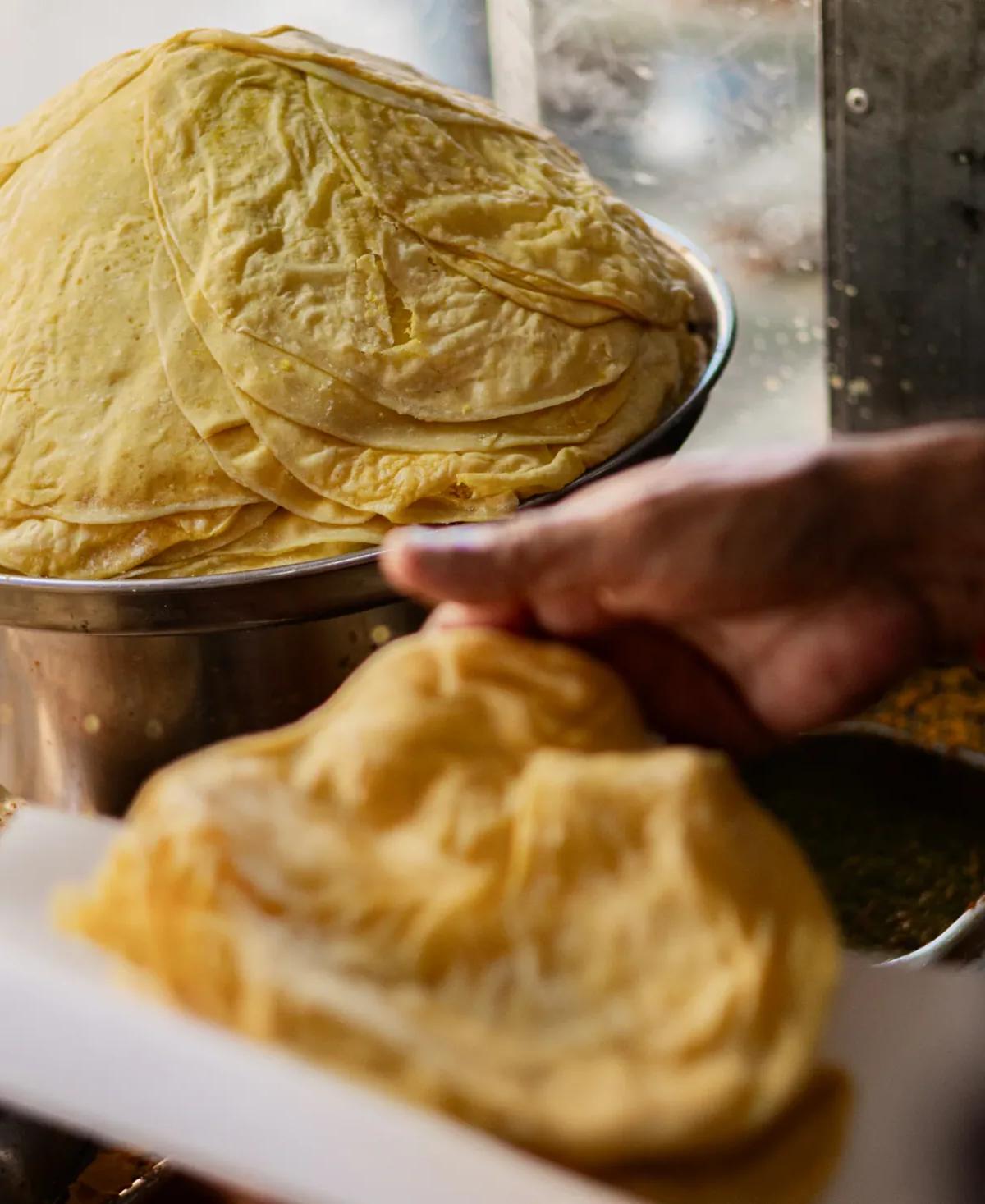
• Dholl puri. The tourism authority describes it as "a flatbread made from yellow split peas that are ground into flour, then stuffed with a mixture of cooked yellow split peas, chutney and pickles". The bread itself is plant-based. What varies is what goes on it, ladled from a line of pots that usually includes meat curries.
• Gato piment. Described officially as "crispy fritters... made with split peas, chillies and coriander". Three plant ingredients. They are deep-fried, and Mauritian snack counters typically fry them alongside fish cakes and meat samoussas.
• Achards. The government glosses these simply as "'achards' (pickles)". Vegetable pickle by that description, though no official source lists ingredients.
• Fruit. Jamalac, pineapple with chilli and salt, tamarind — genuinely uncomplicated street eating.
Ask first — these go either way
• Farata. No official Mauritian source states what farata is made of or cooked in. It is laminated with fat and finished on a griddle, and whether that fat is oil, ghee or butter varies by kitchen. This is the single most consequential unverified point in this guide. Ask.
• Samoussa. Made with both vegetable and meat or fish fillings, sold from the same counters. No official source describes filling or frying practice. Ask what is inside and what else is in the oil.
• Mine frite, riz frit and other Sino-Mauritian dishes. The government says only that "fried noodles or rice, chop suey, spring rolls are eaten by everyone" — no ingredients. Oyster sauce, fish sauce, shrimp, lard and meat stock are ordinary in Chinese cooking across the region, and no Mauritian source addresses any of them. Ask specifically about oyster and fish sauce rather than asking whether a dish is vegetarian.
• Boulettes. The tourism authority's own description lists fillings "including shrimp, lamb, squash, chicken, fish, tofu, fish and calamari" — vegetable and meat versions come from one steamed range. Shared baskets and shared broth are the obvious question.
• Chutney. No official source describes Mauritian chutney composition. Some regional chutney styles use dried fish or shrimp. We could neither confirm nor exclude this, so ask.
• Vindaye. The tourism authority says it is "typically made with fish" and that a vegetable version exists. The vegetable version is the variant, not the default.
Not vegetarian, or not vegan, by official description
• Briyani is a meat dish. The government describes it as "prepared by the Muslim community, with meat mixed with spiced rice and potatoes", and the tourism authority's dedicated biryani article never mentions a vegetarian version. Where a vegetable biryani is offered it is a separate preparation — worth confirming it is not simply the same pot served without the chicken.
• Bol renversé is described officially as rice, vegetables, meat or seafood "and a fried egg on top". The egg is definitional.
• Alouda is a milk drink — the tourism authority's own word is "creamy". Vegetarian, not vegan. Some jelly component uses agar or gelatine, which matters to some vegetarians.
• Napolitaine is described officially as "two melt-in-your-mouth shortbread slices" with jam and icing. Shortbread means butter: vegetarian by description, not vegan by description.
• Poudine maïs is made with cornmeal and milk. Same story.
One word this guide deliberately does not use about any Mauritian street food is "vegan". Preparation varies vendor by vendor, nothing is documented, and a wrong call costs a reader more than a vague one.
Vegetarian and Plant-Based Restaurants: A Short, Verified List
This is deliberately short. It is not a ranking, and it is not a competitor to our restaurant guides, which own the venue lists. These are the places that clear a simple test: the business itself has a current presence, has traded within the last year, and states its own dietary position in its own words.
Before the list, two warnings that will save you a wasted journey. Mauritian restaurant directories tag dietary categories unreliably. One major directory's vegetarian listing includes a KFC branch, a seafood restaurant and a chicken restaurant. One ordering platform's "Veg Only" badge appears on a restaurant whose own menu includes chicken tikka, fish tikka, mutton seekh and prawn dishes. Do not trust a dietary tag on a listing site. Trust what the restaurant says about itself.
Asian Box, Quatre Bornes
The only business in this research making an unambiguous self-published claim. Its own description: "Chinese Food, without meat! The First Vegetarian Chinese Cuisine. You'll get all the great Chinese classics, like boulettes, mine bouillie, teokon farcie, hakien etc 100% veg!" That answers the hardest question in Mauritian vegetarian eating — Sino-Mauritian food without the sauce problem. It publishes no opening hours, and says nothing about vegan, Jain or onion and garlic. Listing
Shlomo, Grand Baie
Describes itself as "Mauritius' first fully plant-based coffee shop in Grand Baie, serving delicious 100% vegan food, specialty coffee, and wholesome plant-based treats". Published hours are Wednesday to Sunday, 11:30 to 15:00, closed Monday and Tuesday — so it is a lunch and coffee stop, not dinner. Listing
Pure Veg Cafe, Ebène
Describes itself as a "place where you can enjoy Indian, Continental, Italian and Chinese Veg dishes", with a live orderable menu. Worth one caution: its menu includes items named Veg Mutton Masala, Veg Chicken Masala and Veg Fish Masala, which read as mock-meat dishes but are nowhere explained by the restaurant. It publishes no hours and makes no vegan or Jain claim. Listing
Jain's Little India Sweets and Snacks, Tribeca
An Indian sweets, chaat, dosa and thali counter with an entirely vegetarian menu. "Jain's" here is a family or brand name — the business publishes no statement about Jain dietary rules. Do not assume no onion and no garlic. Listing
And one to describe accurately
Happy Rajah, with branches at Grand Baie, Tamarin and Phoenix, is frequently recommended to vegetarians and appears in our north restaurants guide. It is an Indian restaurant with vegetarian options — not a vegetarian restaurant. It publishes nothing claiming vegetarian-only status, and nothing at all about Jain, vegan or no-onion-no-garlic food. Published hours at Grand Baie and Tamarin are 12:00 to 13:30 and 18:00 to 21:00 daily. Site
Elsewhere, the island's own restaurant network is thinner on this than you would expect: across our six regional guides only two venues carry a vegetarian note at all. Namaste in Port Louis is tagged vegetarian-friendly in our Port Louis guide, and Happy Rajah carries a vegetarian-options note. The west, east and south guides name none.
Hotels and All-Inclusive: A Decision Framework, Not a Ranking
This is where a vegetarian trip is actually won or lost, because most visitors eat most meals at their hotel. We checked what twelve Mauritian resort groups publish. The result is uneven, and the top of the market publishes the least.
What the groups actually publish
• Attitude Hotels publishes the most by a distance. Sunrise Attitude "has been certified as a vegan friendly hotel" holding "official VeganWelcome certification", with "delicious vegan options in every restaurant", a buffet promising "Vegan alternatives. At. Every. Station." and a breakfast including "vegan eggs, Beyond Meat sausages, vegan crepes, fresh fruits". Attitude
• The Lux Collective publishes a named, menu-labelled scheme: "Go vegan with our Keen on Green concept, found in all restaurants", with dishes "labelled in green". That is a concrete thing you can look for on a menu rather than a promise to accommodate. LUX*
• Beachcomber publishes per-resort dietary FAQs, the most granular of any group. At Trou aux Biches: "All venues... cater to special diets... offer vegetarian options and can adapt dishes upon request. Gluten-free, lactose-free, and halal options are also available with prior notice." Note the axis is gluten-free, lactose-free, vegetarian and halal — vegan is never mentioned in any Beachcomber dietary FAQ we found. Beachcomber
• SALT of Palmar answers the question directly: "Can I find vegetarian and vegan options?" — "Absolutely. The menu includes a variety of plant-based dishes alongside fresh seafood and other seasonal favourites." SALT
• Sunlife publishes one line, for Long Beach: "our Long Beach restaurants have plant base menus and halal, vegetarian, and vegan options are also available." Sunlife
• Heritage Resorts publishes a vegetarian feature naming dishes at Zafarani, its Indian restaurant, with "the menu with countless vegetarian options" and accompaniments including "crispy fried papadums, naan flatbread, yellow split pea dholl, crudités and achards". Heritage
• Constance, One&Only Le Saint Géran and Shangri-La Le Touessrok publish nothing we could find on vegetarian, vegan or allergen provision. Tamassa publishes nothing either, despite its reputation. That absence is not proof they cannot cook for you — it is proof you must ask in writing.
Two findings that should change how you book
First: the resort sector's idea of vegetarian is overwhelmingly lacto-vegetarian. Every named dish in Heritage's own vegetarian feature contains dairy — paneer, feta, goat cheese, mozzarella. A vegan reading that page would find nothing to eat on it. If you are vegan, a hotel saying "we cater for vegetarians" has not answered your question.
Second: no Mauritian hotel or resort group publishes anything about Jain or no-onion-no-garlic meals. We searched all twelve specifically. The only Mauritian first-party provision found anywhere is Air Mauritius's inflight VJML. If this is your requirement, it must be arranged individually and confirmed in writing, well before arrival, and you should quote the Air Mauritius exclusion list so there is no ambiguity about what you mean.
Note too that no Mauritian hotel group publishes a dietary notice period in days. Every one uses an unquantified formula — "prior notice", "on request", "in advance". Set your own deadline and get an answer.
What to ask before you book
• Ask for current menu examples, not the phrase "we can accommodate". A named dish is a commitment; a reassurance is not.
• Ask whether buffet vegetarian dishes are labelled, and whether Indian vegetarian food is available every day or only on request.
• Ask whether each specialty restaurant has at least one substantial vegetarian main, and whether all-inclusive supplements apply to it.
• Ask whether room service and children's menus include vegetarian meals — this is where families get caught.
• If Jain or vegan, ask what the kitchen can realistically guarantee about shared fryers, shared woks and ghee, and get the answer by email.
• Ask how much notice they need, then add a week.
Meal-plan logic
• All-inclusive works if the resort genuinely varies its vegetarian food daily. It fails badly if it does not, because you have prepaid your way out of alternatives. Our all-inclusive guide covers what plans include.
• Half board is better if you want markets, street food and independent restaurants at lunch.
• Where you stay changes the stakes. Grand Baie and Flic en Flac make eating out easy. Le Morne, Bel Ombre and remote east-coast estates are self-contained, so hotel vegetarian quality matters far more.
• If wellness dining matters, our wellness resorts guide covers the properties with plant-forward menus, including LUX* Le Morne's green-labelled dishes.
Markets and Self-Catering: The Reliable Fallback
On a driving day, or on a public holiday, or when a restaurant turns out to be closed, the market is the answer — and Mauritian market hours are better published than restaurant hours.
The City Council of Port Louis publishes Central Market hours as Mondays to Saturdays 05:00 to 18:00 in summer and 05:30 to 18:00 in winter, and Sundays and public holidays 05:00 to 12:00 in summer, 05:30 to 12:00 in winter. That last line is genuinely useful: on a public holiday the market does not close, it closes at midday. City Council of Port Louis · Port Louis Market
The tourism authority describes the market's stalls as "piled high with juicy tropical fruits and vegetables", with "street food kiosks for snacks such as samosas and dholl puri". Central Flacq, described officially as "the largest outdoor market in Mauritius", is best on "Wednesdays and Sundays", when "all the stalls are open". Our markets guide covers the rest. Port Louis Market · Central Flacq
• Supermarkets are the backup for bread, fruit, dairy or plant milks, nuts and snacks on road-trip days.
• One caution on labels. The Mauritius Food Standards Agency publishes a mandate to develop standards for "special dietary uses", but we found no Mauritian standard actually in force defining a vegetarian or vegan label claim. A "veg" marking on a Mauritian pack does not carry the legal weight it would in the EU or India.
• Carry cash for markets and small vendors.
• A table d'hôte is a strong option for vegetarians, because it is a regulated category where the host cooks to a booked number and can be briefed a day ahead. Ask when you book, not on arrival.
Eating Out on Activity Days
The meals most likely to go wrong are the ones booked as part of something else.
• Catamaran cruises and full-day tours. Request a vegetarian meal when you book, in writing, not on the morning. A boat lunch is usually a fixed barbecue with a single menu, and there is no second kitchen.
• Long driving days. Plan lunch around a town rather than a beach. Our 7-day itinerary and car rental page cover routes; the practical rule is that plateau towns and Port Louis have far more vegetarian choice than resort strips.
• Sunday and public holidays. Small family restaurants and pure-veg counters are the least predictable. Phone before driving inland for one specific meal.
• Budget. Our holiday cost guide has current food pricing — street food and market eating remain the cheapest good meals on the island.
Festivals: Real Cultural Context, Carefully Stated
Vegetarian food has a visible place in Mauritian life, but it is worth being precise about whose observance it is. Mauritius is religiously diverse, and no single diet belongs to all Hindus or all Mauritians — the Nutrition Survey figures at the top of this page make that plain.
• Thaipoosam Cavadee is the one festival where an official source describes vegetarian observance. The tourism authority says participating devotees "show their devotion by being vegetarian for 10 days". That is an observance of the devotees taking part, over the ten days before the festival, not an island-wide practice.
• Maha Shivaratree is described by official sources as a pilgrimage on foot to Grand Bassin with offerings at the shrines. No official Mauritian source we found describes fasting or vegetarian observance at Shivaratree, so this guide does not claim it. What is relevant practically is that large numbers of people are walking the roads.
• Divali is described officially as a time for "preparing traditional sweets". Composition is not published anywhere official, and Mauritian festival sweets commonly contain ghee and milk — ask rather than assume.
• Chinese Spring Festival is the one case where the government does describe food distribution: "Food is piled up to ensure abundance during the year and the traditional wax cake is distributed to relatives."
Two practical consequences. Festival dates move substantially year to year, so check our public holidays guide and festivals page before planning around one. And if you are invited to share food, accept graciously or decline warmly — you are a guest at something that is not primarily a food event.
Before You Fly: A Copy-Ready Checklist
• Order your airline special meal at booking and at least 24 hours before departure — AVML for Indian-style vegetarian, VGML for vegan, VJML for Jain.
• Email the hotel your exact requirement and ask for named dishes in reply. Keep the reply.
• Save two or three vegetarian options near each base before you fly, with phone numbers.
• Request vegetarian meals on catamarans and day tours at the time of booking.
• Learn the sentence that works: "Je ne mange ni viande ni poisson." Add "sans œuf", "sans produits laitiers" or "sans oignon ni ail".
• Ask about oyster and fish sauce before ordering any Chinese-Mauritian dish.
• Ask what the farata is cooked in if ghee or butter matters to you.
• Ask about shared fryers if cross-contact matters.
• Carry cash for markets and street vendors.
• Check opening hours before driving inland on a Sunday or public holiday.
• Use supermarkets and markets as the road-trip fallback.
Frequently Asked Questions
Is Mauritius vegetarian friendly?
Yes in practice, though not because most Mauritians are vegetarian — the government's 2022 nutrition survey found 94.1% of the population non-vegetarian. It works because pulses, vegetables, pickles, flatbreads and curries are everyday food. Vegetable curry, dal, dholl puri and gato piment are available almost everywhere.
Is it easy to find vegetarian food in Mauritius?
Easy to find vegetarian food, harder to find certainty about it. Ordinary restaurants and hotels will have vegetarian dishes. What is not published anywhere is preparation detail — cooking fats, shared fryers, sauces — so anyone with a strict requirement has to ask rather than assume.
What vegetarian Mauritian food should I try?
Start with vegetable curry and dal, then dholl puri with vegetable accompaniments, gato piment, achards and a farata. Rougaille is a tomato base and excellent with vegetables, though the menu item is usually named for the meat or fish cooked in it, so specify.
Is dholl puri vegetarian?
The bread is: the tourism authority describes it as a flatbread of ground yellow split peas stuffed with cooked split peas, chutney and pickles. What goes on top is the variable, ladled from a row of pots that usually includes meat curries. Ask which pots, and ask about the ladles.
Is gato piment vegetarian?
The recipe is, described officially as fritters made with split peas, chillies and coriander. The frying is the question. Mauritian snack counters commonly fry gato piment alongside fish cakes and meat samoussas, and no official source addresses shared oil, so ask if cross-contact matters to you.
Is Mauritian curry vegetarian?
Curry in Mauritius is made with meat, fish or vegetables, so no, not by default. Vegetable curries are completely standard and widely available. The word to use is the vegetable, not the word curry — ask for vegetable curry, potato and peas, or chickpea.
Is it easy to eat vegan in Mauritius?
Harder than vegetarian, and the gap is dairy. The resort sector's vegetarian offer is overwhelmingly lacto-vegetarian, and street food preparation fats are undocumented. It is workable with questions: LUX* labels vegan dishes green across its restaurants, Attitude's Sunrise holds a vegan certification, and Shlomo in Grand Baie is entirely plant-based.
Are there pure vegetarian restaurants in Mauritius?
A few, and fewer than directory sites suggest. Asian Box in Quatre Bornes publishes "Chinese Food, without meat... 100% veg", Shlomo in Grand Baie is "fully plant-based", and Pure Veg Cafe in Ebène serves vegetarian Indian, Continental, Italian and Chinese food. Several names in older roundups could not be confirmed as still trading.
Can I get Jain food in Mauritius?
Not off the shelf. No Mauritian hotel or resort group we checked publishes anything about Jain or no-onion-no-garlic meals, and no restaurant we verified makes a Jain claim. Air Mauritius does offer a Jain inflight meal. Arrange it individually, in writing, well in advance.
Can I get no onion no garlic food in Mauritius?
Only by arrangement. Onion and garlic are foundational in Mauritian cooking — rougaille's official ingredient list names both. Use Air Mauritius's Jain meal definition as your written standard: no onions, garlic, ginger, mushrooms, carrots or beetroot, and confirm the kitchen has understood it.
Do Mauritius resorts have vegetarian food?
Generally yes, but what they publish varies enormously. Beachcomber publishes per-resort dietary FAQs, LUX* labels vegan dishes on every menu, Attitude certifies one property as vegan-friendly. Constance, One&Only and Shangri-La publish nothing findable. Ask for named dishes rather than reassurance.
Is all-inclusive good for vegetarians in Mauritius?
It depends entirely on whether the resort varies its vegetarian food daily. When it does, all-inclusive removes the stress. When it does not, you have prepaid your way out of alternatives. Ask for a week's worth of vegetarian menu examples before committing, especially at remote properties.
What should vegetarians ask before ordering Chinese food in Mauritius?
Ask specifically about oyster sauce, fish sauce, shrimp and meat stock rather than asking whether a dish is vegetarian. No Mauritian source documents these, and the tourism authority's own description of boulettes lists tofu and squash fillings alongside shrimp, lamb and fish from the same steamed range.
Are catamaran lunches vegetarian friendly?
Only if you ask when booking. Boat lunches are typically a single fixed barbecue menu prepared ashore, with no alternative available once you have sailed. Request a vegetarian meal in writing at the time of booking and reconfirm the day before.
Where can I find vegetarian food in Grand Baie?
Shlomo is a fully plant-based coffee shop, open Wednesday to Sunday 11:30 to 15:00. Happy Rajah is an Indian restaurant with vegetarian options, though not a vegetarian restaurant. Beyond those, Grand Baie's general restaurants almost all carry vegetable curries and noodle dishes.
Where can I find vegetarian food in Flic en Flac?
What works is the strip's Indian and Chinese restaurants, where vegetable curries and noodle dishes are standard — with the sauce questions above. Our west restaurants guide covers the area.
Where can I find vegetarian food near Le Morne?
Le Morne is a self-contained resort area with few independent options, so your hotel matters more here than almost anywhere on the island. LUX* Le Morne labels vegan dishes across its restaurants. Otherwise look inland to Chamarel village, or plan lunch around a driving day.
Are markets open on public holidays in Mauritius?
Port Louis Central Market is, on reduced hours. The City Council publishes Sundays and public holidays as 05:00 to 12:00 in summer and 05:30 to 12:00 in winter. So a holiday does not close the market — it closes it at midday. Go early.
Explore this topic
Get new Mauritius guides by email
Join the Mauritius Explored list for trip ideas, practical updates and downloadable planning help.

Written by the Mauritius Explored editorial team, a Mauritian travel guide focused on beaches, activities, local places, and practical island planning.
Local Mauritius travel research, itinerary planning, and destination coverage since 2011.