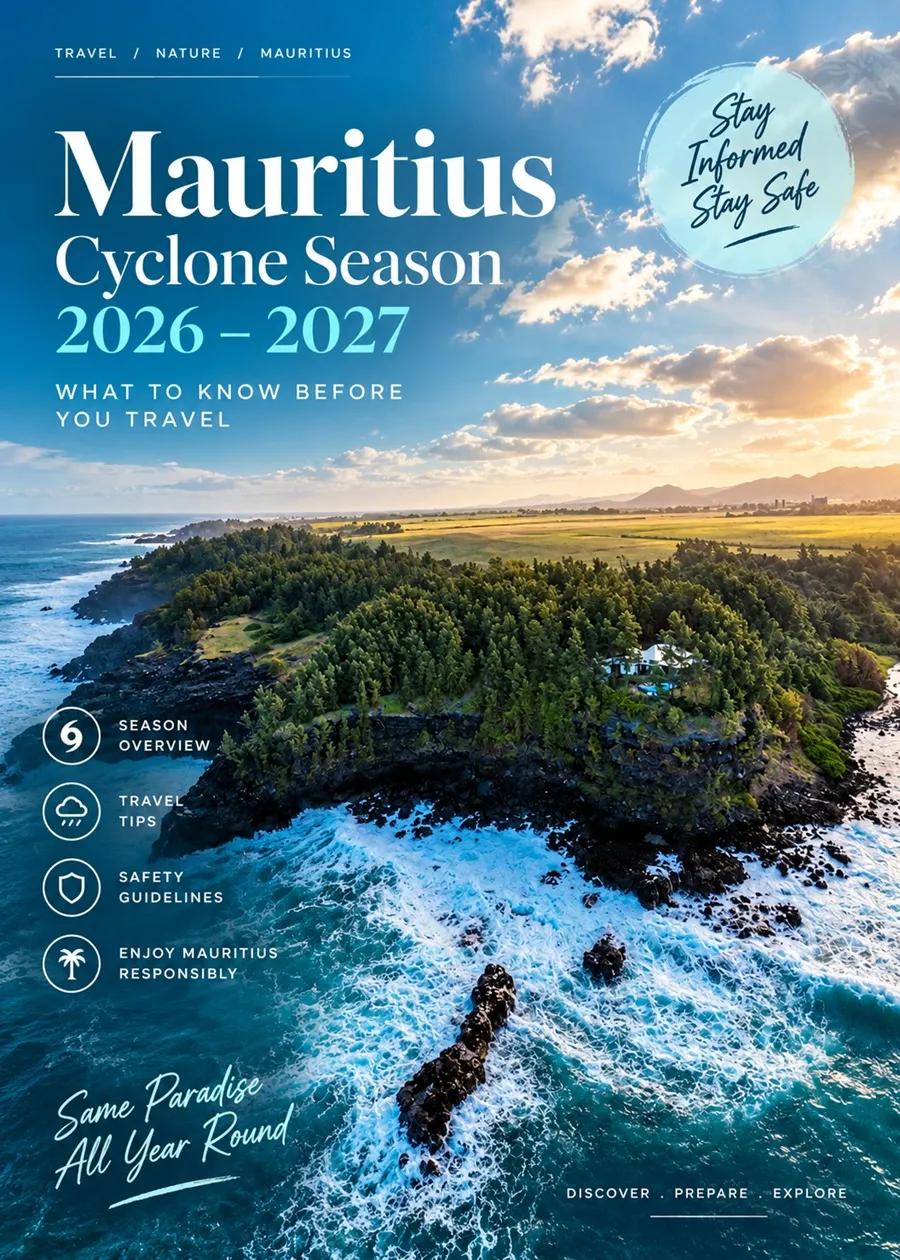
Mauritius Cyclone Season 2026/27: Dates, Weather & Safety Travel Advice
Mauritius Cyclone Season 2026/27: Dates, March, April & Travel Safety
If you are booking a Mauritius holiday between November and May, you will run into the phrase "cyclone season" and wonder what it means for your trip. This guide gives the official dates, explains why March and April still count, sets out the four warning classes in the exact words the Mauritius Meteorological Services uses, and covers what to do if a warning is issued while you are here. Every date and definition comes from an official source.
When is cyclone season in Mauritius?
The South-West Indian Ocean cyclone season runs from 15 November to 30 April, extended to 15 May for Mauritius and the Seychelles. That means March, April and the first half of May all fall inside the official season. Being "in season" does not mean a cyclone will affect your holiday — it defines the period when tropical systems are climatologically most likely, not a continuous warning.
Current Mauritius cyclone status
Last verified: Sunday 13 September 2026.
● At the time of verification, the Mauritius Meteorological Services Current Storm/Cyclone page listed no active tropical system for Mauritius, and no cyclone warning class was in force.
● A heavy swell warning was shown as active for Mauritius, Rodrigues, St Brandon and Agalega. That is a separate warning type, not a cyclone warning.
● This status can change at any time. Always check the live source before acting on it: Mauritius Meteorological Services — Current Storm/Cyclone and the Cyclone Warning Bulletin for Mauritius.
Mauritius cyclone season: quick facts
● Official season start (basin): 15 November, under the World Meteorological Organization regional framework for the South-West Indian Ocean
● Official season end (Mauritius): 15 May — later than the 30 April basin end date, an extension that applies to Mauritius and the Seychelles only
● Cyclone year for counting and naming: 1 July to 30 June, so any system forming in that window belongs to the 2026/27 season
● Months inside the season: November (from the 15th) through to 15 May — so December, January, February, March and April all fall fully within it
● Historically most active window: January to March
● Official warning authority: Mauritius Meteorological Services (MMS), based at Vacoas
● Warning classes: Class I, Class II, Class III, Class IV, plus a Safety Bulletin and a Termination
● The trigger threshold for all four classes: gusts of 120 km/h
● Naming responsibility: MMS names systems reaching moderate tropical storm strength between 55°E and 90°E; Madagascar names those to the west
● Live updates: Live weather Map and Forecast
When is cyclone season in Mauritius?
The season is a defined watch period, not a weather forecast. Under the World Meteorological Organization's regional framework, the South-West Indian Ocean season opens on 15 November and closes on 30 April, with one exception: for Mauritius and the Seychelles it runs through to 15 May.
Three points cause most of the confusion.
The season and the cyclone year are different things. For counting and naming, the cyclone year runs 1 July to 30 June. Any system forming between 1 July 2026 and 30 June 2027 belongs to the 2026/27 season, even if it forms outside the watch window. That is why the 2026/27 name list is already in force — MMS published it on 3 August 2026, and the first name on it is AGUEDA.
You will also see 1 November quoted as the start. Several Mauritian and travel sources give the season as 1 November to 15 May; the MMS warning-system page itself publishes no start date. Practically it makes little difference: treat November through mid-May as the period when tropical systems are climatologically possible.
Systems form outside the window. The first system of the 2025/26 season formed on 16 July 2025, four months before the official start; the 2024/25 season's first formed on 15 August 2024. The dates define the official watch, not the atmosphere. Off-season systems are monitored and named identically.
When does Mauritius cyclone season officially end?
For Mauritius, the official cyclone season ends on 15 May. This is two weeks later than the rest of the South-West Indian Ocean basin, where the season closes on 30 April. Mauritius and the Seychelles are the only two territories with the extended end date. The 15 May date marks the close of the official watch period, not a point after which cyclone risk becomes zero.
The end date is an administrative boundary agreed at regional level. In practice mid-May in Mauritius is already well into the turn toward the dry winter — MMS treats May as a transition month between the warm humid summer and the cooler dry season.
What the date does not do is switch off the atmosphere on 16 May. Any system forming later would still be monitored, named and warned on by the same authorities using the same classes. For a traveller, risk tapers through April and into May rather than stopping abruptly, and late May onward begins the most settled stretch of the Mauritian year.
Is March cyclone season in Mauritius?
Yes. March falls fully within the official cyclone season, which runs to 15 May for Mauritius. March also sits inside the historically most active window for the South-West Indian Ocean basin, which runs from January to March. That does not mean a cyclone will affect a March trip — it means March is a month where checking official forecasts close to travel is genuinely worth doing.
Climatologically, March is one of the two wettest months of the Mauritian year alongside February, and it sits late in the summer that MMS defines as November to April.
Separate two things. Heavy March rainfall is common and mostly unconnected to cyclones — it is simply what late summer does here, and MMS runs a distinct torrential rain warning system for it. Actual cyclone risk for your dates depends on whether a system develops at that time, which nobody can know months ahead.
Travelling in March: book with some flexibility, take insurance covering weather disruption, and check the official bulletin in the days before you fly.
Is April cyclone season in Mauritius?
Yes. April falls within the official cyclone season for Mauritius, which runs to 15 May. April sits after the historically most active January-to-March window, and it is also the month when the Mauritian summer begins giving way to the drier season. Being in season does not make April unsafe, and being late in the season does not make it risk-free.
Two things are true at once in April. The official season is still open and systems have occurred in April in past seasons. At the same time the pattern is clearly turning: MMS defines summer as November to April, with May a transition month, and rainfall generally declines from the February-March peak.
Practically, April often delivers genuinely good travel weather while remaining inside the watch period. Avoid both easy mistakes — do not treat April as "cyclone month" because it appears on a season list, and do not treat it as past the risk because the peak months have gone.
Month-by-month cyclone season: November to May
This is planning context based on the official season definition and long-term climatology. It is not a probability forecast, and no month here carries a predicted chance of a cyclone.
November — In season: yes, from 15 November. Context: the start of the season and of the Mauritian summer; historically quieter than the January-to-March peak. Do: check the MMS seasonal outlook when published, then the forecast closer to travel.
December — In season: yes. Context: summer and the festive travel peak, when flexibility on dates is scarce and worth paying for. Do: monitor official weather information and keep excursions loosely scheduled rather than locked to one day.
January — In season: yes. Context: warm, humid, and inside the historically most active window for the basin. Do: follow MMS bulletins rather than social media if a system develops, and build one flexible day into the itinerary.
February — In season: yes. Context: one of the two wettest months of the year and within the peak activity window. Do: check the live forecast for your dates rather than inferring a personal risk figure from historical frequency.
March — In season: yes. Context: late summer, wettest alongside February, still inside the most active historical window. Do: treat heavy rain and cyclone risk as separate questions, and watch torrential rain warnings too.
April — In season: yes. Context: the end of the MMS summer definition, with rainfall easing from the February-March peak. Do: check forecasts normally and do not assume the season is effectively over.
May — In season: yes, to 15 May; closed for Mauritius after that. Context: a transition month moving toward the cooler dry winter. Do: treat 15 May as an administrative end date, not a risk cut-off.
What does cyclone season actually mean for tourists?
The phrase does a lot of unnecessary damage to travel plans, mostly because it sounds like a forecast when it is a definition. Five things are worth getting straight.
● It is a defined watch period, not a continuous warning. It marks when tropical systems are climatologically possible. For most of the season, there is no system anywhere near Mauritius.
● A full holiday can pass during the season with no cyclone. That is the normal outcome, not the lucky one.
● Actual risk for your dates depends on systems developing at that time. Nobody, including MMS, can tell you in September what will happen in February. Historical seasonality is not a probability for your fortnight.
● Close to travel, the live bulletin beats the season label. A week out, the official forecast tells you something real; the phrase "cyclone season" tells you almost nothing.
● Rain and wind do not equal a cyclone. Mauritian summers produce heavy downpours and breezy days routinely. MMS runs separate warning systems for torrential rain, heavy swell and storm surge precisely because these occur independently of cyclones.
Mauritius cyclone warning classes explained
Mauritius uses a four-class cyclone warning system operated by the Mauritius Meteorological Services. Every class is defined around the same threshold: gusts of 120 kilometres per hour. What changes between classes is the expected timing of those gusts. The definitions below are the official wording published by MMS.
Class I
● Official definition: issued not less than 36 hours, nor more than 48 hours, before the occurrence of gusts of 120 km/h
● What it means for you: the early heads-up, roughly a day and a half to two days out. Check with your hotel and review excursions booked for the next few days
Class II
● Official definition: issued so as to allow, as far as practicable, 12 hours of daylight before the occurrence of gusts of 120 km/h
● What it means for you: conditions are expected to deteriorate. Expect boat trips suspended and services reduced. Follow your accommodation's instructions and charge your devices
Class III
● Official definition: issued so as to allow, as far as practicable, 6 hours of daylight before the occurrence of gusts of 120 km/h
● What it means for you: serious. Follow official restrictions, stay off beaches, coastal roads and exposed areas, and do not travel around the island
Class IV
● Official definition: issued when gusts of 120 km/h are recorded in some places and are expected to continue
● What it means for you: severe cyclonic conditions are occurring. Stay sheltered as instructed. Do not go outside to look at the weather
Safety Bulletin
● Official definition: issued to lift a class III or class IV warning, and to inform the public of severe weather conditions associated with the cyclone and other environmental risk, depending on the nature and extent of damage during its passage
● What it means for you: winds have eased enough to lift the higher class, but hazards remain. Fallen power lines, flooding, debris and unstable trees do not disappear when the wind drops
Termination
● Official definition: issued following a class I, class II or safety bulletin, after consultation with and advice from the National Crisis Committee to the effect that outdoor risks have considerably decreased
● What it means for you: the official all-clear — a deliberate decision taken with the National Crisis Committee, not an automatic expiry
One detail worth understanding: the classes are built around warning time, not storm strength. A Class I does not mean a weak cyclone — it means damaging gusts are expected in roughly 36 to 48 hours. The system is designed to give people usable daylight hours to prepare.
Read the full official definitions at MMS — Warning System.
Is it safe to visit Mauritius during cyclone season?
Many travellers visit Mauritius during the official cyclone season every year, and the great majority experience no cyclone warning at all during their stay. Conditions vary from year to year and from trip to trip, so a specific fortnight cannot be labelled safe or unsafe in advance. The useful information is the forecast and any warning in force close to your travel dates, not the season label.
A few things make the difference between a disrupted trip and a manageable one.
● Flexibility is worth more than avoidance. Bookings with reasonable change terms, and an itinerary not hanging on one excursion on one day, absorb most weather disruption.
● Mauritius is well set up for this. MMS runs a long-established system with defined lead times, hotels have property-level procedures, and warnings are broadcast on radio, television and the MMS website.
● The disruption is usually weather, not danger. For most visitors, the realistic effect of a nearby system is rain, wind, rough sea and cancelled boat trips.
● Where you stay affects ordinary weather. The north and west are generally more sheltered from the prevailing south-easterly trades than the exposed east and south — which shapes everyday comfort more than cyclone exposure.
● Do not treat a whole month as a verdict. February is not "dangerous" and April is not "safe." Both are in season, both are usually fine, both deserve a forecast check.
What should tourists do if a cyclone warning is issued?
Follow official instructions first and everything else second. This section is orientation, not an emergency manual — MMS publishes the full current precautions, and those take precedence over anything written here.
● Follow MMS bulletins and any government instructions. These are the authoritative source, broadcast on radio and television and published in English, French and Creole
● Follow your hotel, villa host or tour operator, who will know what the specific building and location require
● Stay away from beaches, lagoons, exposed coastlines, flooded roads and storm-surge areas when authorities advise against travel. Sea conditions deteriorate before and after the worst of the wind
● Do not continue boat trips or water activities once they are suspended. An operator cancelling is the correct call, not an inconvenience to argue with
● Keep phones charged and essentials accessible — medication, identification, documents and some cash
● Check directly with your airline and the airport if your flight falls near the warning period
● Do not leave shelter during a lull. It can be the centre of the system passing overhead. Wait for the official safety bulletin or termination
Full official guidance: MMS — Cyclone Precautions.
What happens to flights, hotels and boat trips?
These are possible effects, not guaranteed ones. What actually happens depends on the specific system and on decisions taken by individual airlines, the airport, hotels and operators.
● Flights may be delayed, diverted or cancelled depending on the system and on airline and airport decisions. Check with your operating airline for confirmed changes rather than assuming
● Boat, catamaran, diving and snorkelling excursions are usually first to be postponed, because sea conditions deteriorate well before conditions on land — this can happen while a system is still distant
● Hotels may adjust programmes, close outdoor facilities, move dining indoors or ask guests to stay inside and follow property procedures. Policies differ by property
● Road access can be affected by heavy rain, flooding, fallen trees or official restrictions
● Confirm everything with the provider. Your airline, hotel and operator are the only sources for their own decisions
Travel insurance and weather disruption
Insurance is the single most useful preparation for travel during the official season, and also the thing most travellers assume rather than check.
● Read the wording on weather disruption, cancellation, curtailment, missed connections and natural disasters before you buy
● Check when cover starts. Cover for a named event typically closes once that event is announced, so buying after a system is named is usually too late
● Check what triggers a claim. Some policies respond to official advice or airline cancellation rather than to weather alone
● Keep documentation. Written confirmation from airlines, hotels and operators is what a claim rests on
We are not insurance advisers and cannot tell you whether a particular policy covers cyclone disruption. Read the wording and ask the insurer directly.
Cyclone season vs the best time to visit Mauritius
The cyclone season overlaps almost exactly with the Mauritian summer, which is why this question comes up at all. The trade-off is real but smaller than most people expect.
● Summer, November to April: warmest sea, longest days, festive season and a green interior — against higher humidity, more rain and the official cyclone season
● Winter, June to September: dry comfortable days, firm ground for hiking and far less rain, outside the official season — against cooler water and stronger trade winds
● May and October: officially transition months, and often the best all-round compromise. October is the driest month of the Mauritian year
● The honest summary: the mean temperature gap between summer and winter is only about 4°C. You are choosing between different kinds of good weather
For the full month-by-month comparison, see our best time to visit Mauritius guide and our Mauritius weather by month pages.
Where to check the current Mauritius cyclone status
Use official sources directly. Social media reposts and screenshots circulate faster than corrections do.
● MMS — Current Storm/Cyclone — whether a system is being tracked
● MMS — Cyclone Warning Bulletin — the live bulletin, also in French and Creole
● MMS — Warning System — the official class definitions
● MMS — Precautions — official safety guidance
● Local radio and television, which carry bulletins as issued
● Your hotel or villa host, applying the same official information to your location
The 2026/27 cyclone season name list
MMS published the 2026/27 name list on 3 August 2026. Systems are named in order as each reaches moderate tropical storm strength, so the season's first named system will be Agueda.
● Agueda, Bertrand, Celiwe, Dira, Emmie, Fikri, Gumbo, Hisna, Isaura, Jeremy, Kanga, Ludzi, Melina
● Noah, Onias, Pitsana, Quamar, Rita, Solani, Tarik, Urilia, Vuyane, Wafula, Xusa, Yarona, Zacarias
Names are contributed by countries across the region; Hisna and Tarik came from Mauritius. Pitsana replaced Peta on 29 June 2026 after agreement by the RA I Tropical Cyclone Committee, because Peta was already in use in another basin. Note that a system is only named once it reaches moderate tropical storm strength — an unnamed tropical depression can still bring serious rainfall, because intensity describes wind, not rain.
Frequently asked questions
When is cyclone season in Mauritius?
The South-West Indian Ocean cyclone season runs from 15 November to 30 April, extended to 15 May for Mauritius and the Seychelles. For counting and naming purposes the cyclone year runs 1 July to 30 June. Being within the season does not mean a cyclone will occur during a given trip.
When does cyclone season start in Mauritius?
The official basin season opens on 15 November under the World Meteorological Organization regional framework. Some Mauritian and travel sources cite 1 November instead. Either way, November marks the start of the period when tropical systems become climatologically more likely, coinciding with the beginning of the Mauritian summer.
When does Mauritius cyclone season officially end?
It ends on 15 May. That is two weeks later than the rest of the South-West Indian Ocean basin, where the season closes on 30 April — Mauritius and the Seychelles are the only territories with the extended date. The 15 May date closes the official watch period rather than eliminating risk overnight.
Is March cyclone season in Mauritius?
Yes. March falls fully within the official season and also sits inside the historically most active January-to-March window for the basin. March is climatologically one of the two wettest months in Mauritius alongside February. Most March trips are unaffected by cyclones, but it is a month worth checking forecasts for closely.
Is April cyclone season in Mauritius?
Yes. April is within the official season, which runs to 15 May. It falls after the historically most active window and marks the end of the Mauritian summer as defined by the Meteorological Services, with rainfall generally easing from the February-March peak. April often delivers good travel weather while still being in season.
Is May cyclone season in Mauritius?
The first half of May is. The official season ends on 15 May for Mauritius, so 1 to 15 May falls inside it and 16 May onward does not. May is also a transition month in Meteorological Services terms, moving from the warm humid summer toward the cooler dry winter.
Is December cyclone season in Mauritius?
Yes. December falls within the official season and coincides with peak festive travel demand. Historically it is quieter than the January-to-March window, though systems have occurred. Book with flexible terms where you can, since festive dates leave little room to rearrange.
Is January cyclone season in Mauritius?
Yes. January is within the official season and inside the historically most active window for the basin, which runs January to March. It is also one of the warmest and most humid months. Check official bulletins close to travel and keep at least one flexible day in the itinerary.
Is February cyclone season in Mauritius?
Yes. February is within the official season and within the historically most active window. It is also one of the two wettest months in Mauritius by long-term climatology. Heavy rain in February is common and usually unrelated to cyclones — the Meteorological Services issues separate torrential rain warnings.
Is it safe to visit Mauritius during cyclone season?
Many travellers visit during the official season each year, and most experience no cyclone warning during their stay. Conditions vary year to year, so no month can be labelled safe or unsafe in advance. Flexible bookings, appropriate travel insurance and checking official forecasts close to travel are the practical steps that matter.
How often do cyclones hit Mauritius?
Direct impacts are not an annual event, though systems pass within range of the island more often than they make direct hits. The Meteorological Services records cyclone Carol in 1960 as the most devastating on record. Frequency varies considerably between seasons and cannot be converted into a probability for a specific trip.
Which month has the most cyclones in Mauritius?
Historically, activity in the South-West Indian Ocean concentrates between January and March. That reflects long-term basin climatology rather than a prediction for any single season. Individual seasons vary widely, including seasons where the first system formed months before the official start date.
What are Mauritius cyclone warning Classes I, II, III and IV?
All four are defined around gusts of 120 km/h. Class I is issued 36 to 48 hours before such gusts. Class II allows as far as practicable 12 hours of daylight beforehand, Class III six hours of daylight, and Class IV is issued when 120 km/h gusts are already being recorded and are expected to continue.
What should tourists do during a cyclone warning in Mauritius?
Follow Mauritius Meteorological Services bulletins and any government instructions, then follow your hotel or host's procedures. Stay away from beaches, exposed coastlines and flooded roads, keep phones charged and documents accessible, and do not leave shelter during a lull. Wait for the official safety bulletin or termination.
Can flights be cancelled because of a cyclone in Mauritius?
Yes, flights may be delayed, diverted or cancelled depending on the system and on airline and airport decisions. This is not automatic and varies by event. Check directly with your operating airline and the airport for confirmed changes rather than relying on general news or social media.
Do hotels close during cyclones in Mauritius?
Hotels do not typically close, but they may change programmes, shut outdoor facilities, move dining indoors and ask guests to stay inside and follow property procedures. Arrangements differ by property. Your hotel will receive the same official bulletins and apply them to its specific location and buildings.
Are boat trips cancelled during cyclone warnings?
Commonly, yes. Boat, catamaran, diving, snorkelling and speedboat excursions are usually suspended first, because sea conditions deteriorate well before conditions on land do. This can happen even when a system is still some distance from Mauritius. Treat operator cancellations as the correct safety decision.
Where can I check the current cyclone status in Mauritius?
Use the Mauritius Meteorological Services directly: the Current Storm/Cyclone page for systems being tracked, and the Cyclone Warning Bulletin for any warning in force, published in English, French and Creole. Local radio and television carry bulletins as issued, and your hotel will have the same information.
Can a cyclone happen outside the official season?
Yes. The season dates define the official watch period, not the limits of the atmosphere. The first system of the 2025/26 season formed on 16 July 2025, four months before the official start, and the 2024/25 season's first system formed on 15 August 2024. Off-season systems are monitored and named in the same way.
Should I avoid Mauritius from November to May?
No. That would mean avoiding the warmest sea, the longest days and the festive season on the basis of a watch period rather than a forecast. Many visitors travel during these months without disruption. The sensible approach is flexible bookings, suitable insurance and checking official forecasts close to your travel dates.
Explore this topic
Get new Mauritius guides by email
Join the Mauritius Explored list for trip ideas, practical updates and downloadable planning help.

Written by the Mauritius Explored editorial team, a Mauritian travel guide focused on beaches, activities, local places, and practical island planning.
Local Mauritius travel research, itinerary planning, and destination coverage since 2011.