Cyclone Near Mauritius? What Happens to Your Holiday
A Cyclone Is Forming Near Mauritius — What Happens to Your Holiday Next?
Last updated: 27 September 2026
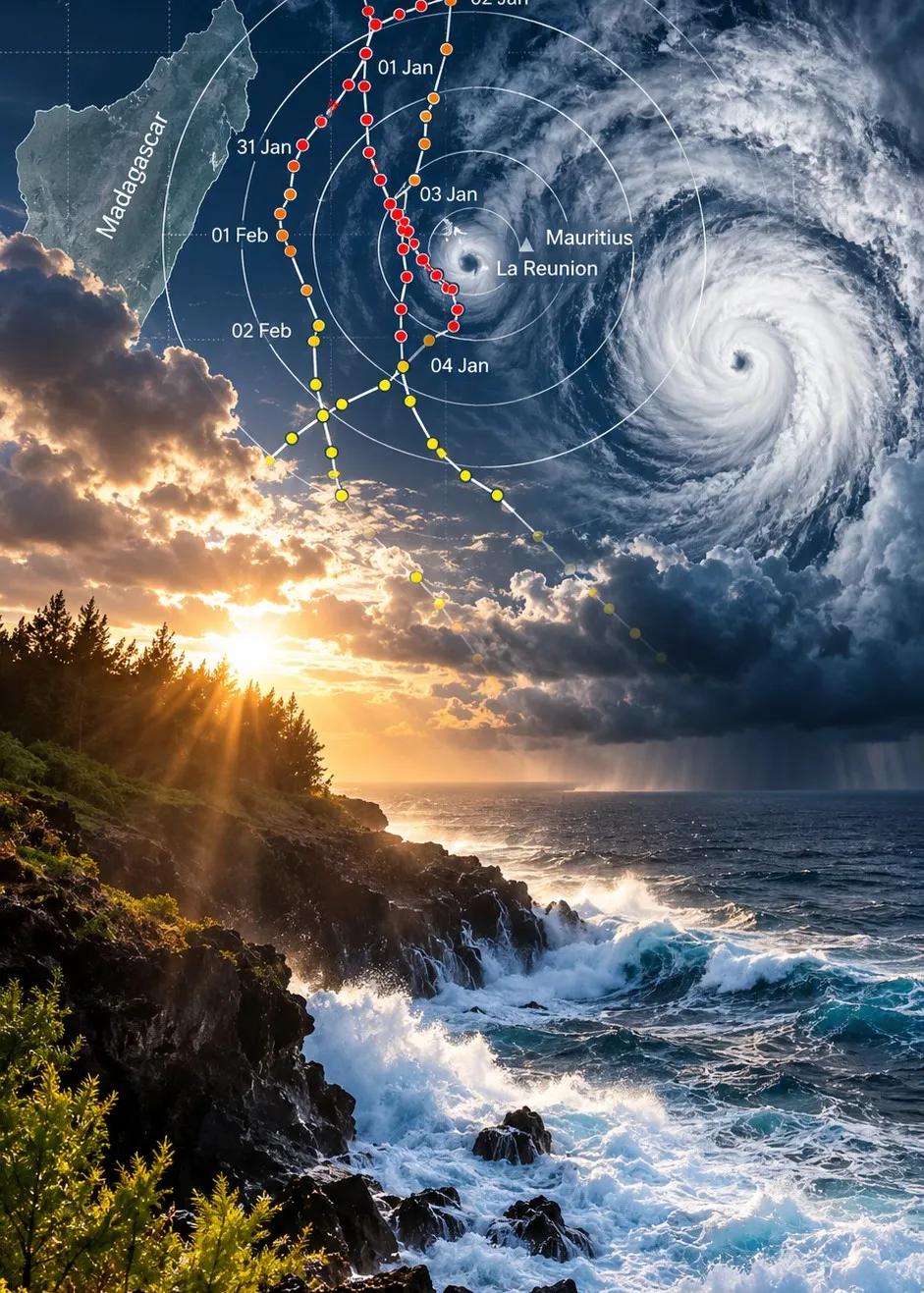
A storm appears on a weather map in the middle of the Indian Ocean, a news site gives it a name (Name list 2027), and someone posts a spaghetti of forecast tracks on social media. If you fly to Mauritius next week, the next few hours tend to go on refreshing maps and wondering whether to cancel.
Here is the useful way to think about it. A tropical system existing somewhere in the South-West Indian Ocean is not the same thing as Mauritius being under a cyclone warning, and almost everything that affects your holiday — flight, hotel, boat trip, hire car — is triggered by the official warning class rather than by the storm's existence. This guide explains what changes at each stage and who decides what.
It does not predict storm tracks. Nobody outside the official forecast centres should.
Always check the live weather forecast for Mauritius
Quick Answer: Does a Cyclone Near Mauritius Put Your Holiday in Danger?
Not automatically. Tropical systems form across a very large ocean basin and many never come near Mauritius, while tracks and intensity change constantly. What matters is whether the Mauritius Meteorological Services issues a cyclone warning class for the island, what your airline tells you, and what your hotel instructs. Wind, swell and rain can affect Mauritius without a direct hit, so watch official bulletins rather than social-media maps.
Does a Cyclone in the Indian Ocean Mean Mauritius Will Be Hit?
Usually not. The South-West Indian Ocean is one of the world's most active cyclone basins, and Mauritius is a small island in a very large stretch of it. Several things have to line up before a storm becomes your problem.
• Systems form across the whole basin, often far to the north-east, and many track towards Madagascar or out to sea without approaching the island.
• Tracks change. Australia's government travel advice puts it plainly: "The direction and strength of cyclones can change with little warning."
• Intensity changes too, in both directions, sometimes quickly.
• Distance matters more than the headline. A severe system several hundred kilometres away may bring only swell and a windy afternoon.
• A direct hit is not required for disruption. Heavy rain, wind and dangerous swell can reach Mauritius while the centre stays offshore, and that alone stops boat trips.
The one thing worth resisting is the screenshot. Forecast-model images circulating without context are not warnings. The official position is published by the Mauritius Meteorological Services, and the UK government's general guidance on extreme weather makes the same point about uncertainty: "the course of a tropical cyclone cannot always be accurately predicated".
Mauritius Cyclone Season: When Is It?
The Meteorological Services' own technical note defines the season as "the period between 01 November and 15 May of the following year". SSR International Airport describes it as "from November to mid May", and the UK Foreign, Commonwealth and Development Office says it "usually runs from November to May". Australia's advice adds the caveat that "cyclones can occur throughout the year", so the season is an operational window rather than a guarantee either way.
A season means cyclones are possible. It does not mean one will affect your trip. For the climatology, the historical pattern and what the season means for choosing dates, see our Mauritius cyclone season guide, and for ordinary summer rain, which is a completely different subject, the rainy season guide.
How Mauritius' Cyclone Warning Classes Work
Mauritius uses four numbered warning classes, and all four are defined by one number: gusts of 120 kilometres per hour. The definitions below are the official ones.
• Class I: "Issued not less than 36 hours, nor more than 48 hours, before the occurrence of gusts of 120 kilometres per hour."
• Class II: "Issued so as to allow, as far as practicable, 12 hours of daylight before the occurrence of gusts of 120 kilometres per hour."
• Class III: "Issued so as to allow, as far as practicable, 6 hours of daylight before the occurrence of gusts of 120 kilometres per hour."
• Class IV: "Issued when gusts of 120 kilometres per hour are recorded in some places and are expected to continue."
Two things follow from those definitions. First, the classes are about warning time, not about how close the storm is: Class I is a day and a half of notice, not an emergency. Second, the sequence can move quickly, and it can also stop. Plenty of Class I warnings are issued and later terminated without a Class II. Source: Meteorological Services cyclone warning system.
What Class I Means for Your Holiday
Class I is the warning stage where normal life continues and you start paying attention.
• Hotels, restaurants, shops and most excursions typically operate as usual.
• Follow the official forecast bulletin and the Meteorological Services home page directly, rather than news aggregators.
• If you fly within the next couple of days, check the airline's app and make sure it has current contact details for you.
• Charge phones and power banks, and find your insurance policy number and emergency line before you need them. Official advice at this stage is simply to "Make sure your emergency kit is ready".
• Treat social-media forecasts as entertainment. A class is a class only when the Meteorological Services issues it.
What Class II Means
Class II means gusts of 120 km/h are expected within roughly 12 hours of daylight, and preparation becomes real.
• Weather-sensitive activities start to fall away, and operators may already have cancelled boat trips on their own assessment of wind and swell.
• Reconfirm anything booked for the next two days with the operator, and ask what their rebooking policy is.
• Ask your hotel how instructions will reach you, so you are not guessing later.
• Official advice includes checking your emergency kit is complete and storing a sufficient amount of drinking water.
• If you are due to fly, keep watching the airline: flights are sometimes brought forward at this stage rather than cancelled.
• Move your own plans inland and onto land. This is not the day for a lagoon excursion or an exposed hike.
What Class III Means
Class III is the stage at which the island visibly changes, and the point where a visitor's day is no longer their own to plan.
• The airport closes. SSR International Airport states that it "closes down within 3 hours of issue of a Cyclone Warning Class III", having been operational through Classes I and II.
• You cannot wait it out at the terminal. During Classes III and IV, "Passengers and members of the public are not allowed to stay at the Airport", and all airport business activities, including food, beverages and shops, close.
• Emergency shelters open. The National Disaster Risk Reduction and Management Centre states that "Emergency Shelters are normally opened as soon as cyclone class III warning is issued".
• Public transport stops soon after. In the NDRRMC's words, "Public transport will be available up to 3 hours after the issue of Cyclone III warning and will resume as far as practicable sooner after all warnings are waived depending on the road network and prevailing winds".
• Official instructions are to finish preparing and stay put: secure doors, windows and loose articles, avoid areas prone to storm surges and flooding, and avoid going outside.
• For a tourist, the practical rule is simple: be back at your accommodation before Class III is issued, not after.
Sources: SSR International Airport FAQ and NDRRMC cyclone page.
What Class IV Means
Class IV means gusts of 120 km/h are already being recorded somewhere on the island and are expected to continue. There is nothing to plan at this stage, only instructions to follow.
• Stay inside and shelter in the safest part of the building. Official advice includes disconnecting electrical appliances and following radio and television bulletins.
• Do not go outside to look at the storm. The Fire and Rescue Service's public guidance is blunt: "Pay attention to all warnings and don't go sightseeing."
• Do not trust a sudden calm. The NDRRMC warns: "Beware of the passage of the 'EYE'. Do not assume that cyclonic conditions are over. The calm period is always followed by violent winds from the opposite direction."
• Keep medication, documents, water and a charged phone within reach, and follow your hotel's instructions rather than your own judgement of the sky.
Will Mauritius Airport Close During a Cyclone?
Yes, but only at Class III, and the airport publishes its own procedure. What it says, in its own words:
• The airport "is operational during a Cyclone Warning Class I and II".
• It "closes down within 3 hours of issue of a Cyclone Warning Class III".
• Passengers and the public may not remain in the terminal during Classes III and IV, and shops and food outlets close.
• It "generally resumes operation within three hours of the issue of Termination of a Cyclone Warning Class III/IV subject to all Airport facilities being up and running".
• Passengers are "strongly advised to contact their airline" for current flight information before travelling to the airport.
One nuance worth knowing: the Meteorological Services issues warnings for the country, not for individual businesses, and the airport's closure and reopening follow the airport's own operational procedures. That is why you check the airline and the airport, not only the weather service. Source: SSR International Airport FAQ.
What Happens to Your Flight?
Several different things can happen, and which one you get depends on your airline rather than on the weather service.
• Brought forward. Airlines sometimes depart early to get aircraft out before closure.
• Delayed or rescheduled, often by a day or more.
• Cancelled, with rebooking onto later flights.
• Aircraft repositioned away from the island, which can reduce capacity afterwards.
• Queues once flights resume. Australia's advice notes that "flights may be delayed or suspended, and available flights may fill quickly".
What you are entitled to depends on the airline, the fare conditions, where the journey started, the cause of the disruption and your insurance, so any page promising cyclone compensation is guessing. Do the practical things: make sure the airline can reach you, save its app and phone number offline, and check flight status before travelling to the airport. UK government advice is to keep in touch with your operator and hotel and to monitor local radio, television and press.
What Happens at Your Hotel?
Hotels in Mauritius are experienced at this, and procedures vary by property, so the honest answer is that your hotel's instructions are the ones that matter. What is consistent is the behaviour expected of you.
• Follow hotel management instructions, including any move away from exposed rooms or outdoor areas.
• Ask early how information will reach you, and keep your phone and a power bank charged.
• Keep medication, documents and essentials somewhere you can reach them in the dark.
• Do not leave the property to watch the storm or photograph the sea.
• Fill water containers when advised, and expect pools, water sports and outdoor restaurants to close well before Class III.
What nobody can promise in advance is the commercial side: meals, generators, bottled water, refunds, free extra nights or transfers if your flight moves. Some hotels are generous, others apply their normal terms, and much depends on how badly the island is affected, so ask the property directly. The UK FCDO is explicit about movement: "During a cyclone you're not allowed to leave your accommodation."
What Happens to Boat Trips and Activities?
This is the part of a holiday that changes first, and it usually changes before any cyclone class is issued at all. Operators make their own decisions based on wind, swell, rainfall, visibility, lightning and marine warnings, and a responsible operator cancels early.
• Most likely to go first: catamaran cruises, speedboat trips, dolphin and whale excursions, Northern Islands trips, Île aux Cerfs crossings, diving, snorkelling and seaplane flights.
• Also affected: kitesurfing, which depends on manageable wind rather than maximum wind, and anything on an exposed lagoon.
• Land activities with their own risks: hiking, waterfall trails, Le Morne Brabant and the Seven Waterfalls, where rain makes ground unstable and lightning on a ridge is a serious hazard.
• Usually still possible early in the sequence: markets, museums, gardens, towns and indoor experiences, until official instructions say otherwise.
There is no universal cancellation threshold, so ask each operator two questions when you book in summer: what conditions cause you to cancel, and what happens to my money if you do.
Can You Drive During a Cyclone Warning?
Once Class III is issued, the answer is no in practice, and there is a further complication most visitors do not think about. The UK FCDO states that "During a cyclone you're not allowed to leave your accommodation, and car insurance policies often become invalid."
• Check your rental agreement and the insurer's wording before summer, not during a warning.
• Flooding, fallen trees, debris, damaged road surfaces and downed power lines can remain dangerous long after peak winds pass.
• The FCDO also notes that "Some areas are prone to landslides, especially during cyclones and torrential rains" and that the Meteorological Services operates 5-stage landslide warnings.
• If you are out when a warning escalates, go back to your accommodation rather than trying to complete the day's route.
If you are planning a summer trip with a hire car, car rental in Mauritius covers the practical side, and the road-trip routes are the easiest thing to rearrange when a day is written off.
What Happens After the Cyclone?
The wind dropping is not the all-clear, and Mauritius has a specific sequence for this that is worth understanding, because it explains why the island does not simply reopen when the sky clears.
• A Safety Bulletin lifts the Class III or Class IV warning and informs the public "of the existence of any severe weather conditions associated with the cyclone and other environment risk, depending on the nature and extent of the damage".
• Termination comes later, after consultation with the National Crisis Committee "to the effect that outdoor risks have considerably decreased".
• Normal life resumes later still, as roads are cleared, power and water are restored and operators reassess.
Hazards in this window include fallen trees, downed power lines, flooding, landslides, rough seas, damaged roads and water-quality problems. Official advice is direct: "Do not leave your shelter until the all-clear signals have been given by relevant Authorities", beware of fallen power lines, do not eat fallen fruit, and boil drinking water. Sources: Meteorological Services warning system and NDRRMC.
For travellers, the useful expectation is a lost day rather than a lost holiday. Beaches reopen when the sea settles, boats resume when operators are satisfied, and the airport restarts once its facilities are confirmed working.
Will Travel Insurance Cover a Cyclone?
Sometimes, partly, and it depends entirely on your policy and when you bought it. Two points from official consumer guidance matter more than anything an insurer's advertising says.
• Natural-disaster cover is often limited. UK government guidance warns that "some policies only offer limited cover for claims related to or caused by a natural disaster".
• Timing matters. The same guidance notes that claims may not be covered "especially if they were known publicly when you booked your trip and/or bought your travel insurance policy", and advises buying insurance "as soon as possible after booking your trip". The government-backed MoneyHelper service makes the same point about disruptions already known about before you travel.
So the practical answer to "should I buy insurance now that a storm has been named?" is that cover bought after an event becomes public knowledge may not help with that event. Buy it when you book instead.
When you read a policy, look for the specific words: natural disaster or cyclone, trip cancellation, curtailment, missed departure, additional accommodation, flight disruption, unused excursions and medical evacuation. If those terms are absent, do not assume the cover exists. Sources: UK government travel insurance guidance and MoneyHelper.
What Happens Next: The Timeline at a Glance
• A system forms, then is named. Nothing changes in Mauritius. A name is a labelling convention, not a forecast for the island.
• Class I. Notice of 36 to 48 hours. Normal life, heightened attention, check flights and insurance.
• Class II. Roughly 12 hours of daylight notice. Boat trips stop, preparations complete, reconfirm everything.
• Class III. Airport closes within 3 hours, shelters open, public transport runs for up to 3 more hours. Be at your accommodation.
• Class IV. Gusts of 120 km/h occurring. Stay inside, ignore the calm of the eye, follow instructions.
• Safety Bulletin, which lifts Class III or IV while severe weather and damage risks remain, then Termination once outdoor risks have considerably decreased.
• Recovery. The airport reopens once facilities are confirmed, roads are cleared and excursions resume when operators are satisfied.
What Should You Pack if a Cyclone Is Approaching?
Nothing exotic, and most of it is in your suitcase already.
• A charged power bank, charger and torch. Power cuts are the most common inconvenience.
• Stored drinking water, and food that needs no cooking.
• All medication, plus copies of prescriptions.
• Passport, insurance details, booking reference and emergency numbers saved offline, not only in the cloud.
• Shoes you can walk in over debris, a light waterproof, and cash in small notes in case card systems are affected.
• Official advice is to keep an emergency kit ready from Class I onward, with a radio, batteries, water, food, a first-aid kit and basic tools.
5 Things Travellers Get Wrong About Mauritius Cyclones
• 1. "A cyclone has formed, so Mauritius will be hit." Systems form across a huge basin and most never reach the island, which is why bulletins are updated rather than issued once.
• 2. "A named storm means the airport will close." The airport closes at Class III, not on a name, and is operational through Classes I and II.
• 3. "Class I means the cyclone is here." Class I is 36 to 48 hours of notice, and it is often terminated without escalating.
• 4. "The wind has stopped, so everything reopens." A Safety Bulletin lifts the class, Termination follows later, recovery later still, and the calm inside the eye is not the end.
• 5. "Cyclone season means Mauritius is unsafe for six months." The season, 1 November to 15 May, is a period when cyclones are possible. Most summer visitors see none.
A Note on the 2026/27 Cyclone Names
The Meteorological Services publishes the South-West Indian Ocean name list for each season, including 2026/27, with names contributed by countries across the region. A name is assigned when a system reaches the relevant strength; it says nothing about where the system will go. One name on the current list was changed by the regional tropical cyclone committee in June 2026, which is a good illustration of how administrative the process is. If a storm in the news has a name, that is not information about your holiday. The warning class is. Source: Meteorological Services cyclone names.
Frequently Asked Questions
Does a cyclone near Mauritius mean my holiday is cancelled?
No. Most systems in the South-West Indian Ocean never affect Mauritius directly. What matters is whether the Meteorological Services issues a warning class for the island, and what your airline and hotel tell you. Even a nearby system may only bring wind, swell and rain that stop boat trips for a day or two.
At what class does Mauritius airport close?
Class III. SSR International Airport states that it is operational during Classes I and II and "closes down within 3 hours of issue of a Cyclone Warning Class III". Passengers and the public cannot remain in the terminal during Classes III and IV, and shops and food outlets close.
When does Mauritius airport reopen after a cyclone?
The airport says it "generally resumes operation within three hours of the issue of Termination of a Cyclone Warning Class III/IV subject to all Airport facilities being up and running". Flights then restart gradually, and seats can fill quickly, so contact your airline rather than going to the terminal to ask.
Can I still go to the beach during a cyclone warning?
Not once warnings escalate. Boat trips and water sports usually stop before any class is issued, and at Class III official instructions are to avoid areas prone to storm surge and flooding and to stay off the roads. During a cyclone, UK government advice states you are not allowed to leave your accommodation.
Will my hotel look after me during a cyclone?
Mauritian hotels are experienced at this and will give instructions, but what they provide varies by property, from meals and generators to bottled water and extra nights. Ask your hotel directly rather than assuming. Your part is to follow instructions, stay inside and keep phones, medication and documents accessible.
Do boat trips run when a cyclone is approaching?
Generally no, and usually the cancellation comes before any warning class. Operators judge wind, swell, rain, visibility and lightning for themselves, and there is no universal threshold. Ask each operator what conditions cause cancellation and what happens to your payment if they cancel.
Can you drive during a cyclone warning in Mauritius?
Practically no, once Class III is issued, and there is an insurance dimension: UK government advice notes that car insurance policies often become invalid during a cyclone. Flooded roads, fallen trees, debris and downed power lines can remain dangerous after peak winds pass, so wait for official all-clear information.
Does travel insurance cover cyclone disruption in Mauritius?
It depends on the policy. UK government guidance warns that some policies offer only limited cover for natural disasters and that claims may not be covered if the event was already publicly known when you booked or bought the policy. Buy insurance when you book, and check for cancellation, curtailment and disruption cover by name.
Should I cancel my Mauritius trip because a cyclone is forecast?
Not on the strength of a forecast track alone, and not before speaking to your airline and accommodation. Tracks change, and cancelling early may cost you the trip and the money. Follow the Meteorological Services bulletins, keep your plans flexible, and make decisions when a warning class is actually issued.
Plan a Summer Trip With Confidence
• Mauritius cyclone season guide for season dates, climatology and how to choose travel dates.
• Mauritius rainy season guide for ordinary summer rain, which is a different subject entirely.
• Mauritius in summer and best time to visit for the seasonal picture.
• Mauritius in December for the festive-season specifics.
• Mauritius Meteorological Services for official bulletins and warnings, and the NDRRMC for what changes at each class.
Explore this topic
Get new Mauritius guides by email
Join the Mauritius Explored list for trip ideas, practical updates and downloadable planning help.

Written by the Mauritius Explored editorial team, a Mauritian travel guide focused on beaches, activities, local places, and practical island planning.
Local Mauritius travel research, itinerary planning, and destination coverage since 2011.